Álvaro de Benito has a degree in Journalism and Communication and a master's degree in Cultural Management. A cultural journalist and correspondent for Arte al Día International in Spain and Portugal since 2005, he has covered the evolution of Latin American art and its institutional fabric from different perspectives, publishing numerous articles, critical reviews, and interviews with its driving forces. He is also the editor of cultural projects focused on promoting linguistic heritage.
BIENALSUR CURATES LATIN AMERICAN VIDEO EXHIBITION AT THE REINA SOFÍA
The Reina Sofía Museum, in collaboration with BIENALSUR, presents the exhibition Resistencia. Una selección de video sudamericano (Resistance: A Selection of South American Video). Curated by Argentine art historian Diana Wechsler, artistic director of BIENALSUR, the exhibition offers two complementary ways to engage with the works, both situated around the museum’s cinema hall.
GRACIELA ITURBIDE RETROSPECTIVE AT CASA DE MÉXICO
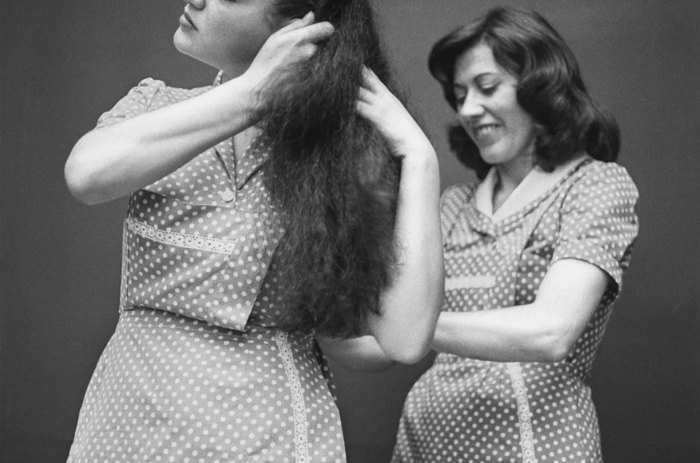
The Casa de México Foundation in Spain is hosting Cuando habla la luz (When Light Speaks), the first retrospective of Graciela Iturbide (Mexico City, 1942) since she received the 2025 Princess of Asturias Award for the Arts. Curated by Juan Rafael Coronel Rivera, the exhibition brings together 115 works spanning from 1972 to 2017.
VAREJÃO AND REGO, DIALOGUES AT GULBENKIAN
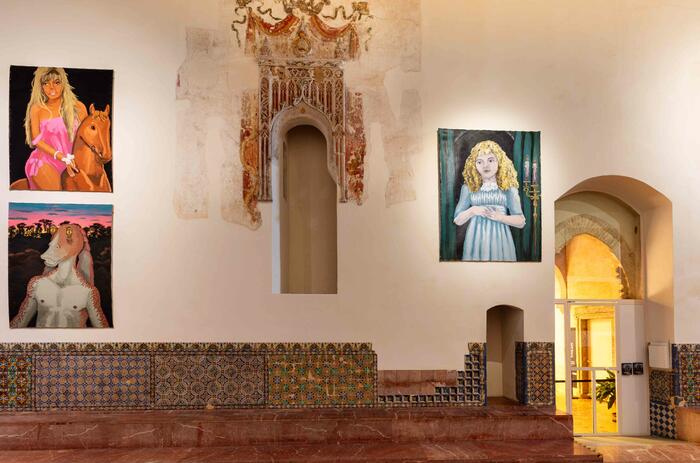
The Gulbenkian Modern Art Center in Lisbon presents Entre os vossos dentes (Between Your Teeth), an exhibition showcasing 80 works by Adriana Varejão (Rio de Janeiro, Brazil, 1964) and Paula Rego (Lisbon, Portugal, 1935 – London, United Kingdom, 2022), reflecting the production, themes, and interpretations of these two artists from different generations.
MYTH AND RESISTANCE IN NEREYDA LÓPEZ AND SANTIAGO YAHUARCANI, AT THE CBA
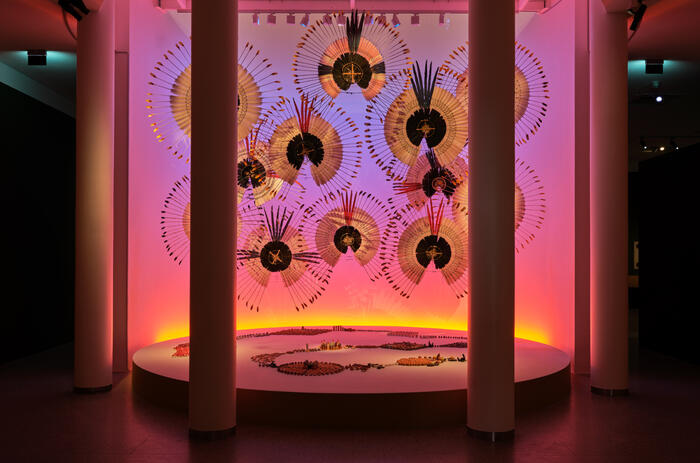
The Círculo de Bellas Artes in Madrid presents Somos raíces (We Are Roots), an exploration of the creative worlds of Santiago Yahuarcani (Pucaurquillo, Peru, 1960) and Nereyda López (Pebas, Peru, 1965), two of the most prominent figures in contemporary indigenous art. Both artists draw from the oral traditions and cosmologies of their respective peoples—the Uitoto in Yahuarcani’s case, and the Tikuna and Cocama in López’s—to give voice to languages of resistance.
INTERVIEW WITH MANUEL SEGADE
Manuel Segade (La Coruña, Spain, 1977) celebrates two years this month at the helm of Spain’s largest public museum of contemporary art. Since taking over as director of the Reina Sofía, he has implemented a series of exhibition and institutional strategies that have gradually shaped the museum’s strong personality and clear direction. In addition to progress on gender and feminist issues, decolonial thinking plays an important role in his vision—always from a perspective that necessarily looks to both sides of the Atlantic. Segade never seems to lose his enthusiasm, as evidenced by his expression and way of speaking. He welcomes us into his office at the Reina Sofía to finalize ideas and details, and to discuss the museum’s positioning and approach regarding Latin America.
ART, COMMUNITY, AND ECOLOGY IN THE MYSTICISM OF THE JAGUAR, AT THE MUSEUM OF AMERICA
The Museum of America in Madrid is hosting El sueño del jaguar (The Dream of the Jaguar), an exhibition curated by visual artist Fredi Casco (Asunción, Paraguay, 1967) and photographer Fernando Allen (Asunción, Paraguay, 1957), which brings together artistic, ethnographic, and scientific perspectives on the jaguar and its symbolic and ecological significance.
INTERVIEW WITH JULIA MORANDEIRA
Julia Morandeira Arrizabalaga (Bilbao, Spain, 1986) is in her first year at the Reina Sofía Museum as Director of Studies, a position she has held since October 2024 and which, since March of this year, she has combined with the directorship of the Instituto Cáder de Arte Centroamericano (ICAC). This organization faces several challenges in its core missions of raising awareness and promoting, but above all, researching and disseminating the reality of contemporary Central American art. It has ten years ahead of it to do so, and the foundations are already being laid to ensure that its objectives are met. Morandeira welcomes us to her office at the Reina Sofía, a few floors above the building that houses the library and which marks its character and connection with divulgation, to talk about the project, her vision, and the progress and future that are already taking shape.
A GAZE INTO SALVADORAN AUDIOVISUAL ART AT THE REINA SOFÍA
From June 19 to 28, Madrid’s Reina Sofía Museum will host Los reyes de la página roja (The Kings of the Red Page), a program dedicated to contemporary audiovisual productions from El Salvador. Part of the series Other Visions of Central America, this selection has been curated by Salvadoran artist Patricio Majano, this year’s resident at the Instituto Cáder de Arte Centroamericano—an initiative promoted by the Reina Sofía Museum Foundation and the museum itself to support research and dissemination of Central American art.
RITE AND SYNCRETISM IN THE DIALOGUE OF CALDERIUS AT THE CAAC
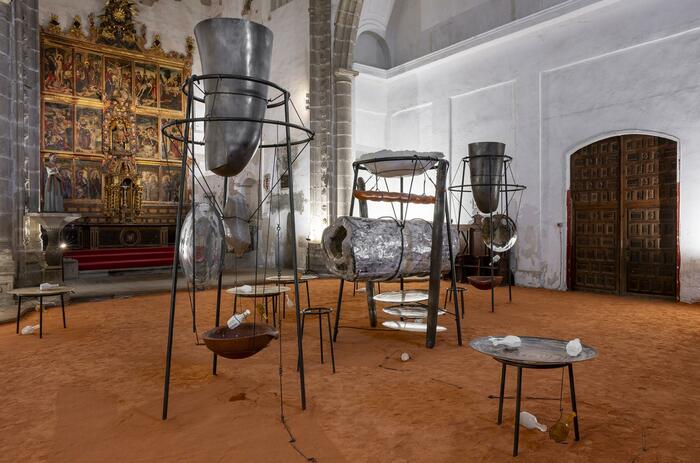
The Andalusian Center of Contemporary Art (CAAC) presents Sensemayá. Cánticos para matar a la Culebra (Sensemaya. Chants to kill the snake), the first solo institutional exhibition in Spain by Claribel Calderius (Havana, Cuba, 1986). Conceived specifically for the San Bruno Chapel, the project is a site-specific intervention that draws on the space’s historical and spiritual resonance—qualities that align seamlessly with the symbolic universe of the Cuban artist.
LOURDES GROBET AND THE LTCI, AT CASA DE MÉXICO
The Fundación Casa de México in Spain presents the exhibition Lourdes Grobet y el Laboratorio de Teatro Campesino e Indígena, a selection of nearly seventy photographs from the project developed by Lourdes Grobet (Mexico City, Mexico, 1940–2022) around the Laboratorio de Teatro Campesino e Indígena (LTCI) (Peasant and Indigenous Theatre Laboratory).
A NEW REVIEW ON CLAUDIA ANDUJAR’S A SÔNIA
The Elba Benítez Gallery in Madrid is currently hosting an exhibition of photographs from A Sônia, a project by Claudia Andujar (Neuchâtel, Switzerland, 1931), created in 1971. This body of work stands as one of the most significant early explorations into the creative manipulation of the photographic snapshot. For this occasion, the exhibition focuses on a carefully curated selection of images that establish a dialogue of balance, intensity, and chromatic richness with the surrounding space.
JONATHAS DE ANDRADE IN MOTION, AT CONDEDUQUE
The videographic universe of Jonathas de Andrade (Maceió, Brazil, 1982) is only one part of his broader artistic practice. It is, of course, significant—complementing other worlds that shape the ideology and imaginary embedded in both the work and the persona of the Brazilian artist. For this reason, the selection of exclusively audiovisual works under the title Tiempo, sueño, olor (Time, Dream, Scent), on view at Madrid’s Centro de Cultura Contemporánea Condeduque, offers a concise, representative, and necessary approach that ultimately bears witness to a part for the whole.
RELIGION, FASHION, AND RESISTANCE ACCORDING TO BÁRBARA SÁNCHEZ-KANE, AT COLLEGIUM
Multidisciplinary artist Bárbara Sánchez-Kane (Mérida, Mexico, 1987) presents ¿Cuántos ángeles caben en la punta de un alfiler? (How Many Angels Fit on the Tip of a Pin?), her first solo show at Collegium—a center for the creation, research, and display of contemporary art, known for its residencies. With Sánchez-Kane’s project, Collegium inaugurates its new role as a museum. All the pieces, curated by José Esparza Chong Cuy, were created on site, and their placement within the Church of San Martín fosters a dialogue with the building’s symbolic and historical character.
THE TRANSFORMATION OF THE IMMATERIAL IN JORGE SATORRE
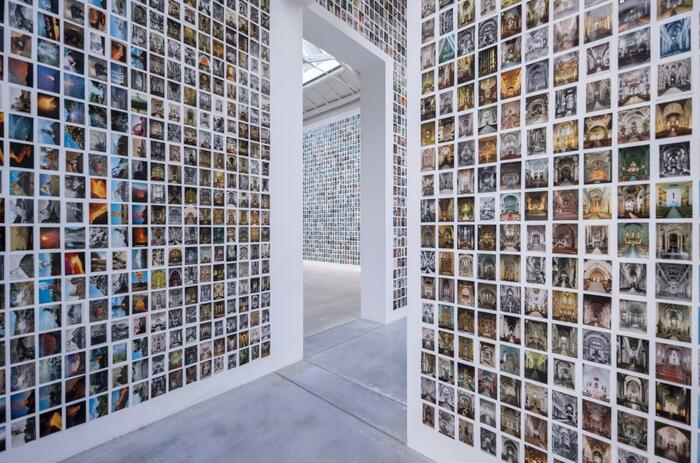
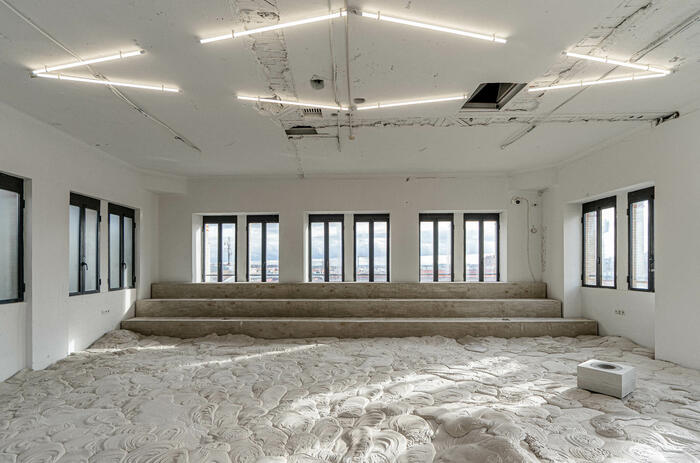
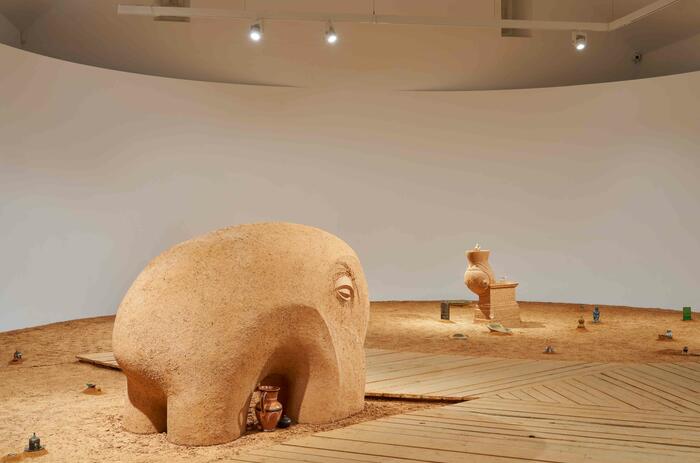
Ría, Jorge Satorre’s (Mexico City, Mexico, 1979) first exhibition in Spain, can be approached as a compendium of the sublimation of his ideas and research into the conceptual and material limits of the different practices he has engaged in. The show, curated by Max Andrews and Uruguayan Mariana Cánepa Luna for the Museo Centro de Arte Dos de Mayo, is thus conceived as an immersive space in which those very boundaries are blurred in favor of a deeper observation of processes.
A LOOK AT MEXICAN ART OF THE '90S FROM THE JUMEX COLLECTION AT CASA DE MÉXICO
The Casa de México Foundation in Spain is hosting, through the second week of June, a must-see exhibition from the Jumex Collection—one of the most significant contemporary art collections in Latin America. Titled Éramos felices y no lo sabíamos (We Were Happy and Didn't Know It), the exhibition revisits the vibrant artistic scene of 1990s Mexico, offering a re-reading of one of the most dynamic periods in the country’s contemporary art history.
THE VAST UNIVERSE OF MARUJA MALLO, IN SANTANDER
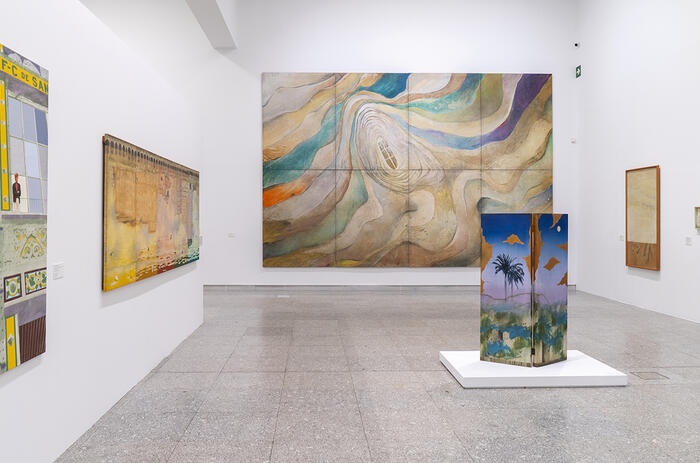
The Botin Center, in Santander, is hosting the exhibition Maruja Mallo: mascara y compás (Maruja Mallo: Mask and Compass), a show that vindicates, through a broad selection of works from her most relevant periods, the figure of Maruja Mallo (Vivero, Spain, 1902 – Madrid, Spain, 1995). This exhibition delves into the legacy of the artist, a body of work which, like her own persona, has recently been the subject of revisions and visibility efforts to better integrate her trajectory into art historiography.
BOTERO'S PAINTING IN DETAIL AT PALAU MARTORELL
The Palau Martorell in Barcelona is hosting Fernando Botero. Un maestro universal (Fernando Botero. A Universal Master), the most comprehensive exhibition of paintings by Fernando Botero (Medellín, Colombia, 1932 – Monte Carlo, Monaco, 2023) ever held in Spain. This exhibition offers a detailed exploration of the Colombian artist’s career, highlighting his mastery of various painting techniques and the scope of his artistic output.
THE PALATIAL EXTRAVAGANCE OF VASCONCELOS
Joana Vasconcelos (Paris, France, 1971) walks that fine aesthetic line between the overwhelming and the excessive. The artist does not hide her intentions—she never has—and if the ornate effect of her works is what she aims for, then the mission is accomplished. When faced with a production that is so clearly personal and deliberate, the setting can only serve to further amplify the challenge her installations pose to our ideas of beauty and artistic harmony.
CHILEAN PHOTOGRAPHY TAKES CENTER STAGE AT PHOTOESPAÑA
Chile will be the guest country at this year’s PHotoESPAÑA. For the first time in its history, the international festival includes a dedicated national section, with four major figures in Chilean photography taking the spotlight. The event will feature major exhibitions of work by Lotty Rosenfeld, Julia Toro, Michael Mauney, and Martín Gusinde. These exhibitions—held across venues in Madrid and Santander—offer audiences a powerful encounter with a body of work deeply shaped by the country’s history and social fabric.
RAC FOUNDATION HOSTS THE BARAYA’S CAMELLIAS EXPEDITION
The RAC Foundation presents, at its headquarters in Pontevedra, Expedition Camellias: Herbal of Artificial Plants, a solo show by Alberto Baraya (Bogotá, Colombia, 1968), originating from the Artist-in-Residence program developed by the foundation. The exhibition features a group of twelve works resulting from a research project on the camellia—a flower native to China and Japan that has become an essential element in the landscapes, gardens, and parks of western Galicia.
FABELO'S LITERARY ICONOGRAPHY TAKES OVER THE CERVANTES INSTITUTE
The Cervantes Institute in Madrid presents Roberto Fabelo. Grafomanía, an exhibition featuring 50 works by Roberto Fabelo (Guáimaro, Cuba, 1951), most of them related to literary worlds and dialogues with other artists. The exhibition includes references to Gabriel García Márquez, Miguel de Cervantes, Goya, and Hieronymus Bosch—figures of great influence on the Cuban artist’s work.
NECESSARY ANCESTRALITY IN ANTONIO PICHILLÁ
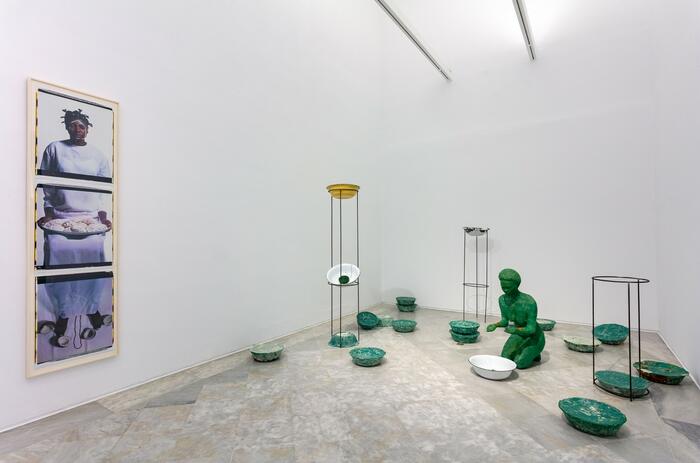
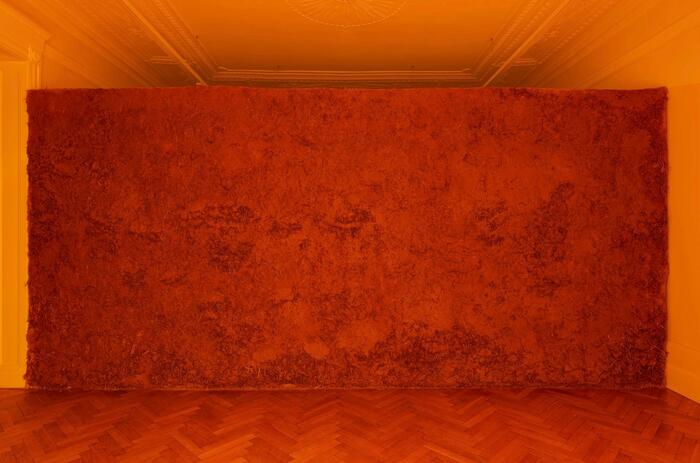
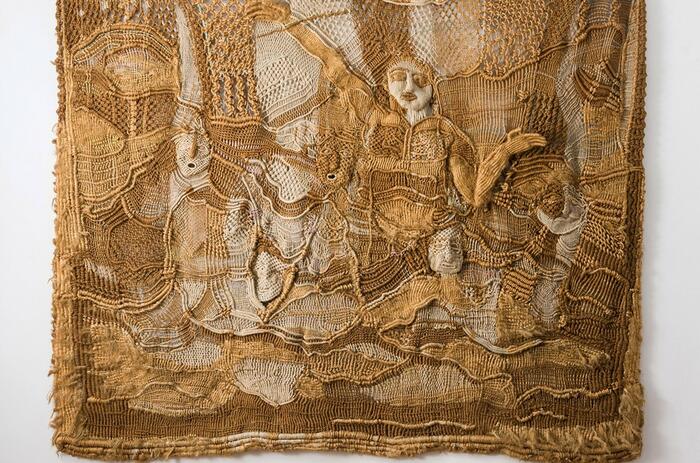
Antonio Pichillá (San Pedro de La Laguna, Guatemala) proposes a broad return to the atavistic and ancestral in his recent work, exhibited in the two venues of the Memoria gallery in Madrid under the title Abuela materna (Maternal Grandmother). This return should be understood beyond the mere construction or defense of an original identity, in order to encompass the full meaning the artist conveys through his work.
LATIN AMERICA ON THE SURREALIST PERIPHERY: A HISTORIOGRAPHY BEYOND BRETON
Amid the centenary of Surrealism, or at least from what is officially understood as its inception with the publication of The First Surrealist Manifesto by André Breton in 1924, it is truly significant to access an exhibition as profound as 1924: Other Surrealisms, presented by the MAPFRE Foundation in Madrid, which will later tour other locations. This exhibition is important for the centrifugal perspectives it presents, emphasizing the expansion of the main official—or officialism—ideas beyond Breton's boundaries and granting maximum importance to Latin America in the acceptance, production, and collaboration within the movement.
SOTO, NEGRET AND CHIRINO LEAD THE REOPENING OF THE REINA SOFÍA TERRACES AS AN EXHIBITION SPACE
The terraces of the Nouvel Building at the Reina Sofía Museum are being transformed into a new exhibition space. Under the title A Different Order: Utopian Geometry and Kinetic Art, the space will showcase two sculptural works by Jesús Rafael Soto and Edgar Negret, along with a third piece by Martín Chirino.