
By
Álvaro De Benito
Naufus Ramírez-Figueroa (Guatemala City, Guatemala, 1978) has long warranted a mid-career exhibition such as the one hosted by the Museo Reina Sofía. His ongoing activity and presence in institutions and performances over recent years have positioned the Guatemalan artist as a key figure in the development and visibility of contemporary Central American art beyond its geographic framework.
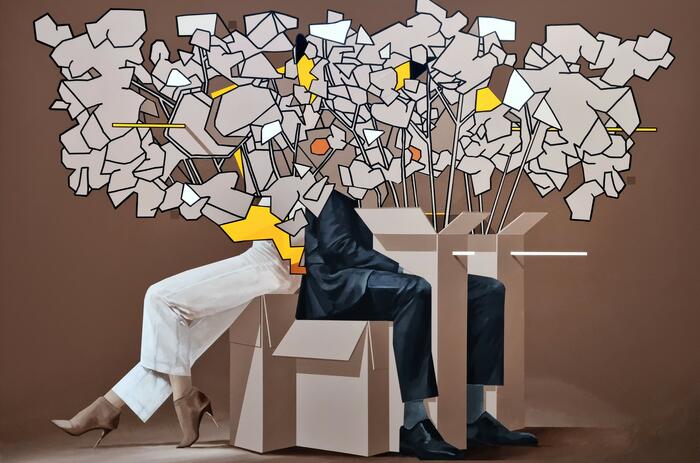
Espectros luminosos, curated by Soledad Liaño, carries a certain sense of debt toward the momentum that the Spanish gallery circuit and institutions have generated around Central American artistic practice. Yet, this only serves to elevate Ramírez-Figueroa’s name within the international scene—which is no small achievement.
The exhibition, retrospective in its scope from the artist’s beginnings to the present, adheres to several of the common threads that run through many artistic proposals emerging from the isthmus. The shared history of violence, dissent, and a certain magical realism intersect, from his own vantage point, with the subjective world and personal memory of the artist’s biography.
The fifteen works on display clearly illustrate Naufus Ramírez-Figueroa’s practice and do so with a dreamlike aesthetic—at times suffocating—that ensures the careful selection of pieces maintains a consistent artistic tone. This aspect, vital as a guiding thread in exhibitions of this nature, shapes a thematic journey that speaks of childhood and the past, of dreams, and of struggle and justice—both internal and in relation to an exterior marked by history.
Naturally, the questioning of historical narratives and the decolonial gaze appear as an intrinsic perspective rooted in lived experience, and take advantage of institutional politics to carve out a precise space. His narrative is tied to personal experience, even if some themes are universal, and is expressed with clear and deliberate language.
Drawing on a combination of techniques and disciplines—from video to the significant influence of theatre and installation—Ramírez-Figueroa conveys a sense of unease throughout the process. Audiovisual works such as Life in His Mouth, Death Cradles Her Arm (2016) or Illusions of Matter (2015) present this symbiosis as a statement of intent. Content merges with action and documentation to illustrate a significant portion of his practice, directly alluding to the dreamlike and to the languages of the theatrical or street performance.
The structuring of violence, repression, and dictatorship is ever-present in his work. However, his condition as an exile in Canada—and previously in Mexico—affords him an authoritative point of view from which a key sense of meaning emerges. El corazón del espantapájaros (The Heart of the Scarecrow), inspired by Hugo Carrillo’s 1962 play and paired in the exhibition with Lugar de consuelo (Place of Comfort), embodies this aspect of struggle and memory, without neglecting the clear connection to the performative and theatrical.
The costumes on display, extracted from their theatrical context, take on life beyond their original environment. Puppets, mannequins, or entities, their expression evokes political activism and even a latent irony rooted in the aesthetic. Alongside the vivid display of costumes, nine black-and-white aquatints depict the creative processes of various projects intended for dissemination across different media.
The audiovisual piece Lugar de consuelo (2020), produced later, attests to the enduring significance that the theatrical work holds for Ramírez-Figueroa. The performance of the piece 45 years later, and its documentation, renew a discourse that appears to remain current. At the same time, it forms a conceptual whole that bridges various expressive languages and forges a common link among them, illustrating the vast possibilities the artist constructs from a single starting point.
God’s Reptilian Finger (2016) and Fettered Flamingos (2017) transport the viewer to a world of apparent surrealism or reverie. Though distinct in language, both installations reference the fragility of alternative narratives. These stories are examined by the artist, who presents a firm commitment to politically and institutionally embedded narratives.
A giant finger of God floats in a dark room, while in the next, impossible flamingos in chains depict this progression. The work prompts a reconsideration of the impact of discourses, and beyond semantics, it advocates for rethinking the importance of social or ecological awareness.
In contrast to the impact of his installations and audiovisual works, the series of paintings on anthurium leaves and the series Chiperrec and Huertos de los Ch’olti (Gardens of the Ch’olti) may ease in aesthetic intensity, yet they delve deeply into the concept of aggression. Direct visual references—such as the story of the French collector who sought to acquire all known variants of the species—are displayed alongside other ideas relating to systemic, structural, and colonial violence.
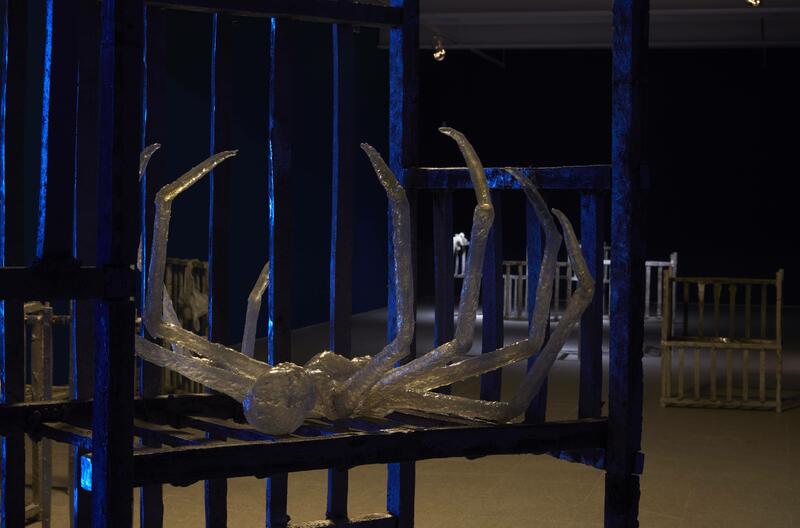
Cuna y arrullo (Cradle and Lullaby, 2025), the work that concludes the exhibition, was created specifically for the occasion. The darkened room contains a large array of cradles inhabited by strange beings, both anthropomorphic and zoomorphic, that evoke a sense of unease. His experience in Mexico as a refugee casts a shadow over the piece. The creatures—more akin to nightmares—maintain the dreamlike language, but unsettle the presumed serenity of the cradles, reinforcing the importance of memory and uniting, even more so, the radical and representational language that characterizes Ramírez-Figueroa’s work.
Naufus Ramírez-Figueroa. Espectros luminosos is on view through October 20 at the Museo Nacional Centro de Arte Reina Sofía, Santa Isabel 52, Madrid, Spain.
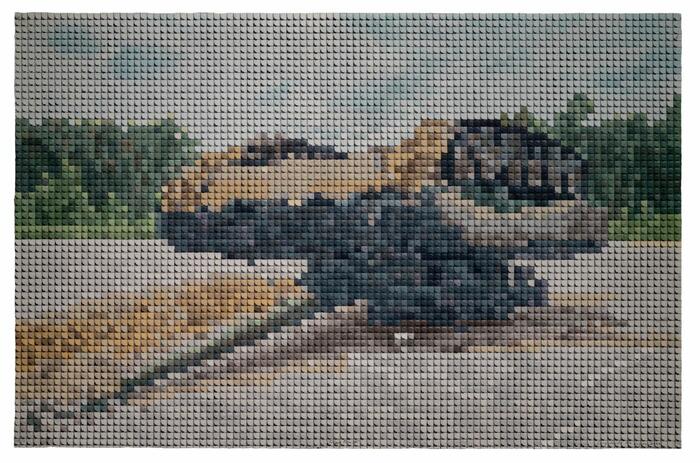
Until the end of September, the Galician city of Pontevedra is reviving its Art Biennial, an event that has been held since 1991 and now reaches its thirty-second edition under the slogan Volver a ser humanos (Becoming Human Again). Under this premise, Antón Castro, along with Agar Ledo and Iñaki Martínez Antelo, have curated a proposal centered on war, violence, and the traces they leave in society and humanity.
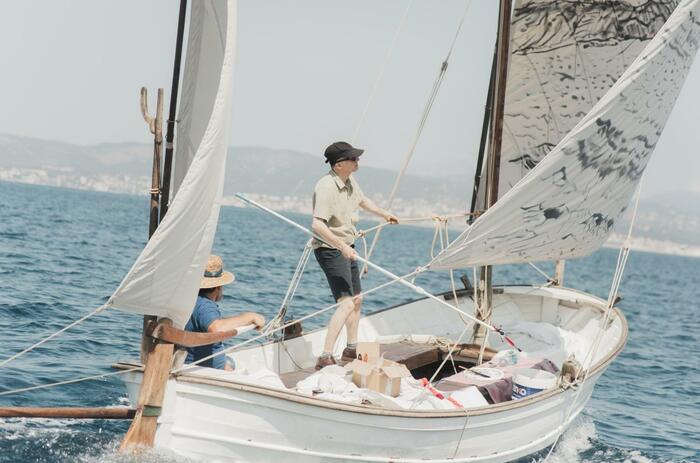
Alberto Baraya (Bogotá, Colombia, 1968) presents his project Llatina i Mestral (Catalan for Lateen and Mistral)as part of the B Biennial in Majorca. The work begins with a performative action in which the artist paints directly onto a sail while at sea. The sail becomes a canvas that captures both a physical journey and a conceptual one.

Priscilla Monge (San José, Costa Rica, 1968) arrives at the Galician Center for Contemporary Art (CGAC) with her exhibition Cuestiones de vida o muerte (Matters of Life and Death). This show brings together works from all stages of the Costa Rican artist’s career, establishing her as a key figure in Central American art through her commitment to social critique.

Sofía Crespo (Buenos Aires, Argentina, 1991) often centers her work on the use of biology-inspired technology. In her exploration of the common ground between artificial intelligence and the way it generates images, on the one hand, and human perception of the environment, on the other, there is a turning point in the Argentine artist's practice.

The presentation of the current season at Madrid’s Reina Sofía Museum has underscored the strategic importance of Latin America and its artistic practices in the vision of Spain’s largest public contemporary art institution. This is not something new, since its commitment as a public museum has incorporated the Ibero-American narrative as an essential part of its historical account from the beginning. However, what does stand out is the accentuation of its critical essence in a program —the first fully developed under the direction of Manuel Segade, with the exception of a single exhibition— which introduces new elements.

Condeduque, one of Madrid’s leading cultural centers, has unveiled its seasonal program, which establishes a strong connection with Latin American art and thought. The municipal institution, which recently appointed the Mexican writer Jorge Volpi to oversee the center’s cultural direction, has also redesigned its proposals into seven areas of activity, reinforcing connections between the various performing arts and exhibition spaces.
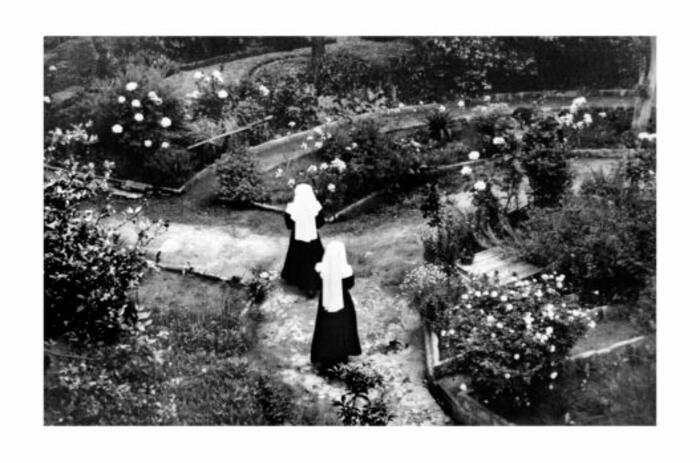
The Lázaro Galdiano Museum in Madrid hosts the first exhibition in Spain of veteran photographer and visual artist Julia Toro (Talca, Chile, 1933). Her photographic production yields to both simplicity and wonder, frameworks that delimit and amplify the everyday themes she addresses. The protagonists of this cyclical, customary flow of life in her work are diverse, and their problems and experiences drift among the concepts of love, pain, memory, and relationship with their surroundings.
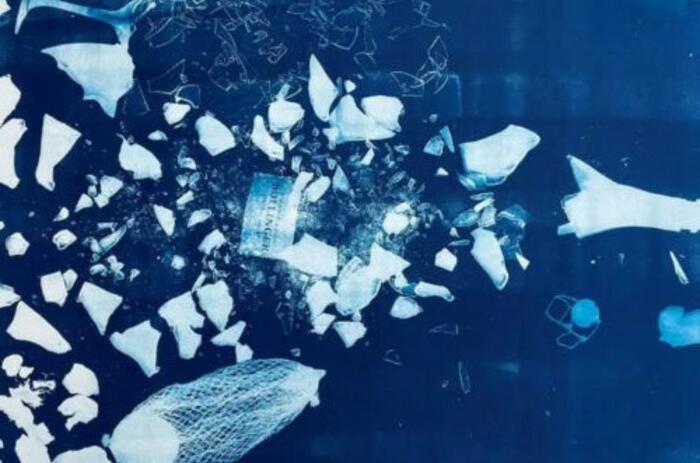
Inventory of Fragile Materials is the title of the exhibition by Rocío Aguirre (Concepción, Chile, 1989) and Camilo Delpin (Concepción, Chile, 1989), presented at Spolia Haus until mid-month. Organized in collaboration with the Chilean Embassy in Spain, the Chile-Spain Foundation, and PHotoESPAÑA, the exhibition brings together two projects that, while distinct in their visual idioms, converge conceptually in their shared investigation of the residual.

Barcelona's MACBA presents I Have Learned to Swim on Dry Land, the first monographic exhibition that a Spanish institution dedicates to Cuban-American artist and activist Coco Fusco (New York, USA, 1960). The exhibition, titled after the opening sentence of Virgilio Peña's short story Swimming, offers a journey through several thematic nuclei revolving around words, language, and silence, as well as the semiotics and symbolism entwined with these concepts.