By
Álvaro De Benito
The Juan March Foundation in Madrid presents an extensive and analytical exhibition on Robert Rauschenberg (Port Arthur, USA, 1925–Captiva, USA, 2008), focusing on the use of image and photography in his work. The exhibition, structured from a novel curatorial perspective, reinterprets the production of one of the great masters of contemporary art, highlighting it as the outcome of an essentially photographic practice.
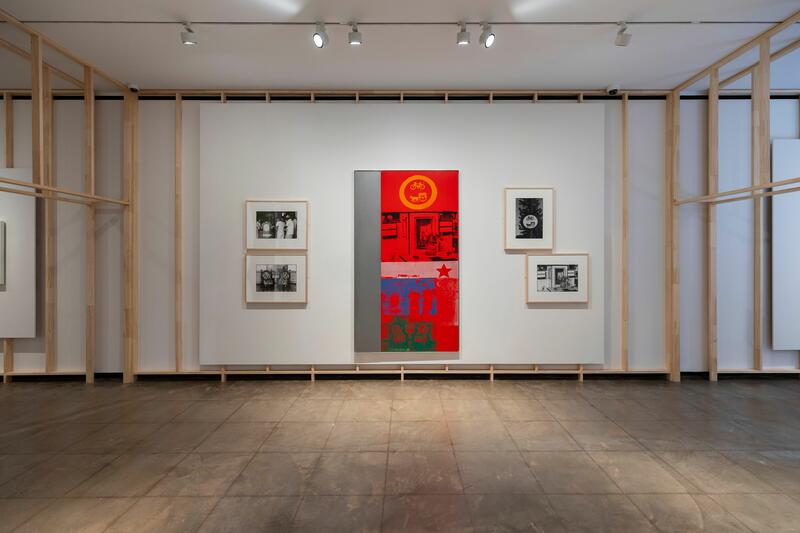
Robert Rauschenberg: The Use of Images, curated by Manuel Fontán del Junco, Inés Vallejo Ulecia, and Lucía Montes Sánchez, with the support of the Robert Rauschenberg Foundation, aims to emphasize how the use of this technique fundamentally influenced the development of his work. The exhibition, which begins with photographs from the 1950s taken at Black Mountain College, explores key periods in the artist’s career, concluding with his Ruminations at the threshold of the new century.
Throughout his different stages, Rauschenberg used snapshots as an essential medium and an inherent part of the execution of his artistic vision. The Texan artist began photographing during his training years and, by the 1950s, had started incorporating photography—particularly from photojournalism—into his Combines, which already featured press clippings transferred onto canvas through collage.
During the following decade, he adopted screen printing as his preferred technique for transferring images onto the canvases of his Silkscreen Paintings. Although he had previously produced series of snapshots and experimented with the possibilities of his own images, it was from 1983 onwards that he began to regularly employ photographs taken by himself.
As a representative part of this new horizon, the exhibition revisits the project Rauschenberg developed under the name ROCI—an acronym for Rauschenberg Overseas Culture Interchange—through which, starting in 1984, the American artist sought to establish cultural relationships with countries that had limited exchange with the United States. Beyond the opportunity to organize exhibitions in the chosen locations featuring works inspired by each place, the artist aimed to immerse himself organically in these new environments through experimentation, engaging with local artists and artisans and exploring the potential of indigenous materials.
From its conception until 1991, Rauschenberg visited several places in Latin America with the project, among them Mexico, Chile, Cuba, and Venezuela. The exhibition at the Juan March Foundation features works created for the latter three projects, as well as for the U.S. edition. These works are presented as case studies, displayed alongside photographs he took in each location, which—like some of the materials themselves—were incorporated into his works as part of the creative process.
For the Copperheads series, part of ROCI CHILE (1985), the use of screen printing was applied directly onto copper, employing various chemical processes of transfer and oxidation to achieve the final result. Stemming from his visit to a copper mine and smelting plant in the Antofagasta region, the two works exhibited (Copperhead-Bite VII and Copperhead-Bite IV) provide a strong synthesis of the project, highlighting both his discovery of copper oxidation techniques and his collaboration with the Chilean painter and printmaker Benito Rojo (Iquique, Chile, 1950).
Rudy’s House, corresponding to ROCI VENEZUELA (1985), transports us to a suffocating, grey landscape where a chair traps a boxer dog—Rudy, whom the artist found on the street—condemned to exist in a silkscreened world of fences and barriers. Meanwhile, Red Sunday (Domingo Rojo), from ROCI CUBA (1988), is part of a series of metal paintings on aluminum and steel supports, in which Rauschenberg used photographs of everyday elements combined with bold, flat colors.
Robert Rauschenberg: The Use of Images can be seen until January 18, 2026, at the Juan March Foundation, Castelló 77, Madrid, Spain.
*Cover image: View of Robert Rauschenberg: The Use of Images.


The Guggenheim Museum in Bilbao presents Anatomy of Space, an extensive exhibition dedicated to Maria Helena Vieira da Silva (Lisbon, Portugal, 1908 – Paris, France, 1992), which primarily encompasses her production from the 1930s through the 1980s. The exhibition is structured around two fundamental axes: architecture and the architectural landscape as compositional frameworks, and memory as the generator of the image.
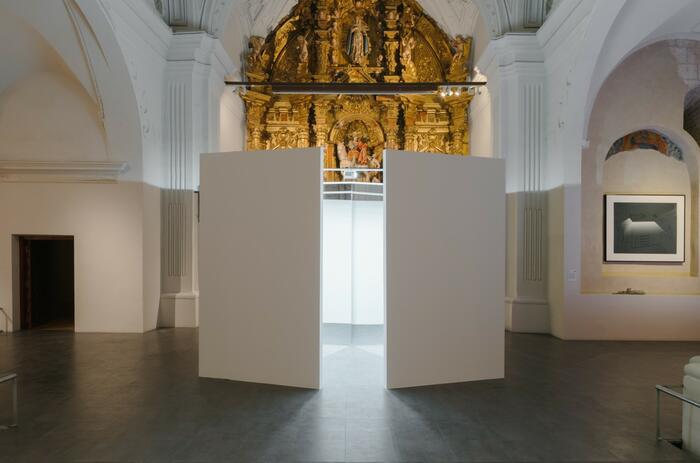
Collegium is hosting at its headquarters in the Castilian town of Arévalo the exhibition Jaque. Poder, tiempo e imagen en estado de juego (Check. Power, Time, and Image in a State of Play), a conceptual show that stems from the relationship between chess and the Torre de los Ajedreces, part of the Romanesque-Mudejar style Church of San Martín, which currently serves as the institution’s main headquarters. The building, dating from the 11th and 12th centuries, features an unusual brick frieze in a checkerboard pattern that evokes the chessboard and the strategic dimension of the game.
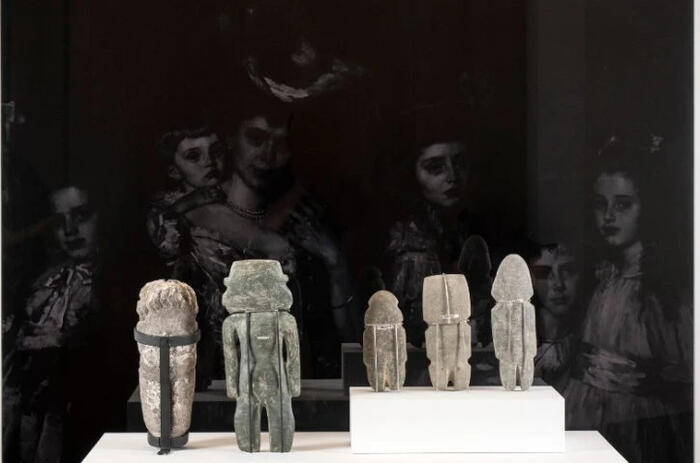
The Fundación Casa de México in Spain hosts Re/Generación, a new installation from the Black Mirror / Espejo Negro series produced by Pedro Lasch (Mexico City, Mexico, 1975) and curated by the National Institute of Anthropology and History of Mexico (INAH). Originating from an initiative originally produced by the Nasher Museum of Art in Durham, North Carolina, in 2007, the series has been transformed through various techniques, evolving its language toward a narrative that makes it impossible to separate past and present, as well as spectator and proposal.