

By
Violeta Méndez
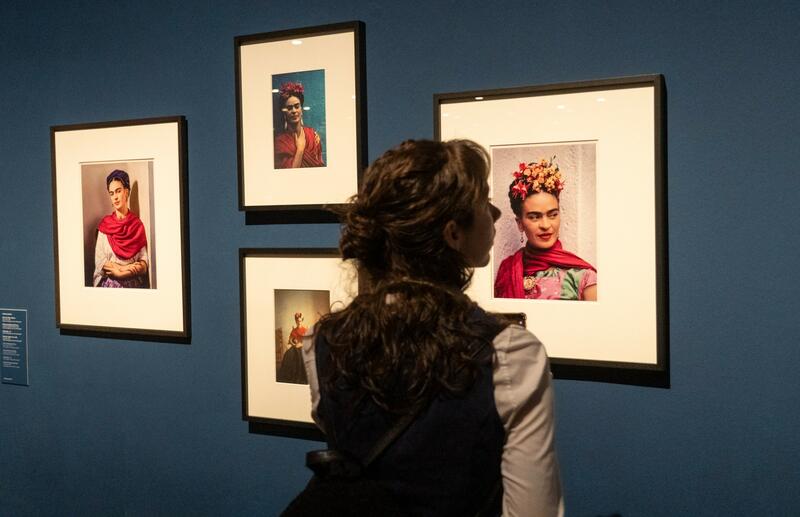
Walking through Viva Frida, the Malba exhibition that revisits the life and work of Frida Kahlo, one of the most influential artists of the twentieth century, feels intimate. The exhibition design has visitors move through the galleries like voyeurs: reading loose pages from her private diary and letters to lovers and to Diego, going through her perfumes and dresses, looking at her prostheses, medical corsets and jewelry. This intimate setting means that our view of her photographic portraits, taken by Guillermo Kahlo, Fritz Henle, Nickolas Muray, Bernard Silberstein, Gisèle Freund, Juan Guzmán and Berenice Kolko (among others), turns them into "mere reflections of her privacy" (Limón Serrano, 2011). I propose instead to analyze Frida's photography as one more expression of her vision as an artist: not as a glimpse into the personal, but as a new unfolding that complements her work.
She posed from a very young age because her father, Guillermo Kahlo, was a photographer: the first pretext for self-exploration in front of a camera. She presents herself to the lens in different ways. In 1926 she wears a suit and tie with her hair pulled back (a man's style at the time) and poses differently from her sisters. Her gaze is firm and confident, as is her stance. The camera invites her to wear "the masculine." The same year she poses in heels and a dress, holding a book, delicate. For her, the portrait was an opportunity to construct images, to show herself as a duality in terms of gender, or really as a whole. An opportunity for visual self-representation.
Besides playing with her own image, Frida works with her territory. As a model, she was not a passive subject: she chose how she presented herself and what she presented. In Frida Kahlo en Xochimilco (1937), for example, by the German photographer Henle, her hand chases the water of the lake, serene and connected to nature, in traditional Mexican dress. The composition (what is chosen of the landscape, of the title, of the action) is a way of building a narrative, a description of Frida in her country. She uses the artistic device to reinforce a story. The same goes for Frida Kahlo con su traje de Tehuana (1940), by the American Silberstein. The woman poses in her dining room in front of shelves full of Mexican handicrafts, ex-votos, ceramics and folk objects that she collected with Diego Rivera at La Casa Azul in Coyoacán. In the photograph, Frida projects a calculated identity: nationalist, artistic and political. And even when she was not in her Mexico, the artist seeks to construct the same gaze. In 1946 Muray frames her on a terrace in New York; Frida wears a traditional red and yellow huipil and a long blue skirt with white lace.
Frida also presents herself in photography as a painter, in countless examples. She paints from bed, seated, standing.
We also remember Frida as this ornate, colorful, baroque woman thanks to Muray's photographs. The Hungarian-American photographer uses color drawing on his experience in celebrity and advertising photography. "It adds to his images a hint of artificiality that harmonizes with the particular use of color in Frida's paintings and clothing" (Limón Serrano, 2011). The tools keep changing, but the identity does not; they only help to keep forging it from different angles.
With intense green, blue and red backgrounds. With Mexican dresses. With flowers in her hair, and bows. Earrings, rings, necklaces, paintings, Diego, handicrafts. Frida Kahlo built, through photography, through naturalness, cunning and art, an absolute, complete image: a myth.
Viva Frida can be seen until March 15, 2027 at Malba, Av. Figueroa Alcorta 3415, Buenos Aires, Argentina.
Bibliography
Limón Serrano, N. (2011). Frida Kahlo y el posado fotográfico. Área Abierta, (28). https://dialnet.unirioja.es/servlet/articulo?codigo=3671256
The Fukushima control room, Snowden's refuge in Moscow, and Bill Gates's dorm room: built in cardboard, photographed, and destroyed.
La noche y las palabras brings together the artist's installations, photographs, films, and drawings, curated by Francisco Lemus and Mariana Marchesi.
In late October and early November, the city of Buenos Aires will host three fairs with three distinct identities in a single period of intense artistic activity.

Suave es la noche, by Silvana Muscio, and Trago Amargo, by Claudia Coca and Claudia Casarino, propose two distinct ways of inhabiting memory from Buenos Aires: one sensory and oneiric, the other historical and colonial.

The museum welcomes Juan Del Prete and, for the first time, Líbero Badíi, along with donated pieces by Jorge Pineda, Mario Testino, and Margarita Paksa.