FROM FIELD TO FABRIC: THE ECOLOGICAL JOURNEY OF AMERICAN QUILTS
The American Folk Art Museum presents an innovative exhibition examining the natural history of quilts and their connections to agricultural production, industrial manufacturing, and international trade, revealing the environmental and social impact of this quintessentially American art form.
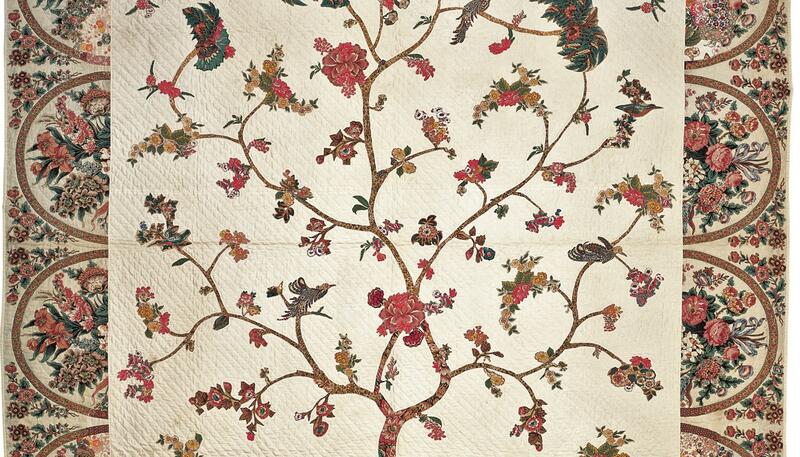
An Ecology of Quilts: The Natural History of American Textiles offers an eco-critical study based on the museum’s collection of over 600 quilts. The exhibition brings together approximately 30 examples, spanning the 18th to 20th centuries, presented from an ecological perspective that traces the relationships between the environment and traditional quilting practices.
Curated by Emelie Gevalt, Deputy Director and Chief Curatorial & Program Officer of the museum, and Austin Losada, Art Bridges Fellow, the exhibition explores not only the work of the quilter but also the origins of textile production and how it informs quilting mastery. It examines the environmental and social impact of cultivating and harvesting raw materials, the overland and maritime trade networks required to transport dyes, fibers, and fabrics, and the technologies developed to process them, such as the cotton gin.
-
Floral Appliqué Quilt, United States, 1856, Cotton, 80 x 84 in., Gift of the Estate of Joanna Rose, 2023. Courtesy American Folk Art Museum
-
Mary Alice Kenny-Sinton, Mala Pua Aloha / Garden of Aloha Quilt, Ponca City, Oklahoma, 1991, Cotton, 72 x 72 in., Museum purchase through funds provided by Northern, the Quilted Bathroom Tissue, made by James River Corp., 1991. Courtesy American Folk Art Museum
-
Attributed to a Member of the Sinclair Family, Adam and Eve in the Garden of Eden Quilt, Possibly Vermont, Mid-19th century, Cotton, 87 x 92 in., Museum purchase with funds provided by Nina Beaty, 2024.Courtesy American Folk Art Museum
-
Olivia Denham Barnes (1807–1887) and Louisa Denham Farnham (1804–1833), Stenciled Quilt Conway, Massachusetts, c.1830–1831, Cotton and paint, 83 x 72 in., Gift of In the Beginning Quilts, Inc., Seattle, 2002. Courtesy American Folk Art Museum
-
Tree of Life Cut-Out Chintz Quilt, Probably Wiscasset, Maine, 1925–1935, Cotton, 96 x 90 in., Gift of Cyril Irwin Nelson in honor of Elizabeth V. Warren and Sharon L. Eisenstat, 2001. Courtesy American Folk Art Museum
According to Jason T. Busch, the museum’s Director & CEO, the exhibition casts American quilts in an unprecedented light, highlighting the diversity of artisans and the wealth of knowledge revealed by studying the ecological impact of historical textiles. Gevalt adds that the show encourages looking beyond quilts as recycling projects, raising questions about the environmental and social costs of their production across centuries.
Divided into thematic sections on color, fiber, and pattern, the exhibition explores the history of natural and synthetic dyes and their complex production; the making of fabrics from wool, cotton, linen, and silk; the origins of printed motifs and patterns; global trade of goods; and the historical engagement of quilters with the natural world. Highlights include the use of indigo, cultivated in 18th-century South Carolina, and chintz patterns that energized the American textile market in the 18th and 19th centuries.
An Ecology of Quilts also emphasizes the diversity of people and communities involved in quilt and textile production, showcasing the range and ubiquity of quilting as an art form. Featured artisans include Malissia Pettway, the St. Louis tailor who repurposed men’s suiting wool into brick-patterned quilts, retired sociologist Dr. Raymond F. Bellamy, and contemporary textile artist Tomie Nagano. The exhibition also includes quilting and textile traditions from Hawaii and Oaxaca, Mexico, reflecting the breadth and universality of quilting as an art form.
The exhibition will be on display from September 26, 2025, until March 1, 2026, at American Folk Art Museum, 2 Lincoln Square, New York City (United States).
Related Topics
May interest you

THE BATTLEFIELD OF ANTONIO HENRIQUE AMARAL: BANANAS, POLITICS, AND MOVEMENT

THE CONTEMPLATIVE IN THE LABORIOUS, IN NEW YORK
Apexart presents the work of seven Latin American artists who, through meticulous and repetitive handcraft processes, transform labor into an act of resistance, joy, and the creation of possible futures.

AFRO-CUBAN SPIRITUALITY AT PAMM: DIASPORIC HERITAGE AND CONTEMPORARY VISION
Twin Photography Duo’s First Solo Museum Exhibition Weaves Afro-Cuban Spirituality with Painterly Explorations of their Cultural Heritage.

WIFREDO LAM AT MoMA: BETWEEN DREAM AND DECOLONIZATION
The Museum of Modern Art will host the most extensive retrospective devoted to the artist in the United States, on view at MoMA from November 10, 2025, through March 28, 2026.

FAIR EXPANSION AND BRANDING: FROM LOCAL EVENTS TO GLOBAL POWERHOUSES
By Maria Sancho-Arroyo
Over the past two decades, the global art fair landscape has undergone a radical transformation. What was once a relatively contained circuit of regional events has exploded into a complex network of branded cultural destinations. Since 2000, the number of art fairs has skyrocketed - from fewer than 60 to over 300 worldwide -reshaping how art is marketed, sold, and consumed.

CIRCLES, SPOKES, ZIGZAGS, RIVERS: CONTEMPORARY ABSTRACTION AT WHITNEY MUSEUM
Artist Grace Rosario Perkins’s solo exhibition reveals a dynamic process of layering, erasure, and renewal, where personal and collective histories converge.specifically for this exhibition.
THE AMERICAN DREAM, REIMAGINED BY DIMITHRY VICTOR
By Violeta Lozada
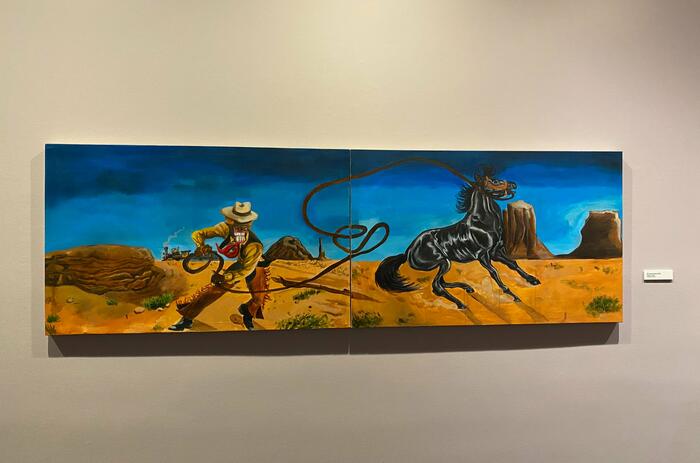
What does the “American Dream” really mean? For some, it’s white houses with new furniture and success stories. For others, especially immigrants from Latin America and the Caribbean, it’s a more complicated mix of hopes, struggles, and reinvention. That’s exactly the conversation Haitian-American artist Dimithry Victor brings to the table in his exhibition The American Dream at the NSU Art Museum in Fort Lauderdale.

“BETWEEN COCA AND GOLD” AT THE 2025 NEW YORK TRIENNIAL
Tatiana Arocha's artistic approach examines the connections between nature, history, and cultural resilience, presented alongside a collaborative publication blending critical thought and visual research.

THE ARMORY SHOW 2025: LATIN AMERICAN ARTISTS AND NEW TRENDS
By Violeta Lozada
The Armory Show 2025 returns to the Javits Center in New York, reaffirming its status as one of the most influential events in modern and contemporary art since nineteen ninety-four. Every year, the fair brings together leading international galleries to showcase innovative works, with a strong focus on curatorial excellence, engaging public programming, and bold artistic activations.
GYULA KOSICE: INTERGALACTIC, AN EXHIBITION THAT RESHAPES HIS VISIONARY CONTRIBUTION
By Adriana Herrera Téllez, PhD
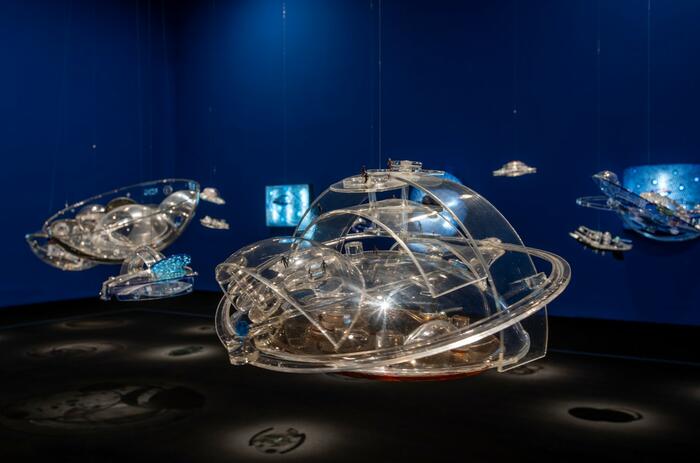
Gyula Kosice: Intergalactic is one of those axial exhibitions that unsettle the boundaries of the usual narratives of art history by incorporating visions that broaden our understanding of the contributions of foundational artists who, like this creator—born in today’s Slovenia in 1924 and later naturalized in Argentina—have not been sufficiently incorporated into the global narrative of concrete art.

ABOUT ROOTS AND RESISTENCE AT GFS, NEW JERSEY
Salvador Jiménez-Flores’ exhibition explores migration, resilience, and hybrid identities through murals, sculptures, and site-specific works.

NEW PEDAGOGIES AT THE HEART OF MoMA PS1
LA ESCUELA___ debuts in the United States with a proposal that turns education into a creative and collective experience.
MIAMI PHOTOGRAPHIC OBSERVATORY OPENED WITH ARTIST RAMÓN WILLIAMS
The new center promotes residencies and curatorial projects focused on visual research and artistic production, building an alternative archive on Miami’s urban transformation.