
THE AMERICAN DREAM, REIMAGINED BY DIMITHRY VICTOR
By Violeta Lozada
What does the “American Dream” really mean? For some, it’s white houses with new furniture and success stories. For others, especially immigrants from Latin America and the Caribbean, it’s a more complicated mix of hopes, struggles, and reinvention. That’s exactly the conversation Haitian-American artist Dimithry Victor brings to the table in his exhibition The American Dream at the NSU Art Museum in Fort Lauderdale.
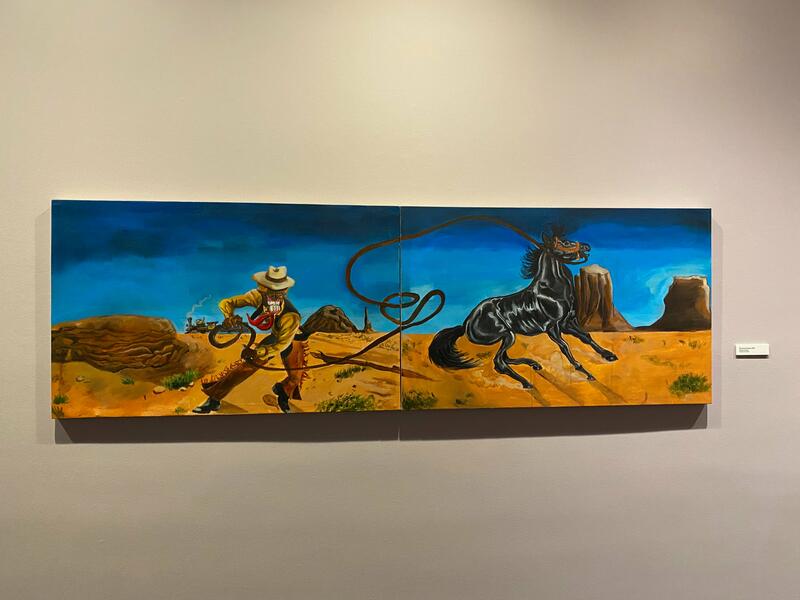
Running through August, the show feels less like a history lesson and more like flipping through the scrapbook of an immigrant kid growing up in South Florida—filled with pop culture, sports, cartoons, and iconic images of “America.” Except, Victor twists them. He paints, layers, and distorts what we think we know, turning cultural references into mirrors of identity, memory, and belonging.
One standout piece, Tranquility (2023), now part of the museum’s collection, shows a young Black man sitting calmly under clouds and sunlight, surrounded by flowers that stretch toward the sky. It’s peaceful, but it also feels powerful—like a reminder that claiming space and serenity is its own kind of resistance.
So, what sticks with you after seeing Victor’s work? First, it’s the idea of duality—that the American Dream can be both inspiring and exhausting. For many Latin Americans, chasing opportunity here means balancing two worlds: embracing U.S. culture while holding on to your own. Victor’s art doesn’t shy away from that tension; it celebrates it.
Second, the exhibition reminds us about the power of representation. Seeing immigrant stories and Black faces framed as central—not side characters—matters. It’s about visibility, and about saying: We’re part of this dream too.
Finally, Victor shows us that art is more than just reflection—it’s reconstruction. By remixing childhood memories with media imagery, he reimagines the American Dream as something not fixed, but constantly evolving. And maybe that’s the point: the dream isn’t about arriving; it’s about reshaping, challenging, and claiming it in your own way.
For young Latin Americans walking into NSU, the exhibition hits differently. It’s not just about nostalgia or critique—it’s about seeing your story, your family’s journey, and even your doubts on the wall of a major museum. That’s the real power of Victor’s American Dream: it reminds us that the dream is alive, but it’s ours to rewrite.
Related Topics
May interest you

CIRCLES, SPOKES, ZIGZAGS, RIVERS: CONTEMPORARY ABSTRACTION AT WHITNEY MUSEUM
Artist Grace Rosario Perkins’s solo exhibition reveals a dynamic process of layering, erasure, and renewal, where personal and collective histories converge.specifically for this exhibition.

FROM FIELD TO FABRIC: THE ECOLOGICAL JOURNEY OF AMERICAN QUILTS
The American Folk Art Museum presents an innovative exhibition examining the natural history of quilts and their connections to agricultural production, industrial manufacturing, and international trade, revealing the environmental and social impact of this quintessentially American art form.

THE CONTEMPLATIVE IN THE LABORIOUS, IN NEW YORK
Apexart presents the work of seven Latin American artists who, through meticulous and repetitive handcraft processes, transform labor into an act of resistance, joy, and the creation of possible futures.

AFRO-CUBAN SPIRITUALITY AT PAMM: DIASPORIC HERITAGE AND CONTEMPORARY VISION
Twin Photography Duo’s First Solo Museum Exhibition Weaves Afro-Cuban Spirituality with Painterly Explorations of their Cultural Heritage.

THE ARMORY SHOW 2025: LATIN AMERICAN ARTISTS AND NEW TRENDS
By Violeta Lozada
The Armory Show 2025 returns to the Javits Center in New York, reaffirming its status as one of the most influential events in modern and contemporary art since nineteen ninety-four. Every year, the fair brings together leading international galleries to showcase innovative works, with a strong focus on curatorial excellence, engaging public programming, and bold artistic activations.