
GYULA KOSICE: INTERGALACTIC, AN EXHIBITION THAT RESHAPES HIS VISIONARY CONTRIBUTION
By Adriana Herrera Téllez, PhD
Gyula Kosice: Intergalactic is one of those axial exhibitions that unsettle the boundaries of the usual narratives of art history by incorporating visions that broaden our understanding of the contributions of foundational artists who, like this creator—born in today’s Slovenia in 1924 and later naturalized in Argentina—have not been sufficiently incorporated into the global narrative of concrete art.
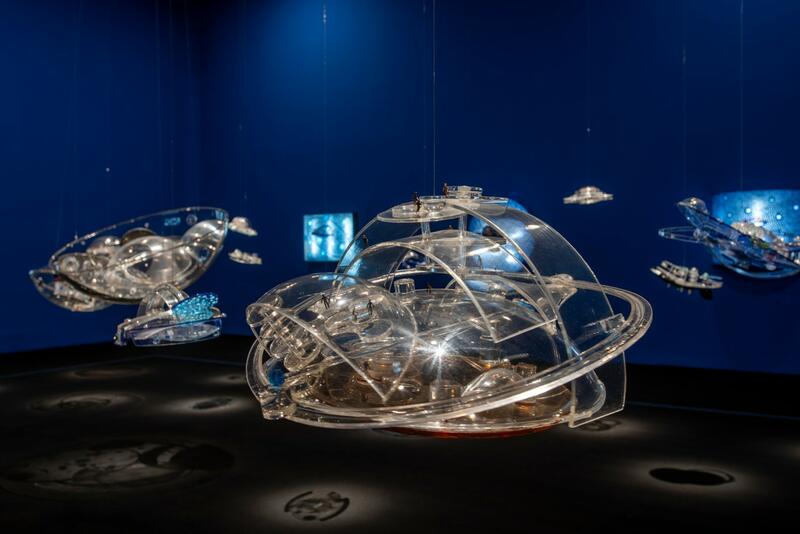
The unmissable exhibition, co-curated by María Amalia García, chief curator of the Museo de Arte Latinoamericano de Buenos Aires (MALBA), and Mari Carmen Ramírez, Wortham Curator of Latin American Art at the Museum of Fine Arts, Houston (MFAH), emerges from an extensive research project on the life and work of Ferdinand Falik. As an adolescent, he adopted the name Gyula—from a Hungarian city—and Kosice—from his birthplace—as the first sign of his incessant task of reinventing, both in life and in art, the genesis and scope of each creation. To the point of overflowing every previous boundary, he became the poet, self-taught theorist, and artist who—regardless of his permanent and tireless construction of his own myth—not only created the first interactive piece, Röyii (1944), destined to be reconfigured by others, but also conceived the models for the Hydrospatial City (1946–2004) as the seed of a future, alternative imaginary of communal life on earth—an imaginary still not fully comprehended today.
Gyula Kosice (1924–2016) said he never forgot the experience of crossing the ocean at the age of four. With the immensity of infinite water forever engraved in his eyes, he arrived in the south of a continent with a new language—Spanish—that would allow him to open unprecedented passages, enunciating and building an artistic vision conceived to transform the art of his time and to imagine alternate futures for humanity.
-
Gyula Kosice: Intergalactic, en PAMM
As a teenager, surrounded by multiple forms of orphan hood and class limitations, in a country where intellectual life seemed to belong to a sophisticated elite far removed from the debates of working-class neighborhoods (he himself was a leatherworker), he clung to fragments of poetry and philosophy, of visual arts and other inquiries, enough to convince him to launch manifestos and theories. By the age of 20, he was one of the illuminated young creators who would change history by participating in the iconic launch of Revista Arturo in 1944, and the Madí art. Yet that single publication—obsessively studied in academia as the beginning in Latin America of a new abstract art liberated from all referents—is not the axis of this exhibition. It’s fascinating display at the Pérez Art Museum Miami (PAMM) represents a milestone for the depth of its inquiry into Kosice’s crucial contribution between 1950 and 1980. It retraces his role as a great pioneer in the incorporation of moving water into sculptures and motorized installations, and culminates with the deployment of the central project of his existence: the Hydrospatial City. This conception began with the phrase he wrote in capital letters in the Madí manifesto of 1946—“MAN WILL NOT END ON EARTH”—and extended throughout his life.
It is indeed the first monographic exhibition of Kosice since his death, and it repositions the extraordinary contribution of a true visionary: although other constructivists had used light and plexiglass before him, by hanging transparent spheres on the wall and illuminating them, he projected virtual volumes in the form of “a flow of transparent forms,” as Ramírez highlights—expanding the reach of spatial plasticity, conceived not as a container but as an active and transformable entity, as a continuum.
-
Gyula Kosice: Intergalactic, en PAMM
Kosice was the great pioneer in the incorporation of water in tridimensional pieces, an element that defined his very being: “I am water,” he proclaimed. His First Hydraulic Sculpture dates 1958–1960, and from his Hydric Cosmogony No. 2, 1959, onward, he constructed light boxes with color filters, plexiglass semicircles, and moving water that generated shifting chromatic perceptions. The installation at PAMM, with its “drops of water” illuminated and moved by motors, has an immersive and fascinating effect. Amalia García writes about the association between water and the body that leads him to “erotic invention.” Paradigmatic is the piece evoking his relationship with his wife, the remarkable (and forgotten) artist Diyi Lañ: Homage to Diyi, 1965, a transparent sculpture with a current of water flowing from a high semicircle into two others, sensually intersecting, situated over the container box of countless drops.
But above all, his (1946–2004)—the vital project that forms the exhibition’s axis—with its floating architectures of water and light, situates him in a time that belongs to the future. Yet already from its very formulation in the postwar years, it was a judgment on the course imposed on humanity by architectural modernity and the rapacity of capitalism. In the catalogue accompanying the impeccable exhibition design, Giovanna M. Bassi Cendra reflects on the critical and antagonistic relationship between the hydrospatial city imagined by Kosice and the Le Corbusier functionalist city with its pervasive productive coldness.
The exhibition deploys his hallucinatory architectural prototypes, three-dimensional models of hydrospatial transparent cells built of acrylic, plexiglass, light, and paint, like a sky of intense blue, and the habitats conceived as constellations floating in a starry night sky. Suspended five thousand feet above the ground, the transparent spherical cells of his city would extract water from the vapor of clouds, could move and reconfigure, and—being alien to the idea of property and to the reality of environmental destruction—would, according to his notes, include rooms for eroticism and for liberation from anguish.
When he presented his city in the mid-seventies at the Espace Pierre Cardin in Paris, it was perceived as science-fiction aesthetics. But Kosice, as Bassi emphasizes, believed his post-industrial proposal was realizable: he experimented with rain, consulted astronomers, and even traveled to NASA in 1982 to demonstrate that this floating city—powered by atmospheric energy and by the very possibility of an alternate form of common existence in the galaxy—was viable, though costly. Years after his death, companies generating atmospheric water began to appear.
It is crucial to consider that other projects of architectures linked to social utopia—such as Constant’s New Babylon or Yona Friedman’s Spatial City—are often cited without including his Hydrospatial City, whose precociousness has yet to be sufficiently acknowledged and whose significance as a critique of modern capitalist urbanism has not been properly recognized in scholarship, as Bassi rightly points out. In any case, his acrylic mobiles and luminous floating galaxies succeed in transforming—during the interregnum of this exhibition—the museum space into a heterotopia in Foucault’s sense: not a utopia, but an existing place where, upon entering, we pass from the paradigm of real modernist cities and their relentless productive fury to an immersive possibility that pushes them to the threshold where the impossible can be imagined as possible.
Related Topics
May interest you

CIRCLES, SPOKES, ZIGZAGS, RIVERS: CONTEMPORARY ABSTRACTION AT WHITNEY MUSEUM
Artist Grace Rosario Perkins’s solo exhibition reveals a dynamic process of layering, erasure, and renewal, where personal and collective histories converge.specifically for this exhibition.

FROM FIELD TO FABRIC: THE ECOLOGICAL JOURNEY OF AMERICAN QUILTS
The American Folk Art Museum presents an innovative exhibition examining the natural history of quilts and their connections to agricultural production, industrial manufacturing, and international trade, revealing the environmental and social impact of this quintessentially American art form.

THE UNKNOWN AND ITS POETICS AT KINOSAITO
The interdisciplinary art center located in New York presents work shaped by the experience of relating to the foreign in order to build a unique identity.

THE CONTEMPLATIVE IN THE LABORIOUS, IN NEW YORK
Apexart presents the work of seven Latin American artists who, through meticulous and repetitive handcraft processes, transform labor into an act of resistance, joy, and the creation of possible futures.
AGUSTIN DI LUCIANO'S CHRONOTOPIC REALITY AT MARCO MUSEUM
Last few weeks to enjoy a unique experience at the Museum of Contemporary Art in La Boca: an immersive exhibition that combines art, technology, and audience participation.
KARA WALKER'S SILHOUETTES AT FUNDACIÓN PROA: HISTORY, POWER, AND REPRESENTATION
For the first time in Argentina and South America, Fundación Proa presents an exhibition dedicated to the American artist, one of the most influential figures in contemporary international art.
GALLERY RETURNS TO PALERMO AND VILLA CRESPO FOR ITS SECOND 2025 EDITION
The cultural event turns Buenos Aires into a vibrant art route: galleries, museums, artist studios, and independent spaces open their doors with free activities and special programs.

JOSÉ CARLOS DIAZ IS PAMM'S NEW CHIEF CURATOR
The curator returns to the city where he began his career to take on the role of Senior Director of Curatorial Affairs & Chief Curator at the Pérez Art Museum Miami, with a vision focused on accessibility and intercultural dialogue.

THE HYPNOTIC NATURE OF AN EXPOSED STAGECRAFT
Just steps from the door, I heard the echoes of Tramoya. Curiosity guided my body toward the gallery, stealing from me the chance to prepare for the detours and fragmentations the works would provoke—and for the attempts to piece together those fragments within my own body.
ARTEBA: AT THE CENTER OF CONTEMPORARY ART
Youth, performance, and permanence: Argentina’s most important art fair has opened at Centro Costa Salguero and will run until August 31.