

By
Julia P. Herzberg
October 17, 1979 was a watershed moment in the career of Wifredo Lam whose painting Ogue Orisa (1943) was illustrated on the cover of the catalogue of the first Sotheby Park Bernett auction of Latin American Art in New York. The decision to feature Lam was providential. Ogue Orisa attracted the attention of a new collecting constituency in this country and abroad. The artist’s work increased in value over the decades as it became central to academic research, teaching, publishing and to museums in the US.
Prior to 1979, Lam’s early critical attention in the U.S. was due to many factors. As early as 1942, the year following Lam’s return to Havana from Marseilles, France, his gouache Mother and Child (1938) was included in MoMA’s exhibition “New Acquisitions: Latin America Art,” now in the first gallery of the MoMA exhibition When I Don’t Sleep, I Dream. The artist exhibited in First Papers of Surrealism, the first émigré surrealist exhibition in New York at the Coordinating Council of French Relief Societies, Inc. (October 1942). The exhibition, curated by André Breton and installed by Marcel Duchamp, introduced Lam’s work to Pierre Matisse, who in the late fall organized Lam’s first gallery exhibition, one that took place almost yearly through the early 1950s. Through an established network of surrealist artists in exile, Lam contributed his illustrations to their magazine VVV (1943, 1944), edited by David Hare, Breton and Duchamp.
Lam’s first solo exhibition was at the Arts Club of Chicago (1944) and his second at the Pierre Matisse Gallery where his now famous paintings La jungla (The Jungle), La mañana verde (The Green Morning), and La silla (The Chair) (all 1943) were first seen in New York. The artist designed the cover of VIEW in May 1945. The artwork, including the covers of this most significant surrealist magazine, was designed by European and American avant-garde artists, including André Masson, Man Ray, Marcel Duchamp, Alexander Calder, to name a few. Lam’s hybrid images create the letters of the title of the magazine. The center and lower images are composed of birds, wings, leaves, a horse shoe (a syncretic symbol as a talisman for protection), female breasts doubling as papaya fruit, and fingers with long nails.
Lam visited New York in 1946 and spent time with Duchamp, John Cage, Arshile Gorky, Frederick Keisler, Roberto Matta, Robert Motherwell, Isami Noguchi, and others. On that trip he would have seen The Jungle then installed on MoMA’s first floor. In 1947 Lam’s Le Présent éternal (Hommage á Alejandro Caturla) / The Eternal Present (An Homage to Alejandro Caturla) (1944) was installed from the ceiling in Nicolas Calas’s exhibition Bloodflames in New York in 1947. Matta published Lam’s drawings in the New York magazine Instead in 1948. The following year, Lam participated in several group exhibitions at the Brooklyn Museum, MoMA, and the Pierre Matisse Gallery. His solo show at the Pierre Matisse Gallery in 1950 was followed by Esso Standard Oil Company’s commission to paint his first of several murals for its Havana building in 1951.
In May 1952, a couple of months after Lam had left Havana to live in Paris, The Jungle left MoMA to be exhibited at the Musée national d’art modern in Paris and then at the Tate Gallery in London. Lam returned to the States in 1958 when he visited Chicago where he was named a member of the Graham Foundation for Advanced Studies in the Fine Arts. The following year in 1959 his work was included in the Solomon R. Guggenheim Museum and The Art Institute of Chicago as well as the documenta II in Kassel and at the Salon de Mai in Paris.
The gallerist Albert Loeb, who first exhibited Lam’s work in Paris in 1939, showed his work in New York in 1960 and 1961. In 1964 the artist received the Guggenheim International Award and participated in documenta III. That same year he began moving between Albissola Marina, Italy and Paris. In 1966 Lam had his first major touring retrospective at the Kestner Gesellerschaft in Hanover, Germany. It traveled through 1967 to the Stedeljk Museum in Amsterdam, the Modern Museet in Stockholm, and the Palais des Beaux-Arts in Brussels. MoMA included Lam in Dada, Surrealism, and Their Heritage (1968) further underscoring the Cuban artist’s relationship to the broad-based movement that continues to find new expressions throughout the world. (Recall: Surrealism Beyond Borders, The Metropolitan Museum of Art, New York, October 4, 2021-January 39, 2002; Tate Modern, London, February 25-August 2022).
By 1970 twenty monographs had already been published in addition to an extensive bibliography. Ogue Orisa on the cover of the Sotheby Parke Bernet Auction catalogue (1979) was, in spite of the artist’s renown, an aspirational choice. It was unlikely then that Lam’s historical importance in today’s global art world would have been predicted. Nor would his multifaceted work become central to academic research, teaching, publishing and museums. The following U.S. exhibitions are important predecessors to the MoMA retrospective When I Don’t Sleep, I Dream. They include Wifredo Lam: A Retrospective of Works on Paper at the Americas Society (September 18, 2022-December 20, 1992); Wifredo Lam at Museo Nacional Centro de Arte Reina Sofia (Sept. 29–December 14, 1992); Wifredo Lam and His Contemporaries 1938-1952 at The Studio Museum in Harlem (December 6, 1992-April 11, 1993); Wifredo Lam Imagining New Worlds, The McMullen Museum of Art at Boston College (August 30-December 14, 2014) and then the High Museum in Atlanta (February 14-May 24, 2015).
Wifredo Lam: When I Don’t Sleep, I Dream is the first comprehensive retrospective of the artist in the United States. The works span six decades of Lam’s prolific career. There are more than one hundred and thirty artworks from 1920 to the 1982—including paintings, small and large scale works on paper, collaborative drawings, illustrated books, prints, ceramics, and archival material, much of which has not been previously shown together. This exceptional exhibition will be remembered for acknowledging Lam as a major artist of the 20th-century who created an aesthetic language to express the complexity of religious beliefs, diverse ethnicities, cultural backgrounds, and political otherness. In claiming his African and Chinese heritage as the well spring of his universe, Lam’s universe is identified by his unique transformations of Surrealism and his political belief in self-determination.
Lam, a polymath, contributed to modernism in exceptional ways by exploring the possibilities of cubism and expanding the inventive parameters of surrealism while negotiating figuration and abstraction with a highly recognizable iconography and an extraordinary imagination. Beginning in the 1940s, he worked with a vocabulary of images based on Afro-Cuban worldviews, redefined the visual language of single figures, multifigured compositions, landscapes, and still lifes. His subjects addressed rituals, elements in folktales, and religious beliefs held by many descendants of Yoruba (also known as Lucumí or Santería) as well as non-Yoruba Cubans. Lam’s artistic and thematic outreach was broad, beginning in his Spanish period and continuing through the years he was repatriated to Havana (1941-1952). He returned to Paris in 1952; lived in Zurich (1961); and in Albissola Marina, Italy (1962-1982) while moving back and forth to Paris during the same years. During his European years, Lam also made several return trips to Cuba.
The first gallery introduces Lam (1902-1982), who was born and raised in Sagua la Grande, a major sugar producing province. Among other works and paraphernalia in the vitrine from Lam’s earliest years, there are two small, delicate line drawings the young art student penned when he lived and studied in Havana (1918-1923). One of the drawings is of Lam Yam, the artist’s Chinese father who came from a Confucious background. Lam’s mother of mixed African and Spanish ancestry, was raised in both the Catholic church and in Afro-Cuban spirituality. The paintings in this gallery are from the artist’s years in Spain (1923 to 1938) and his early years, in Paris (mid-1938 to 1940). Lam’s two different self-portraits are among the many depictions of single and double figures in a multiplicity of poses. He worked through a range of styles from realistic to cubist-based figuration, sometimes incorporating the decorative patterns of Matisse as in Self-Portrait (c. 1938).
In several single figure subjects, he responded to African art as noted in Madame Lumumba (1938). The Spanish Civil War (1937), Lam’s largest painting to date, is a tour de force. The horrors experienced by Lam, who fought on the Republican side, are depicted in a tightly compressed, single plane. The cubist derived figuration of the fallen figures of men, women, and children alongside their weapons makes for an unforgettable war scene.
In the same gallery, the viewer is introduced to the artist’s new surrealist experiments in Marseilles. Lam left Paris on June 14th, the day Germany occupied the city and arrived in the occupied Vichy city in July. There he reunited with Helena Holzer with whom he had lived in Paris. In the war-like atmosphere of Marseilles, their life was supported through the assistance of Varian Fry who headed the American Rescue Committee in the U.S. Together with many artists and writers, they waited for visas and passage to the Americas. Through their friendship with André Breton, they were invited to meet every Sunday at Villa Air- Bel to participate in Surrealist games such as the Game of Marseilles / Juego de Marsella, Exquisite Corpse / Cadáver exquisto and Collective Drawing / Dibujo colectivo. Breton invited Lam to illustrate his book Fata Morgana. Lam’s new drawings reveal a completely changed morphology. The figures, hybrid in form, unconventionally configured, appear to spring from the imagination rather than from empirical reality. In their entirety, they foretell the formal shifts that would occur in the Havana work.
Lam and Holzer finally left Marseilles in March 1941 on a boat with more than 300 other refugees. About a month later, they arrived in the Vichy occupied country of Martinique where they stayed for forty days. Breton introduced Lam and Helena to the Afro-Martinican Aimé Césaire and his wife Suzanne. Césaire, teacher, writer, poet, and politician, coined the term “négritude,” a concept that would change the relationship of the colonizer and the colonized. Césaire, who had also studied in France, returned to his native country due to the war. He and his wife had just published their first issues of Tropiques: Revue Trimestrielle, a magazine about art, politics, and the negritude movement. Lam’s Martinique sojourn marked both the beginning of Lam’s interest in the socio-political negritude movement as well as his life-long friendship and collaboration with Césaire.
After leaving Martinique, it took several months of additional travel for Lam and Holzer to reach Havana in July (1941). After an eighteen-year absence, Lam was able to start a new life there during which time he created an enormous body of work on paper. He embraced his surrounding landscape and people whom he had known when growing up in Sagua la Grande. Within two years his new work gave voice to his Afro-Cuban worldview. Lam and Elena had the good fortune of meeting several people, who not only became very close friends, but who were also writing about Afro-Cuban subjects in folklore, oral history, anthropology, music, prose, and poetry. Lam’s early work explored hybrid forms of plant, animal, and human elements that together reconfigured their anatomical parts and interchanged their sexual organs. Lam understood the relationship between aesthetics and creative freedom according to Surrealist theory. His subversion of traditional subjects whether portraits, still lifes or landscapes, redefines the empirical world in terms of the spiritual world. While the Surrealists believed that the spiritual world was part of the unconscious, Afro-Cubans understood it as central to their everyday reality. That belief was the essence Lam expressed in his art throughout his career.
The Jungle, an amazingly masterful painting, establishes the interconnectedness between deities (orishas) and nature through hybrid forms echoing the surrounding vegetation. The legs of the four hybrids conflate with sugarcane stalks and their breasts with papaya fruit. One of the figures holds its arm toward its ear as if listening to the mysteries of nature. Santeria devotees believe in the sacredness of mother earth, commonly referred to then as the monte. The monte is both a physical place and a spiritual realm where prayer and offerings are made (in Africa it is the bush). Deities were born in the monte, and some continue to inhabit its natural elements; others bestow their blessing in the form of ashé, divine force or power. Priests and devotees alike propitiate plants and herbs before cutting them for medicinal or ritual use. The act of cutting plants or herbs is symbolized by the fourth figure with the scissors on the right. The two figures holding plants in their outstretched hands are, in all probability, offering them to the deities / orishas. The group, amalgams of human, plant, and animal forms, dances slowly and rhythmically, as in a bembé, to honor and celebrate those spiritual, life-giving forces.
The Green Morning / La Mañana Verde (1943) features the voluptuous figure with several heads, huge bird wings, limbs echoing the contours of the sugarcane stalks, feet shaped like horseshoes, and round heads for kneecaps. Elleguá, the guardian of one's paths, is signified by the little round head surmounting the central head of the winged figure. Among Elleguá's many advocations, he predicts, prevents, and allows for the vicissitudes of life. His role as protector is represented by a small votive image commonly placed in a receptacle by the entrance of Cuban homes. Other manifestations of the spirit world are the little heads with ringed-toothed mouths. Their ominous appearance is intended to evoke evil, which looms large in the monte.
The Somber Malembo, God of the Crossroads personifies the forces of nature (ashé). Lydia Cabrera, an ethnographer of Afro-Cuban culture, and a very close friend of Lam, titled this work. She was reminded of evil or a magic spell, which in Cuban Congo parlance is malembo. The surface dappled in rich colors, the multi-directional positions of the figures’ anatomical parts are characteristic features in many works at this time.
Anamú refers to a short wild plant with white flowers that is used for ritualistic and medicinal purposes. According to Afro-Cuban folkways, it is common to put two leaves of anamú in one’s shoes to deflect evil or malembo. Anamú and Eggue Orissa, two of the most beautiful pictures from these early years are notable for the delicate splashes of color and application of pigments. If there are any works that speak to the refinement of Chinese drawing and color, these are they! (Anamú was shown next to The Somber Malembo at the Pierre Matisse Gallery in New York in 1944.)
In a nearby vitrine, we delight in the drawings Lam gifted to Lydia Cabrera, including a painted fan and her portrait. Cabrera kept Lam’s gifts when she left Cuba after the Revolution. Eventually she donated them together with her archives to the Lowe Art Museum at the University of Miami. The ephemeral material here includes a copy of El Monte, a ten-year field study of Cuba's black folk legends and oral history first published in Spanish in 1954. It remains an invaluable source of study today. Pierre Loeb’s Voyages à travers la peinture is a reflection on modern artists including Lam. Loeb wrote: “If there was ever an artist who, by means of fragile lines and immaterial touches, could synthesize the blinding light of his country, its ethnic secrets, the richness of its vegetation, it is he [Lam].” Lam’s etching for the catalogue cover is placed next to the publication in the vitrine. Loeb gave Lam his second solo exhibition at Galerie Pierre in Paris in February, 1946.
The vitrine also features Aimé Césaire’s poem Cahier d’un retour au pays natal (Notebook of a Return to the Native Land), which Lam first encountered when he and Helena spent time with Césaire and his wife in Martinique. In 1943 the poem was translated in Spanish by Lydia Cabrera, illustrated by Lam, and introduced by Benjamin Péret. It was this publication that sealed a life-time friendship; one that was intertwined with poetry and art; one that furthered their personal conversations concerning the primacy of the negritude movement in the Americas.
The Christian titles of Annunciation (1944), Nativity (1947), The Body and the Soul (1966), and Annunciation (1982), evoke the syncretic belief system of many Afro-Cubans, who practiced their traditional religions, and at the same time considered themselves Catholics. Lam was raised in both belief systems, but according to Cabrera, he never spoke about his beliefs. There was no conflict in going to church and attending ceremonies honoring the orishas / deities on the same day.
The Eternal Present (1945) is another ambitious multifigured composition in which the hybrid figures have a sculptural quality. Their forms no longer conflate with the surrounding vegetation. The iconography suggests the presence of four warrior deities. From the left, Oshún, orisha of the river and fresh water, is noted by her sensuality; next is Elleguá, the first deity summoned when the ceremony begins, represented both by the little round head and the votive image; the third is Ogún, symbolized by the knife, which when used in ritual sacrifice is guided by the orisha's power; and the fourth, Ochosí, the orisha of the hunt and the mysteries of the forest, is symbolized by the lance.
Lam was invited to Haiti by Pierre Mabille, who had lived in Cuba before he became the French Cultural Attaché in Haiti. He organized an exhibition of Lam’s work at the Centre d’Art in Port-au-Prince. Astral Harp / Arpa astral (1944) was also one the works on view. Lam reconnected with André Breton and others with whom he attended vodun ceremonies. They had a series of experiences that provided Lam with a greater understanding of Afro-Diasporic religions and anti-colonial views. During Lam’s four months in Haiti, he probably started Song of Osmoses / Canto de osmoses (on exhibition), an amalgam of little heads (Elleguas), with horns and staring eyes, a horse-shoe attached to wings, disembodied limbs seemingly moving in multi-directions thereby creating an energized, jewel-like surface. The caption reads that Lam remembers starting this painting the day Japan bombed Pearl Harbor. I mention this because Lam had always had a deep interest in political events (as first noted in his years in Spain), an interest borne out in many of his non-literal scenes. (The Third World, 1965-66, not on exhibition, is one of many examples).
When Lam returned from Haiti, he had many experiences that are well detailed in the excellent catalogue chronology. Due to restrictions of space, consider the following: Lam passed through New York in the fall for the first time since the war ended. There he met many well-known New York artists. He and Helena traveled on to Paris where he reunited with the Césaires. Lam described their meetings as a great joy for it offered them the time to talk about their common aspirations, art, the tropics, black people, and the miseries of life! When Lam returned to Cuba that year, he brought with him a collection of African sculptures and a few Oceanic pieces.
Schango, Schango (1946) is one of four large-scale pen and ink drawings beautifully installed near The Eternal Present. Lam dated this drawing 9-1-46, Haiti. He chose not to depict a thunder ax, symbol of the warrior deity (orisha); instead with the most delicate lines in pen and ink, he drew magical beings in motion to express an abstract vision for the viewer to unravel.
In a play of shadow and light, Canaima (1947) appears as a non-traditional three-quarter portrait a horse-headed figure with horn-like projections protruding around its body. It is possible that the plantains in his garden inspired the exaggerated, surrealist forms. The caption states that the title is from a novel about the Amazon and that the subject refers to a shamanic practice based in the Amazon and Orinoco River basins. Lam reminds us that the Caribbean spirit, its magic, its legends are present in his paintings.
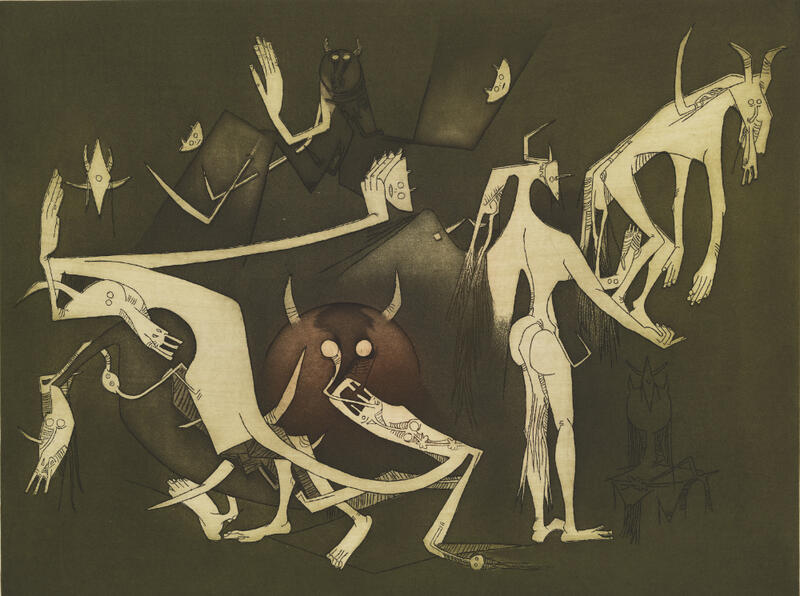
Grande Composition (1949) is a reincarnation of Lam’s objective of infusing his work with the Caribbean spirit, its magic, and its legends. Lam returned to painting on paper as he did for The Spanish Civil War (La Guerra Civil) and The Jungle (La Jungla). This multifigured work adapts the similar play of shadows and light as is in Canaima III. There is no specific point of entry. One’s eye could start, as mine did, at the upper right where the horse-woman’s head is crowned with a winged figure with a horseshoe (a signifier to ward off evil) and a knife, symbol of the deity warrior, Ogún. Or one’s eye might see the middle horse-woman figure whose body is elaborated with diamond shapes and an outstretched arm with an Elleguá in the hand. Or one could begin on the left and read the conjoined figures across the entire surface. Or one might begin looking at the floor where all the feet are configured differently. Not only does this remarkable history-like gathering present a full cast of Lam’s inventive figures sourced from his knowledge of Afro-Cuban worldviews, but it is also composed so that every figure in the scene is literally connected to another. No figure stands alone. To restate: Lam has constructed his Grande Composition as if the world was a united place—an ideal that courses through his work and aligns him with independence movements occurring in different parts of the world. While the painting has not been seen in public for more than 60 years, it had been installed at the University of Havana in 1955. It was also a stage set for one of Aimé Césaire’s plays in 1963. Its recent discovery is a great addition to this exhibition and MoMA’s collection.
Threshold / Umbral (1950) features three central lozenge forms overlaid with multiple smaller diamond forms that emerge as magical configurations. Horn-like images transverse the lozenge forms in front and behind the center subjects. The under drawing reveals a crisscrossing of bamboo stalks. Wherever the threshold exists or paths cross, Elleguá will be there, hopefully, to assure safe entry. Note the presence of a head in the lower left. Lam inserts her again in Eduard Glisaant’s poetry book, La Terre inquiète (The Restless Earth) (1955). Lam’s collaboration with Glissant and Char and others aligned him with their critiques of the legacies of imperialism and racism in the postcolonial world.
Lam often drew forms directly on the surface, creating an interchange between drawing and painting, and surface and line. The dark background creates a sense of depth from which the images spring to life. This is certainly evident in Quand je ne dors pas, je réve (When I Don’t Sleep, I Dream) (1955). This relatively minimalist painting is particularly notable for its configuration of a disembodied horse-woman whose anatomy extends along the lower register from left to right. Although Lam did not design a descriptive bed, the hybrid’s anatomy echoes the shape of one! As in The Gran Composition, the artist has given us a “marvelous” exercise that encourages us to follow the complexity of the figure, allegedly asleep. Let’s look in the lower left at the horse foot that anchors the figure; follow the shape of the leg where another woman’s hand is at the end of her second leg. The legs transform into the body which is supported by a woman’s hand, which in turn becomes a leg that is raised on a table! A crescent- moon head with wisps of long hair occupies a space separate from, but near the reconfigured legs of the horse-woman (also a de facto bed). Lam suggests through the title that “the dream” is the site of spiritual unification.
Quand je ne dors pas, je réve (When I Don’t Sleep, I Dream) is installed in a large gallery with three of the six “Brouse” series (1958) that are among the most visually impressive groupings in the exhibition. The abstract works interweave densely woven sugarcane stalks, totems based on Oceanic sculptures the artist collected, and geometric configurations. The works painted on large pieces of paper are also in a photograph of Lam handling them in his studio in Abissola Marina where he was part of a coterie of artists and writers. La Brouse (The Bush), the only titled painting, informally lends its name to the series. The series harkens back to The Jungle (La Jungla) where the Cuban landscape was likened to the sacredness of the monte or manigua, and therefore, the “Brouse” series is an essential referent to the early 1940s work. Lam aimed for a more expansive territory, albeit abstractly. I believe he referenced the bush in Africa, the land of his maternal family.
As noted throughout this exhibition Wifredo Lam’s universe communicates transcultural beliefs rooted in the African diaspora not only in Cuba and the Caribbean, but in many other countries around the world.
Les Abalochas dansent pour Dhambala, dieu de l’unité (The Abalochas Dance for Dhambala, the God of Unity) is a crowning achievement. The word Abalochas in the title is probably a variant of babalochas or priests of a deity in the Aftro-Cuban religion Lucumí. Les Abalochas dansent pour Dhambala, dieu de l’unité are an acknowledgment of the importance of Vodou. Robert Farris Thompson asserts that one of the signal achievements of people of African descent in the western hemisphere is the vibrant, sophisticated synthesis of the traditional religions of Dahomey, Yorubaland, and Kongo, all of which are infused with Roman Catholicism. Lam also mixed the words in the title to signify the reblending of practices defining Afro-Caribbean religions. Lam used poetic license in both his naming of Les Abalochas dansent pour Dhambala, dieu de l’unité and his iconographic interpretation of the religious scene. Lam improvised in expressing the intricacies of a ceremonial dance from the perspectives of formal unity, innovative commingling and content. The delicately outlined figures appear to advance and recede into the dark forest-green background in continuous movement. Lam’s consummate draftsmanship created lines that flowed from one anatomical part to another without seeming to separate being from being. Several of the gendered figures, some identified in part by their skirts, another by a phallus, are visible from the side, back, and full front, producing a sense of constant movement. All the figures are connected to each other as if sharing the same energy source. As the abalochas dance, we decipher the large figure in the foreground in a reclining position, similar to the one in the foreground in If I Don’t Sleep, I Dream. That figure (a devotee), whose head is configured by a horse mask, is experiencing spirit possession. Never interested in straightforward narrations of magico-religious practices, Lam intuits them with his inventive morphologies. Although no drums are depicted in this painting, one can hear them. They have been beating (in spite of intermittent prohibitions) since the 1500s in religious ceremonies in Cuba, and their invisible presence resounds herein as well.
In a large vitrine in the final gallery Lam’s sculptural ceramics are showcased. He dedicated himself to ceramic work in Abissola from 1965. One of many impressive pieces Poussiere d’atomes (Atomic Dust). The signature female bust with small horns and no specific facial features is replete with surface cracks–a metonym for the world’s concern with destruction from an accumulation of atomic dust. The Elleguá figure is similarly composed to the ones illustrated in La Terre inquiète (The Restless Earth).
Lam’s final work on the subject of the Annunciation (1982) was published as a portfolio with Aimé Cesaire. Lam wrote an epigraph in memory of his spiritual godmother Ma’Antoñica Wilson, who had brought him as a youngster under the guidance of Changó, deity of thunder. Changó was worshipped in the guise of Saint Barbara. The Church recognized the dual religious association of worship. Ultimately, the same decolonization strategy of a dual worship system as exemplified by Santería and other diasporic religions enabled Christian saints to be equated with the orishas. ©
Wifredo lam: “When I don’t sleep, I dream” - Restrospective at MoMA
Curated by Christophe Cherix and Beverly Adams
What is a Culturally Specific Institution? Director of El Museo del Barrio for over eight years, Patrick Charpenel reflects on the role of museums in the United States, the visibility of Latinx communities, and the challenges of thinking about art beyond fixed categories and market logics.
The art maket stabilizes, but the recovery remains uneven.
The intergenerational selection traces a sensitive map of practices connected to the United States, where affective, political, and technological ties intertwine through an experimental lens.
Prestige at a Discount: Salaries and Careers in the Art World
Between references to art history and spectacular visual statements, the 2026 Met Gala once again pushed the boundaries between aesthetic creation and performance.
A new exhibition at Americas Society reclaims the work of a painter who defied muralism and held her own in dialogue with American Abstract Expressionism and European Informalism.
In the week that followed the passing of Evelyn W. Politzer (1961–2026), a pivotal figure in the city's textile art scene, countless expressions of affection emerged alongside a mobilization of cultural initiatives that revealed how, in a time when the sense of community seems to have vanished, art in a city like Miami has been capable of building a social fabric able to bind itself to the meaning of creation even beyond death.