
ESTRANGEMENT AND ANTICIPATION: ORNELLA POCETTI AND IVANA DE VIVANCO AT MACBA
The Museo de Arte Contemporáneo de Buenos Aires (MACBA) presented the work of two women artists. In ¿Cómo suenan las lágrimas antes de secarse? (What Do Tears Sound Like Before They Dry?), Ivana de Vivanco builds a warning. Snakes, with their capacity to sense catastrophe. In Curada de espanto (Cured of Fright), Ornella Pocetti brings together scenes that hold a story that never fully reveals itself. Both artists hold the abyss steady through anticipation and the suspicion of an estrangement. All you have to do is pay attention.
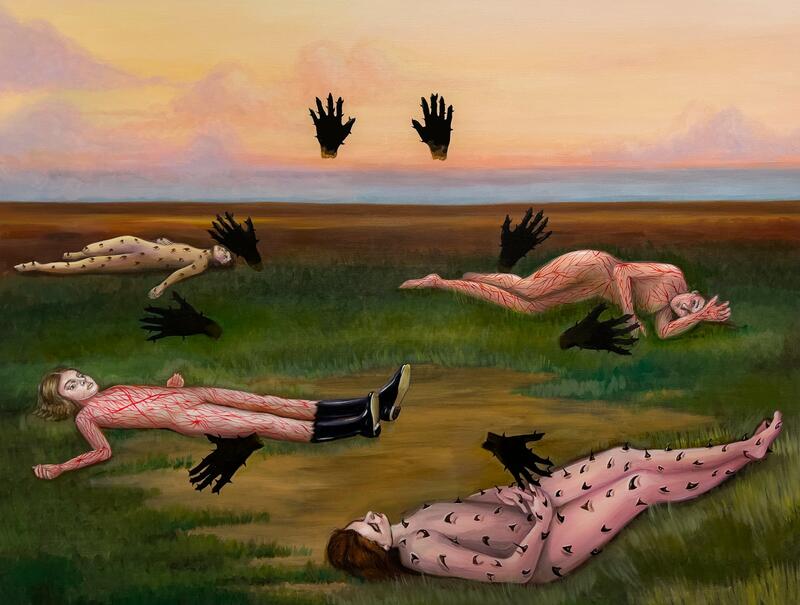
Cured of fright is a very common phrase in Argentina; nothing can scare me anymore, because I've already lived through the worst. But you have to go through the worst first—the most horrific, unimaginable, traumatic, outlandish yet real experiences. Sometimes only magic can cure fright, the way one cures empacho, the evil eye, or sunstroke. The women in Ornella Pocetti's (Buenos Aires, 1991) works live through terrifying scenes: arrows piercing their bodies, decapitations, bleeding flowers, bodies wrapped in rose thorns, threatened by poisoned apples—yet their expressions remain neutral, perhaps cured, perhaps merely used to it. The fiction the artist presents us with—her mythology, her magical realism, her own femgore—is built in such a way that it remains incomplete. The narrative has jumps, sighs, gaps. Ornella and Carlos Gutiérrez, curator of the show, built a space that, despite being loaded with objects—flowers, drops, keys, gloves, apples, flies, glasses, volcanoes, hands—leaves a vast emptiness. Together they produce a film with no script, a novel with chapters out of order, a kind of "choose your own adventure," one that keeps you wondering for hours: What are these women talking about, these women who all seem to be one and the same? What are they looking at in the forest? Was the girl with a body of thorns born with them? Do the thorns harm her, or protect her? Who cut off that woman's head? Have I seen this woman before? Is that world mine too?
The room is divided by a yellow arch, a pale color, not very vibrant, nothing cheerful—perhaps the same shade as Charlotte Perkins Gilman's 1890 story "The Yellow Wallpaper." In that fiction, a woman who believes herself ill spends three months confined in an estate to cure her ailments. But during her stay she becomes obsessed with interpreting the patterns forming on the wallpaper of a peeling wall; these patterns end up writing her fate. She tries to read the strangeness that condemns her. Or perhaps she was already condemned, and what she was receiving was only a warning. Maybe fright cannot be cured after all; maybe the adventure cannot be chosen.
In "La Soga," the famous story by Argentine writer Silvina Ocampo, the boy Antoñito discovers a rope. But the rope, which at first was a hammock, then a harness, then many other things, in the end turns out to be a snake. Antoñito plays with his imagination, chooses his own adventure, and his fright doesn't cure him—it ends up killing him.
The snake is the animal of betrayal. It moves backward and tempts one to bite the apple. But it also sheds its skin. It renews itself. And in Ivana de Vivanco's (Lisbon, Portugal, 1989) video installation ¿Cómo suenan las lágrimas antes de secarse?, it takes the form of an oracle.
The artist returned to the Atacama Desert over the course of two and a half years to research, forge connections, and gather images and sounds. There she found the extraordinary richness of a territory scarred by lithium and copper extraction. And the snake.
Drawing on studies of the reptile, she documented its ability to sense seismic movements before humans can register them. De Vivanco imagines a snake also capable of anticipating catastrophes caused by human action. She turns it into prophet and guardian, alongside the sounds she recorded across the territory: wind, sand, water, and lithium running through the mine's pipelines. The snake moves backward, seeking to suspend itself in another time, or to get ahead of renewal.
Both exhibitions propose learning to distrust. A snake that foretells, a woman immersed in her own estrangement, a reactive territory, a world where, as Silvina Ocampo said, what's strange is always what's most true.
Related Topics
May interest you
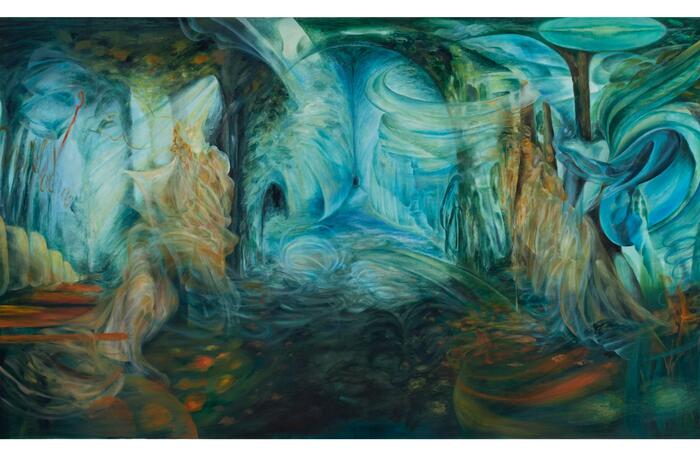
SOFÍA MULJAT'S WORK IS A TUG-OF-WAR OF CORNERED INTENTIONS
At Casa Santa Ana, Panama, the Argentine artist presents Este rincón, mi rincón through September of this year, a show that stirs a desire to sense in the air traces of vanquished scenes, as Muljat paints them.
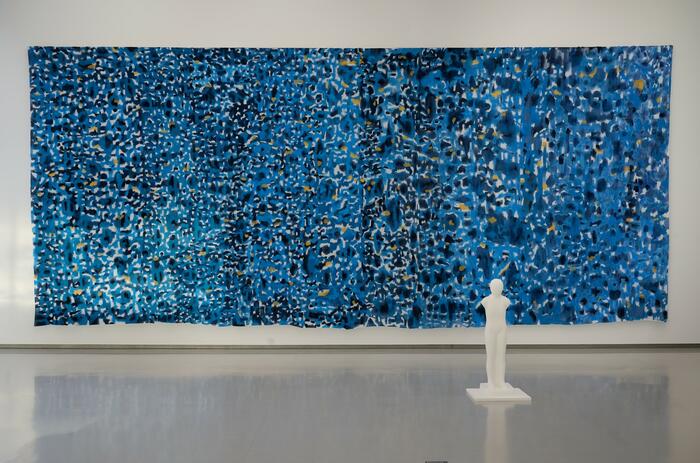
POETRY, LANDSCAPE, AND FORM: ELBA BAIRON AND PAOLA VEGA AT EL MAR
On Saturday, July 4, the exhibition biformes bicoloreadas bitremendas bilejanas lejanas lejanas opened at Museo MAR in Mar del Plata, featuring artists Elba Bairon and Paola Vega, curated by Sofía Dourron.
A GHOST INSTITUTE FOR ARGENTINE PHOTOGRAPHY, ACCORDING TO FRANCISCO MEDAIL
An interview about Argentina and its institutions, about Argentina and photography, about Argentina and its contemporary art audience. About the Instituto de Estudios Artísticos, Francisco Medail's new space.
CHEATING TIME WITH FORNER AND LÓPEZ
At Galería Ruth Benzacar in Buenos Aires, Argentina you'll find “EL ORIGEN DEL MUNDO” and “Futuro acontecer”; two exhibitions with artists building from distant temporalities that are, in their own way, entirely their own.
VENTANA GALERÍA PRESENTS “CORPORALIDADES” AT CANTRAL NEWBERY
The third edition of the curatorial cycle El amor puede funcionar brings together works by Jovita Kelmelmajer, Matías Jesús Funes, Romina Cruz, and guest artist Carla Fonseca.
COLORS AND TEXTURES AT PLATEADA, LA PLATA’S ARGENTINE ART FAIR
With a work by Lido Iacopetti presented by Aldo de Sousa at the beginning of the fair, as a La Plata's city grail, as Facundo Belén—artistic director of Plateada alongside Virginia Martin—described it, the fair presents its 2026 edition in the main hall of the Teatro Argentino, in La Plata, Argentina.
EXHIBITION ON FRAGILITY AS A SHARED CONDITION AT PALACIO LIBERTAD
Yo, frágil brings together works by eight artists —including Nicolás Bacal, Marcela Cabutti, and Silvia Rivas— who explore interdependence through installations, sculptures, videos, and paintings. Through September 14 at Sarmiento 151, CABA.