By
María Galarza
A tour of the Argentine pavilion at the 61st Venice Biennale, with Matías Duville’s proposal Monitor Ying-Yang, curated by Josefina Barcia, in dialogue with the Argentine group exhibition Oscuridad visible: La larga sombra de la dictadura (Darkness Visible: The Long Shadow of Dictatorship), in collaboration with Museo de Arte Moderno de Buenos Aires at Spazio Punch.
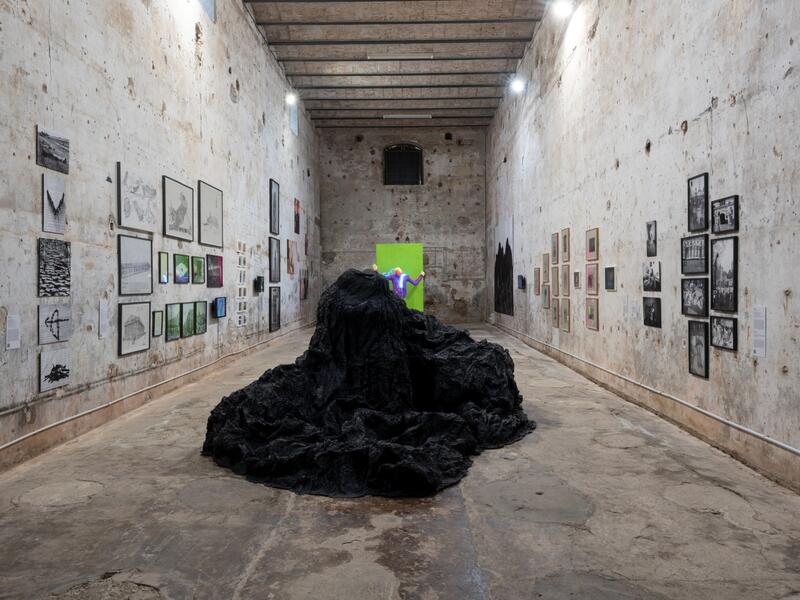
The 2026 edition of the Venice Biennale is coming to an end and, although the main exhibition curated by Koyo Kouoh did not include work by Argentine artists, the country underscored its presence in the Italian city. On one side, artist Matías Duville’s salt installation in the national pavilion. On the other, the group exhibition Darkness Visible: The Long Shadow of Dictatorship, part of the official circuit outside the Biennale grounds. Across the water on the island of Giudecca, at Spazio Punch, the show traces the shadows of the civic-military dictatorship through the coordinates of artists Guillermo Kuitca, León Ferrari, Archivo de la Memoria Trans, Liliana Maresca and Marcos López, Aldo Sessa, Nicanor Aráoz, Eduardo Basualdo, Marcelo Brodsky, Luis Camnitzer, Flavia Da Rin, Sergio De Loof, Ana Gallardo, Eduardo Gil, Gianni Mestichelli, Marta Minujín, Luis Pazos, Néstor Perlongher and La Organización Negra.
Color
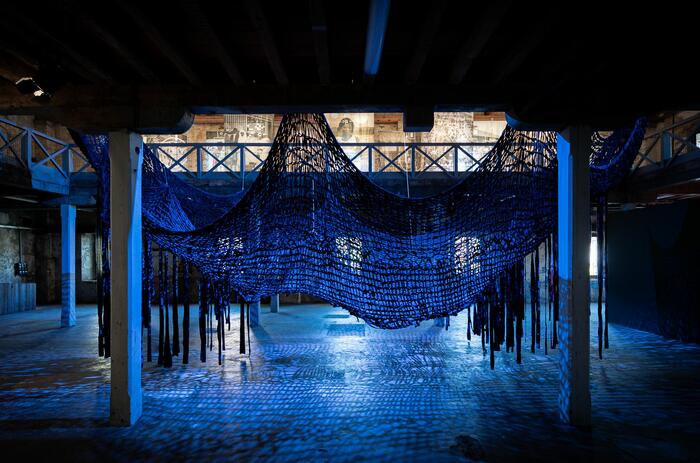
Eduardo Basualdo’s sculpture at the center of the exhibition space (wide, industrial, with concrete floors) and Ana Gallardo’s charcoal drawing set the atmosphere through the color black, which will be predominant with its various scales toward white. Marcelo Brodsky’s work show the forced disappearances of militants and political dissidents through color interventions in the b&w photographs Also, those of Aldo Sessa document the Madres de Plaza de Mayo across the many mobilizations demanding memory, truth and justice. The scene-paintings of Guillermo Kuitca in muted, mortuary, liminal tones add a new texture to the black-and-white tones.
Although in Matías Duville’s Monitor Ying-Yang the tonality does not carry that connotation as it does in the exhibition at Spazio Punch, white returns, with salt and charcoal. The site-specific installation, spreading in a darkened Argentine pavilion, sought to work as a device for neutralizing opposing forces. A way of synthesizing without resolution. And, after a tour of the Arsenale marked by heat, we entered a pavilion of dim lights and enveloping sounds, to move through the space rhizomatically.
Space
Dimensionality, or size, is an aspect to consider in both exhibitions. Returning to Basualdo’s sculpture at the center of Spazio Punch, made with paper and black chalk pastel, textures, curves, shadows and contours unfold. The work dialogues to the monumental installations that characterize this Biennale’s main edition. And it is a great way to portray absence through size. The sculpture covers (and also, paradoxically, exposes) the contours of bodies in motion, appealing to all 30,000 disappeared by the Argentine civic and military dictatorship.
Duville’s Monitor Ying-Yang, on the other hand, throws you into the work. The charcoal drawings on the floor, scattered throughout the space, demand attention and suspension to finally recognize their forms. They ask you to walk, to move through, to look down, to circle the pavilion’s columns, to enter on one side and exit by the other. Because reaching the immersive state the installation proposes requires active effort. The artist mentions that the “experience of displacement” is fundamental to invoke desolate atmospheres, so that the feeling gets inside the body.
Sound
That hot Monday in July, with the Biennale’s Arsenale and the Giardini circuit closed, after having lunch looking at the water, we entered Spazio Punch, housed in a brick building with a Río de la Plata remnant. The intricate streets of Venice were left far behind. Upon entering, a recording of Néstor Perlongher reciting his poem Cadáveres (Corpses) could be heard. In the necessity for this absence / In what underlines that speech / In your godly presence. Minujín’s characteristic voice is also heard, speaking about the sketches, photographs and plans of her famous installation El Partenón de libros (The Parthenon of Books), first made in 1983, at the return to Argentine democracy. Added to the already whispering echo, the projected videos of the eccentric and charismatic Sergio De Loof, with fashion shows and performances that marked Buenos Aires’s underground nightlife in its return to democracy.
The cumulative process of different voices sounding on top of one another gained strength. It is no coincidence that the exhibition’s curatorial text takes its title, Darkness Visible, from John Milton’s poem Paradise Lost, to speak of the role of the visual arts and their capacity to shed light on what was censored or hidden. On absences.
On the other hand, Duville’s Monitor Ying-Yang includes a sound composition made together with his brother Pablo Duville at Centolla Society, with the collaboration of Alvise Vidolin and the team of the Centro di Sonologia Computazionale (CSC) at the University of Padua. It integrates real-time environmental data from Venice that affect the final sound. A time that coincided with a Venice battered by high temperatures and, finally, a summer storm to send us off until the next edition.
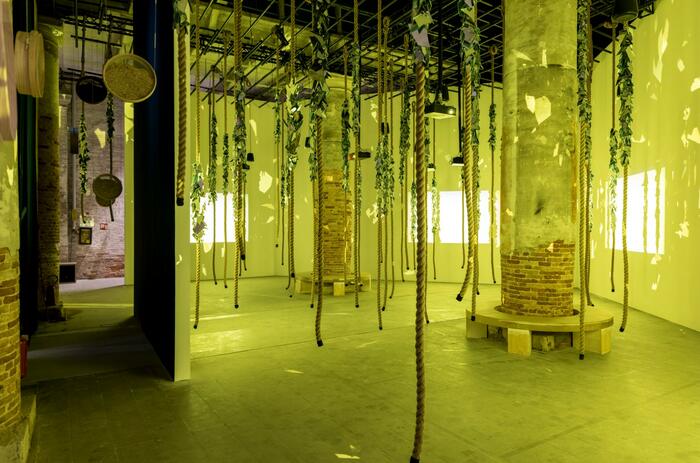
From the ghosts of cyberspace to the Orixás, the Venice Biennale builds correspondences between visible and invisible worlds.

In Minor Keys is the title Koyo Kouoh chose for the Biennale we now read in the light filtered through her branches. What was she telling us? In this piece I reflect on its meaning and on the possibilities artists sow as they resignify the structures of our modernity. It is a walk through six works understood as ecologies, in the way philosopher of science Isabelle Stengers conceptualized it.
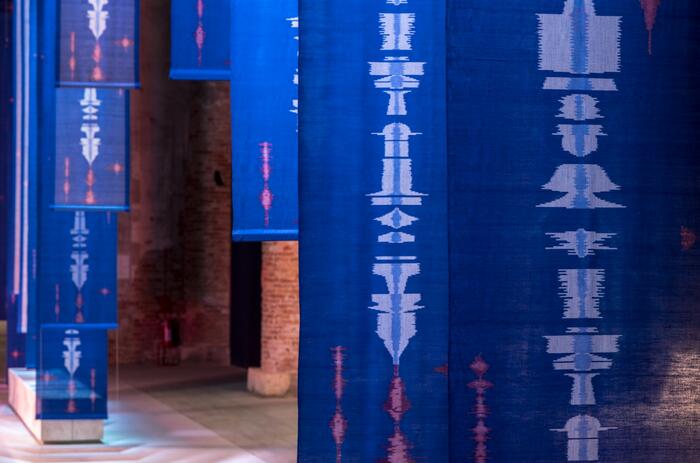
An overhead summer sun, harsh and multiplied by the closeness of the water, beat down on us in the streets, bridges and canals of Venice caught in a heat wave. We were looking for shelter, and then darkness. And then, a panel, an immersive installation by Khaled Sabsabi that glowed in the middle of the entrance to the exhibition. Colors, slow movements, spectral sounds. Can we also imagine, perhaps, certain scents? This is the solemn entrance to the Arsenale in the 2026 edition of the Venice Biennale exhibition.
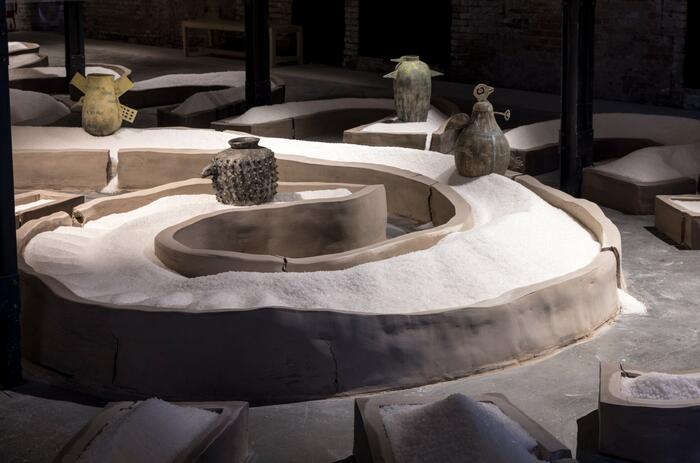
Through a ritual ecosystem of materials, sound, and gesture, RojoNegro's proposal for the Mexican Pavilion opens a space of pause and listening in the face of the saturation of the contemporary world.
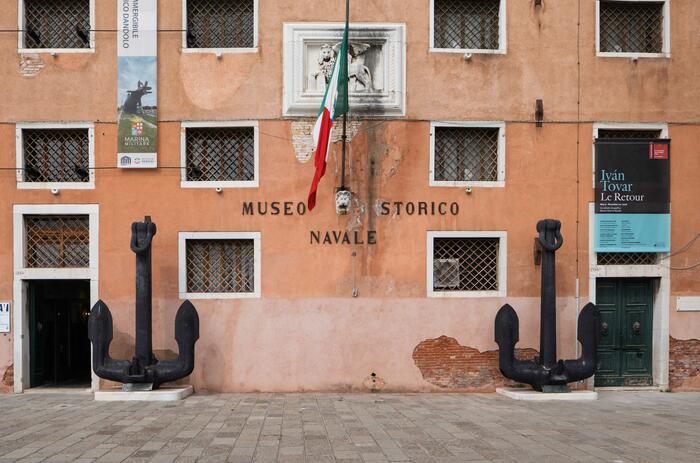
The Iván Tovar Foundation presents Le Retour, a collateral event of the 61st Venice Biennale that repositions the Dominican artist within the global history of Surrealism.
In line with the theme of the 61st edition, the duo Messengers of the Sun turns hyperstition into a tool for rewriting an untold story: that of the peoples displaced by a mythologized feat of engineering.