
By
María Galarza
From the ghosts of cyberspace to the Orixás, the Venice Biennale builds correspondences between visible and invisible worlds.
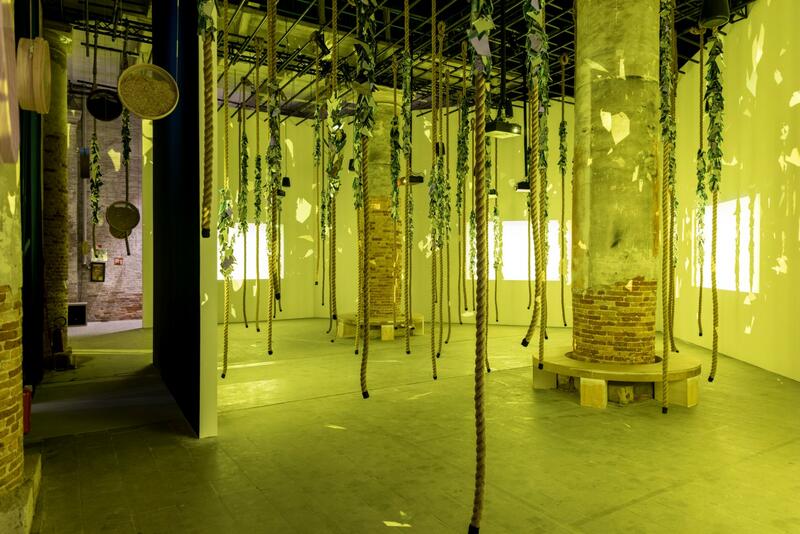
In the midst of the winding labyrinth of the main exhibition In Minor Keys at the Venice Biennale, there is a room. Floating, hanging photographs by artist Kader Attia mark the beginning of the installation. His work draws on the beliefs of a Vietnamese shaman who believed in spiritual entities inhabiting the virtual world. The spiritual within the virtual is almost an oxymoron. Are there ghosts in cyberspace?
The writer William Gibson was the first to coin the term cyberspace. A virtual universe originated in science fiction territory, in his 1982 short story Burning Chrome, and unfolded in his influential novel Neuromancer. A way of delineating virtuality and, above all, shedding light on the invisible networks surrounding it. A “consensual hallucination,” as the author defines it: a geographical non-space experienced collectively. A narrative space that can also accommodate ghosts.
The installation Whisper of Traces searches for those traces. Passing through the hanging photographs, one enters a labyrinth of objects, vines, mirrors, and videos. A cybernetic forest that reveals other beings. Are these computer viruses autonomous ghosts? Are they trying to communicate with us? Are they punishing us? A ghost is something or someone that insists on returning, something that belongs to the past yet acts upon the present.
Within the Internet's horror stories, creepypasta culture—with figures such as Slenderman, Jeff the Killer, and Momo—gave form to characters born in this cyberspace. The first online legends. They were the ones haunting the teenagers who were growing up with the Internet (we were young then, and not-so-young now). Stories that replicated like viruses. Copied and pasted. Taking shape through blogs, forums, and enthusiasts contributing to the narratives of these characters. Perhaps prophets. Special envoys who connected with these spiritual entities as they sought to communicate their message: the Internet is hiding something (or someones). Cyberspace is inhabited beyond the machines that hold it (which we, humans, also cannot control).
In his photographs, artist Estáquio Neves also invokes, almost as a premonition. He seeks to connect past and present through fractures. By fractures, I mean his darkroom manipulations, which make visible the legacy of slavery within the community he portrays in Minas Gerais in his Arturos series, as well as his research into the ruins of the Valongo Wharf in Rio de Janeiro, which resulted in his Cartas ao mar series. Traumas that are transmuted into bodies. What are the remains after these alterations? A “melancholic meditation,” as curator Thiago de Paula Souza writes, brings to light that which lies beyond perception. Or, as Mark Fisher understood the eerie: “that which should not be there,” and yet coexists in irreconcilable form with the images we consider familiar. Fisher spoke of collage as the joining of two or more things that should not be together. Something material and immaterial, juxtaposed. Beyond their archival dimension, Neves’s photographs are surrounded by a spectral aura, an invisible charge that floats around them, acquiring density through other forms that escape the physical.
The unofficial South African pavilion also reflects on how to make the absent present. In the hidden Chiesa di Sant’Antonin in Venice, outside the Biennale’s Arsenale and Giardini circuit, Gabrielle Goliath’s work unfolds across screens showing opera singers performing a continuous lament in memory of displaced and murdered people. Elegy addresses the femicide and murder of members of the LGBTQ+ community in South Africa, as well as the twentieth-century massacre of the Herero and Nama carried out by German colonial forces in what is now Namibia. The video performance was also set to include a tribute to Palestinian poet Hiba Abu Nada, who was killed in Gaza in 2023 alongside her son during an Israeli airstrike, prompting a censorship controversy involving the South African government. “A single note sustained by different women traces transgeographical connections through pain,” writes Mercedes Abella in her review. An invocation that, like the cyberspace imagined by Gibson, transcends the physical boundary and seeks a shared plane beyond geography, reaching toward absence.
Along similar (and minor) keys, Brazilian artist Ayrson Heráclito presented stainless steel sculptures rooted in the cosmology of West Africa, whose insignias and totems refer to the Orixás, the pantheon of deities in Candomblé. Each person is guided by at least two Orixás: one assumes the primary and more pronounced role, while the other occupies a subtler, secondary position associated with emotional support. The artist also presented ink and watercolor drawings to make visible the complete matrix of combined primary and secondary guardians. Discovering one’s own guides and bringing them into one’s life is a spiritual task, because what is there is not always what can be seen.
According to the laws of correspondence set forth in The Kybalion, the different planes of existence are not separate from one another, but reflect each other. As within, so without; as above, so below. This year’s Venice Biennale exhibition insists on what remains unseen through digital, videographic, and spiritual projects that twist the meaning of the monumental installations surrounding them.
Attia’s ghosts of cyberspace, the memories underlying Estáquio Neves’s photographs, the voices Goliath makes sing for the dead, and the Orixás accompanying Heráclito’s sculptures are all ways of establishing these correspondences between past and present, body and memory, matter and spirit, absence and presence, the human and that which exceeds it.
Each with its own invocation device. A way of appealing to the subtle, the subterranean, the minor keys. What remains in circulation after something has been invoked? What ghosts, what memories, what stories return?

In Minor Keys is the title Koyo Kouoh chose for the Biennale we now read in the light filtered through her branches. What was she telling us? In this piece I reflect on its meaning and on the possibilities artists sow as they resignify the structures of our modernity. It is a walk through six works understood as ecologies, in the way philosopher of science Isabelle Stengers conceptualized it.
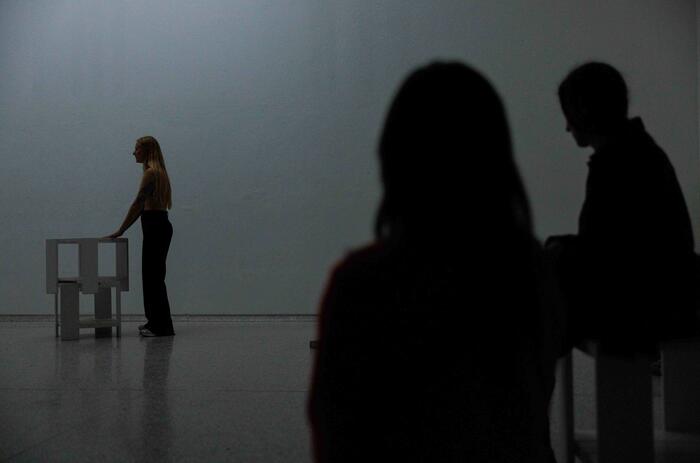
An orderly, Dutch line. A pavilion, white, tall and closed. We were given generic instructions: no filming, keep silent, respect the tempo of the piece. All the visitors entered together and we followed the implicit choreography, finding where to place ourselves in the space. There is something terribly solemn in performances that make room for waiting, that builds tension.
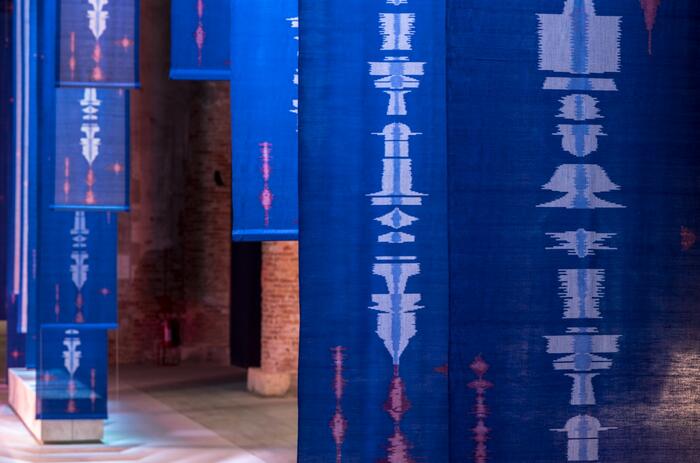
An overhead summer sun, harsh and multiplied by the closeness of the water, beat down on us in the streets, bridges and canals of Venice caught in a heat wave. We were looking for shelter, and then darkness. And then, a panel, an immersive installation by Khaled Sabsabi that glowed in the middle of the entrance to the exhibition. Colors, slow movements, spectral sounds. Can we also imagine, perhaps, certain scents? This is the solemn entrance to the Arsenale in the 2026 edition of the Venice Biennale exhibition.
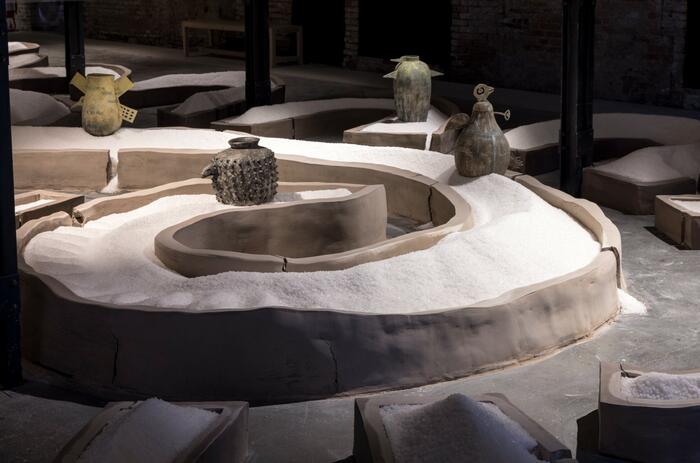
Through a ritual ecosystem of materials, sound, and gesture, RojoNegro's proposal for the Mexican Pavilion opens a space of pause and listening in the face of the saturation of the contemporary world.
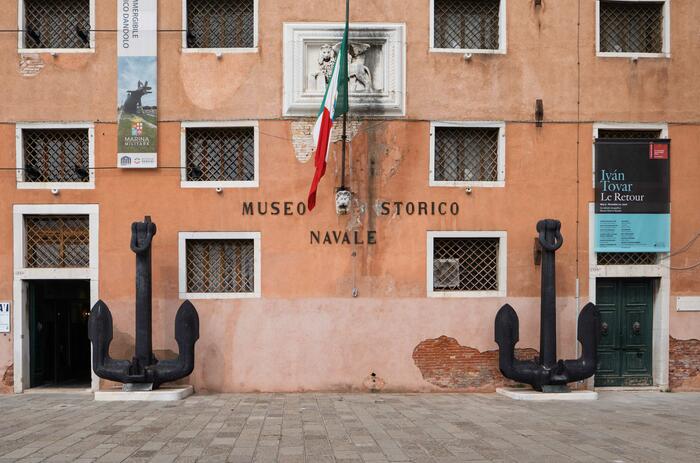
The Iván Tovar Foundation presents Le Retour, a collateral event of the 61st Venice Biennale that repositions the Dominican artist within the global history of Surrealism.