

By
Mercedes Abella

In Minor Keys is the title Koyo Kouoh chose for the Biennale we now read in the light filtered through her branches. What was she telling us? In this piece I reflect on its meaning and on the possibilities artists sow as they resignify the structures of our modernity. It is a walk through six works understood as ecologies, in the way philosopher of science Isabelle Stengers conceptualized it.
Koyo Kouoh and her curatorial team invite us to tune in to the frequencies of minor keys: the moment when emotion is a sign of life and metaphor becomes a tunnel into alternate worlds, worlds undreamt and yet thought through in detail. On the curatorial map Kouoh leaves us we find small islands with ecosystems of their own, stretching out between political seas and currents of power to create oases, gardens and mangroves of possibility. Among them sails the frequency of this Biennale in minor keys, blurred as if by a kaleidoscope, or broken up by the branches of a great tree.
Twenty-three years ago Isabelle Stengers described her own way of thinking in minor keys. Calling herself a daughter to philosophy, she argued that to understand the world through grand universal logics is to suffocate it, whereas seeing it as a set of ecologies, each with its own particularities, opens its infinite possibilities to exploration. Kouoh proposes the same thing when she writes that if minor keys in music tend to be associated with “strangeness, melancholy and sorrow, here their joy, solace, hope, and transcendence manifest as well”. This is why, projected as ways of feeling and thinking that seep through cracks, the minor key is an expression of desire. Desire that germinates and blooms where there is love and where there is magic, as Toni Morrison declares, the first Black woman to receive the Nobel Prize in Literature, portrayed alongside Koyo Kouoh by María Magdalena Campos-Pons.
The garden is one of the oldest metaphors ever used against us women. Between biblical accounts and love poems and paradises, spring perfumes deceive us and we are built as domains of land to be owned, seeded, decorated and enclosed. From the hortus conclusus onward, tradition turned the female body into terrain and terrain into property. The attributes of the minor key reached her through diaphanous percolation: affection, care, memory, the capacity to hold life amidst putrefaction. The six artists in this article embody that metaphor and resignify it: soil turns into creation, sorrow into color, and time into connection. The curatorial text says as much of the creole garden, “where material and imaginative freedom emerge dialectically in the midst of restriction.” Dialogue should not be synthesized, Stengers would say, nor contradiction resolved into a single destination, just as the works described here do not add up to a single feminine coherence. What prevails instead is a diversity of poetics that let us feel the subtlety of belonging.
I chose six works that correspond to different ways of making and being a garden. Two of them spill beyond the international pavilion: Sara Flores shows in the Peruvian pavilion, and Elegy was censored out of the South African pavilion by the Minister of Sport, Arts and Culture, Gayton McKenzie. That overflow is part of the argument, given that minor keys cross institutional perimeters the way roots crack stonewalls.
The garden as space
Stengers uses the term technology of belonging for that which addresses people not for what they are but for what they become able to do, feel and think because they belong. The first three works are built on that logic.
1. At the entrance to the pavilion in the Giardini, Seyni Awa Camara’s sculptural bestiary introduces a world of thresholds. Beings that never conclude beginning to be, made from clay sourced from the mangroves of southern Senegal, telling stories of kinship, of food and of care. The craft came to her through her mother and through a long line of sculptors in the family. It is the most literal example of what Stengers calls thinking par le milieu, through the middle and with the surroundings: no position grants the power to disentangle something from its particular surroundings. The clay, the mangrove, the mother and the daughter are one and the same gesture.
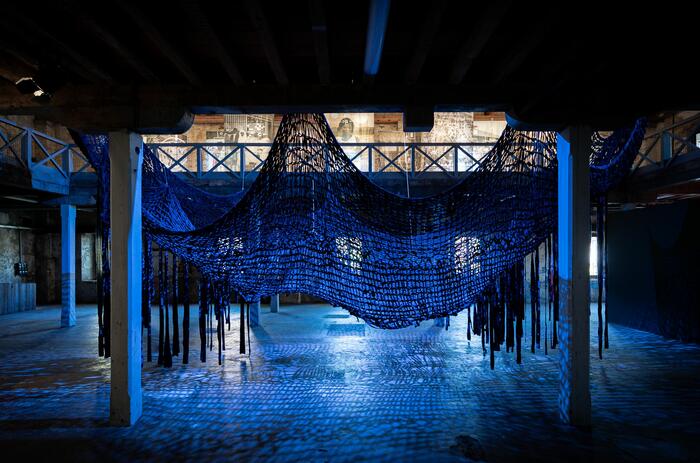
2. In Omo Elu, Tabita Rezaire hangs panels dyed in deep indigo that invoke Yemoja, the Yoruba mother of the sea and of life, stormy and healing. She is joined by the trinity of mothers: Earth blesses the gardens of food and medicine, Moon blesses fertility, mother Sun blesses the constellations. The work operates as an island of affect, a pause in modern tensions in order to reconnect with regeneration and care. That pause is the acknowledgment of affects, of the relations that, according to Latour, the modern European cauterized in order to free himself from ecological and folkloric obligation. The locus of devotion Rezaire creates is therefore a garden of fertile possibility grown out of what roots us.
3. Anatomy of the Magnolia Tree for Koyo Kouoh and Toni Morrison, by María Magdalena Campos-Pons, portrays the first African woman to curate the Biennale alongside the first Black woman to receive the Nobel Prize in Literature. Grace Aneiza Ali describes the work as anchored in the solidarity among Black women. The magnolia holds up the scene: a twenty-million-year-old plant, hardy, which in the United States South condenses hospitality and a certain idea of feminine elegance, two courtesies that served for centuries to decorate violence. Campos-Pons gives the tree back what it once was, a symbol of fertility for thought and of the cyclicality of memory.
The garden as a way of being
There are other spaces, imaginative and potential, that are inhabited inward. A design that exists first in the imagination and is only after projected; a shared note that travels and holds common griefs, a body that is at once desired terrain and territory of its own.
4. Sara Flores is the first Indigenous artist to represent Peru at the Biennale. From her pavilion, the Shipibo-Konibo episteme and its inherited, living language find a scale of attention no ethnographic display ever gave them, resting on kené as a system of transmission, resistance and communication between spiritual and material worlds. Its making is sustained by grandmothers, mothers and daughters who materialize their imaginative projections. This is why it troubles me that the institutional text speaks of an “elevation” of kené. Elevation toward where, if the whole of kené already preexists our world in potential? The objection is Stengersian: thinking par le milieu means thinking without founding materialities and without an ideal horizon. Flores does not propose other ways of seeing the world, but the possibility of inhabiting Otros Mundos, as the show is titled, where the ancestral and the future converge in interconnection and eco-dependence.
5. Amagugu, by Buhlebezwe Siwani, presents six African women, nude and adorned with flowers and other divine elements. Siwani appropriates Renaissance portraiture and chiaroscuro to crystallize histories of colonization and to question the objectifying gaze on expropriated bodies, mirroring the extractivist logics that still govern the expectations placed on non-hegemonic bodies. Stengers describes the modern who believes himself a nomad, free to enter any territory not his own in order to judge or disqualify it, breaking attachments without a second thought. That is the genealogy of the gaze Siwani intercepts. Chiaroscuro was the technique with which Europe learned to illuminate what it wanted to possess; here the light falls where she decides, and the nomad stays at the door.
6. Elegy, by Gabrielle Goliath, censored from its pavilion and devastating in its depth, was exhibited at the Chiesa di Sant’Antonin, where it co-created a space of mourning to commemorate victims of femicide and genocide. A single note sustained by different women traces transgeographic connections through pain. Several bodies, one voice, one cry. The sound links lives lost to femicide, homophobia and genocide into a network of resistance and memory. In the guestbook, someone left a dedication to those who suffer despite their innocence, to women and girls, to those who live in pain; another person thanked the work and asked for solidarity. Stengers distinguishes between being part of and belonging, and says that you do not belong without knowing that you belong. That book is the material record of such knowing, and of the obligation it generates: because I belong, I can and must do what I otherwise could not. We wrote: “We found it by chance without knowing we were looking for it. Thank you. From Argentina, an embrace to all women.”
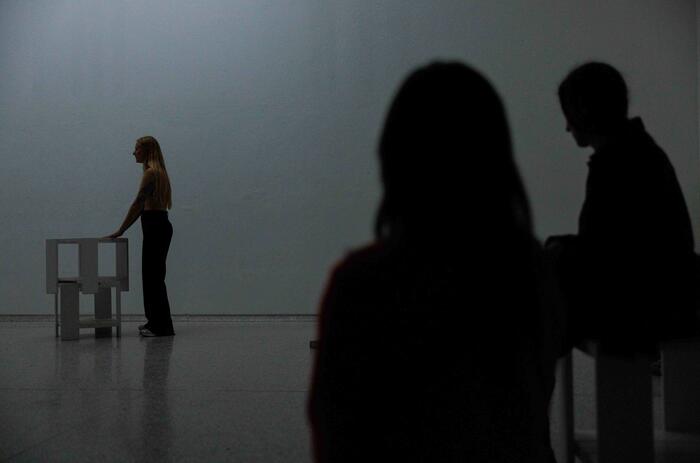
An orderly, Dutch line. A pavilion, white, tall and closed. We were given generic instructions: no filming, keep silent, respect the tempo of the piece. All the visitors entered together and we followed the implicit choreography, finding where to place ourselves in the space. There is something terribly solemn in performances that make room for waiting, that builds tension.
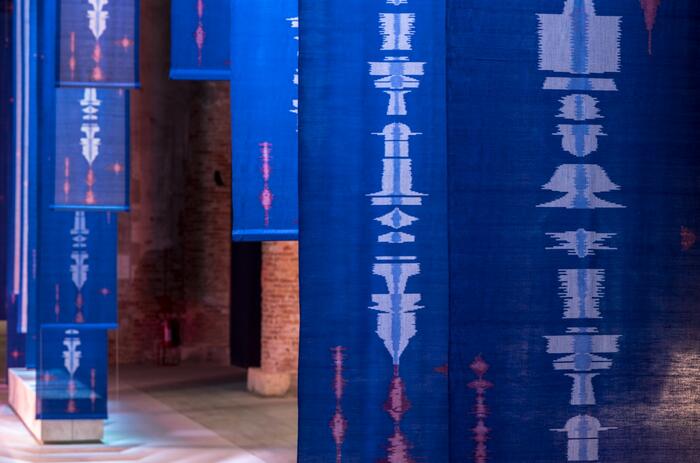
An overhead summer sun, harsh and multiplied by the closeness of the water, beat down on us in the streets, bridges and canals of Venice caught in a heat wave. We were looking for shelter, and then darkness. And then, a panel, an immersive installation by Khaled Sabsabi that glowed in the middle of the entrance to the exhibition. Colors, slow movements, spectral sounds. Can we also imagine, perhaps, certain scents? This is the solemn entrance to the Arsenale in the 2026 edition of the Venice Biennale exhibition.
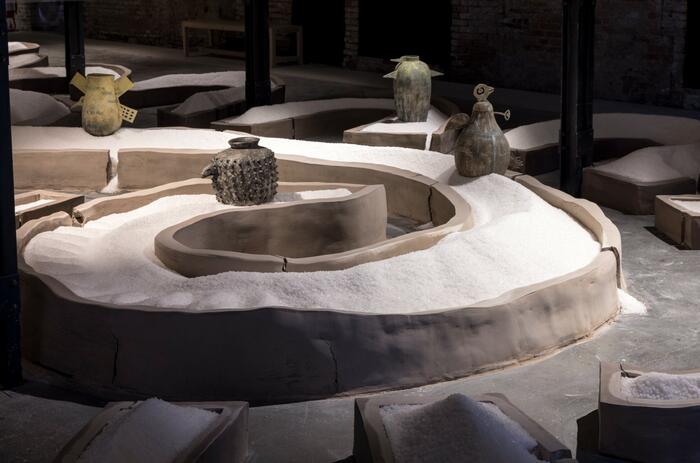
Through a ritual ecosystem of materials, sound, and gesture, RojoNegro's proposal for the Mexican Pavilion opens a space of pause and listening in the face of the saturation of the contemporary world.
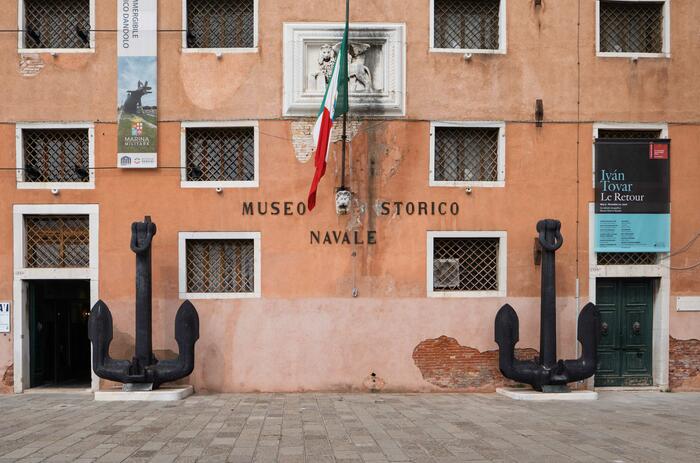
The Iván Tovar Foundation presents Le Retour, a collateral event of the 61st Venice Biennale that repositions the Dominican artist within the global history of Surrealism.
In line with the theme of the 61st edition, the duo Messengers of the Sun turns hyperstition into a tool for rewriting an untold story: that of the peoples displaced by a mythologized feat of engineering.

Growing Deep Roots, curated by Meredith Malone, brings together sculpture, drawings, and video, tracing water stewardship, ecofeminism, and just energy transition.
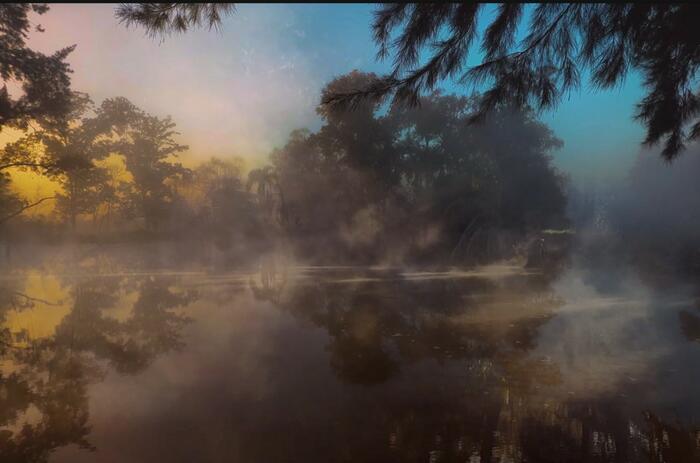
Suave es la noche, by Silvana Muscio, and Trago Amargo, by Claudia Coca and Claudia Casarino, propose two distinct ways of inhabiting memory from Buenos Aires: one sensory and oneiric, the other historical and colonial.
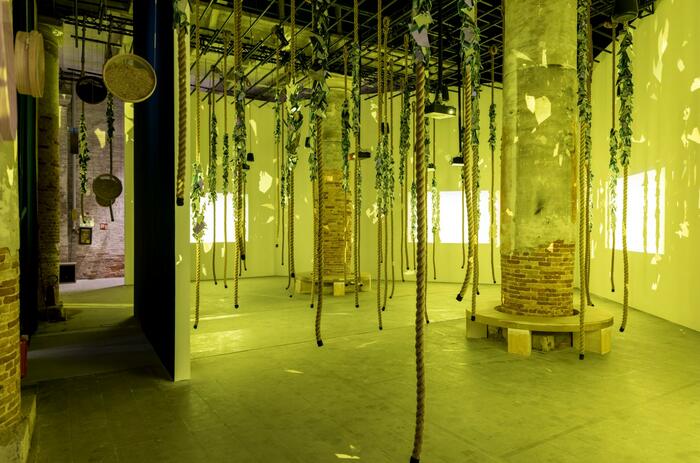
From the ghosts of cyberspace to the Orixás, the Venice Biennale builds correspondences between visible and invisible worlds.
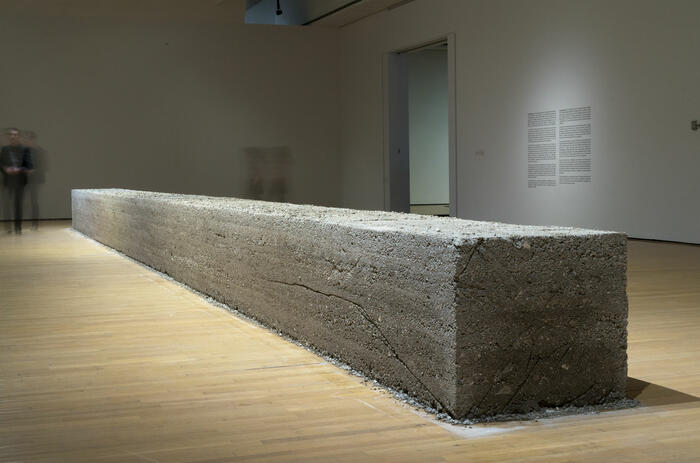
The exhibition spans three decades of works addressing disappearances, femicides, and forced displacement, with a focus on the border between Mexico and the United States.