SIGN, STONE, AND TIME: A CONTEMPORARY EXHIBITION IN CANTABRIA
Cave Art Centre of Cantabria 'Alberto I de Monaco' in Puente Viesgo is hosting its first-ever contemporary art exhibition.
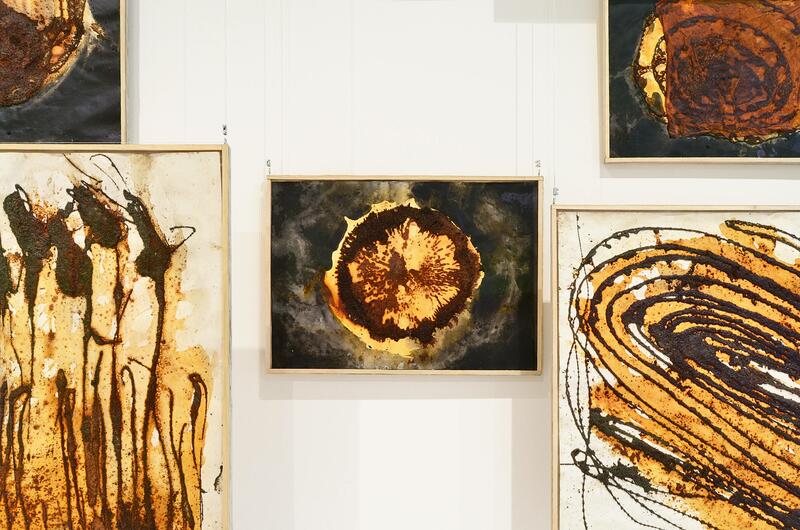
In this setting—where nature and human history converge—María Villacorta (Arce, Cantabria, 1991) presents Tiempo y profundidad (Time and Depth), an exhibition that invites viewers into a synchrony between past and present. Using mainly recycled iron—a recurring material in her practice—and various types of paper, Villacorta incorporates time itself as another material at play.
These seemingly contrasting elements merge into a resilient “skin” that, depending on light, distance, and perspective, reveals layers, textures, and subtle shifts. The resulting shapes, born of both chance and control, recall the essential forms of prehistoric art: the sign.
-
María Villacorta: Tiempo y profundidad, en El Centro de Arte Rupestre de Cantabria. © Miguel de Arriba
-
María Villacorta: Tiempo y profundidad, en El Centro de Arte Rupestre de Cantabria. © Miguel de Arriba
-
María Villacorta: Tiempo y profundidad, en El Centro de Arte Rupestre de Cantabria
-
María Villacorta: Tiempo y profundidad, en El Centro de Arte Rupestre de Cantabria
Alongside her works on paper, the Cantabrian artist also presents a series of sculptures made from recycled metal. Their surface treatment gives them a stony texture, evoking the rocky walls of ancient caves—timeless witnesses and connectors between us and our earliest ancestors.
These works take us back to the origins of art over 50,000 years ago, to the ancestral gesture of the first human interventions on cave surfaces. It is a kind of “archaeology of consciousness”—a connection between language, nature, humanity, and time. They evoke the sensations our ancestors may have felt when selecting a cave wall to paint a sign, trace an animal, or imprint a hand. Something deep within our DNA seems to resonate with these gestures, awakening a mysterious and intuitive affinity.
-
María Villacorta (Arce, Cantabria, 1991)
According to the artist, “The exhibition explores both a lithic and an anthropological landscape: the stone as protector, refuge, fortress, and witness to wars and erosion. It addresses the formation and transformation of the great rock—guardian of time—that transcends all human scale. These works arise from contemplating the landscape, from its erosion by sculptural hands. They inhabit the wild terrain between creation and the destruction of civilizations that have settled on it without impunity.”
María Villacorta holds a degree in Fine Arts from the Universidad Complutense de Madrid and the Accademia di Brera in Milan. She received a university scholarship from the Botín Foundation. Her solo exhibitions include gotasaladas at CACFM, Medium at Los Arenales, and SeaLevel in Comillas. Together with artist and architect JL Zúñiga, she runs an intergenerational, multidisciplinary studio engaged in installation, architecture, design, and socially-driven projects. Their collaborations have been featured in national and international residencies and exhibitions, including Caminantes, which travelled from Spain and Italy to Colombia as part of the Bienal Sur with the Pilar Brahim Foundation, and Espacio Deriva, presented at COP26 and the University of Ljubljana.
The exhibition was curated by fellow Cantabrian Míriam Callejo and organized in collaboration with the Department of Culture, Tourism and Sport of the Government of Cantabria.
Tiempo y profundidad remains on view until 30 November at the Cantabrian Centre for Rock Art ‘Albert I of Monaco’, Diseminado Puente Viesgo, 26, Puente Viesgo, Cantabria, Spain.
May interest you

MARCO HOSTS THE POETICS OF LAURA LIO
MARCO, the Museum of Contemporary Art in Vigo, presents Savia y sangre (Sap and Blood), a solo exhibition by Laura Lio (Buenos Aires, Argentina, 1967), which reveals the artist’s social vision and commitment through her work. Lio's practice involves a meticulous observation of certain organic and natural processes in search of a kind of internal order. With a poetic approach, the Argentine artist based in Spain challenges this natural structure through visual language and words.

SPACE AND REPETITION IN FAUSTO AMUNDARAIN, AT BIBI + REUS
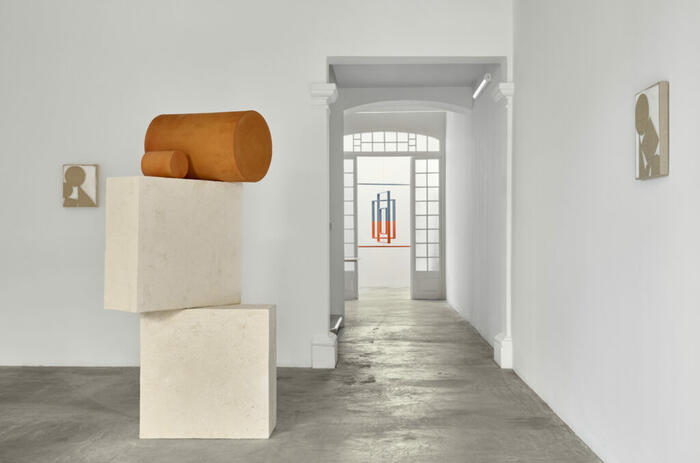
DIMENSION AND ARCHITECTURE IN JOSÉ DÁVILA, AT ALBARRÁN BOURDAIS
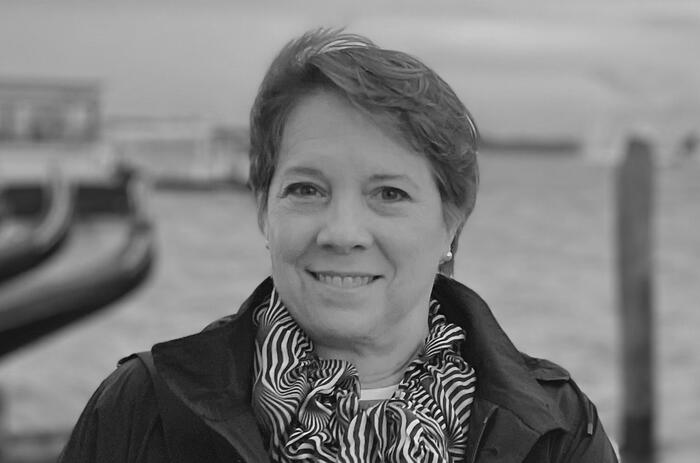
MÓNICA KUPFER: “IT’S NOT ENOUGH TO EXHIBIT ART, WE NEED TO WRITE ITS HISTORY”
For over four decades, Mónica Kupfer has been researching, writing, and curating exhibitions that seek to tell a story of Panamanian and Central American Art that is still under construction. She played a key role in the first edition of Pinta Panamá Art Week, where she coordinated FORO—a regional discussion platform that brought together artists, curators, collectors, and institutions.
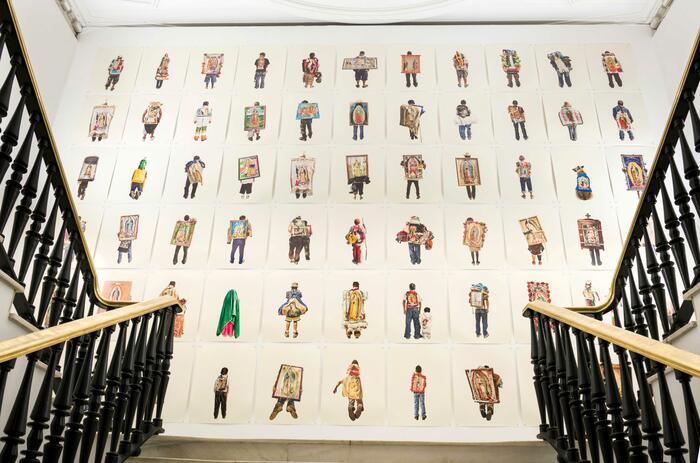
THE VIRGIN OF GUADALUPE: BETWEEN CRAFTS AND ANTHROPOLOGY
By Álvaro de Benito
The Casa de México Foundation in Spain presents Guadalupe. La Virgen de México (Guadalupe. The Virgin of Mexico), an extensive program of exhibitions and activities centered around one of Mexico's most iconic and anthropologically significant figures. In addition to lectures and various screenings, the program revolves around two main themes: craftsmanship and popular culture on one hand, and anthropology on the other.

PEMJEAN AND HIS RECONSTRUCTION OF SPACE FROM MEMORY AT COAM
The Official College of Architects of Madrid (COAM) is hosting No tan lejos (Not So Far Away), an exhibition by Emilio Pemjean (Santiago, Chile, 1971), which continues to explore his characteristic artistic approach that blends photography, design, architecture, and painting. In this exhibition, the Chilean artist presents a series of imagined and reconstructed spaces, virtually brought back to life through memory, which makes their reconstruction possible.

CHAOS AND TECHNOLOGY BY SANTOSCOY, AT THE MUSEUM OF AMERICA
The Museum of America is hosting an exhibition of paintings by Juan Carlos Santoscoy (Guadalajara, Mexico, 1973) in its La Tapada gallery, open until the end of the month. Titled Algoritmos del caos (Algorithms of Chaos), the show features a selection of the artist’s most recent large-scale works, which engage with pressing themes in contemporary art such as global warming and the overexploitation of natural resources.

CARLOS MOTTA'S ANTHOLOGICAL EXHIBITION AT MACBA
Barcelona’s MACBA is hosting Plegarias de resistencia (Prayers of Resistance), the first major anthological exhibition of the work of Carlos Motta (Bogotá, Colombia, 1978) to be held at a European institution. The presentation spans more than twenty-five years of the artist’s production, practice, and activism.

A TECHNOLOGICAL GAZE AT THE PARIETAL ART BY SOFÍA CRESPO
Sofía Crespo (Buenos Aires, Argentina, 1991) often centers her work on the use of biology-inspired technology. In her exploration of the common ground between artificial intelligence and the way it generates images, on the one hand, and human perception of the environment, on the other, there is a turning point in the Argentine artist's practice.