
By
Antonio Arévalo
THE THREAD THAT DOES NOT BREAK THIRTY YEARS LATER AT THE CASTELLO DI RIVOLI
May 12, 2026
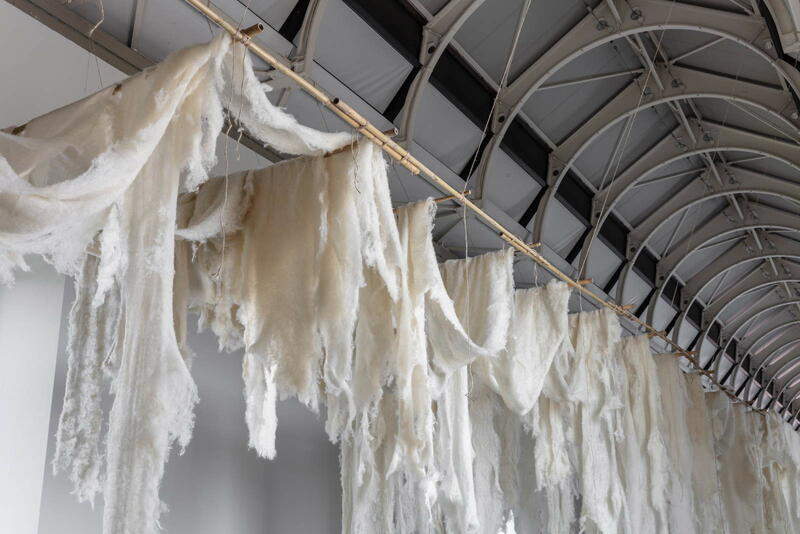
Cecilia Vicuña, El glaciar ido, 2026; veduta dell'allestimento al Castello di Rivoli Museo d'Arte Contemporanea, Rivoli - Torino. Photo: Sebastiano Pellion di Persano © Cecilia Vicuña, by SIAE
There are encounters that do not occur in the present, even though they happen there. They open, rather, like a crack in time where what has been lived and what has been forgotten recognize each other without announcing themselves. That was my visit to the Castello di Rivoli, in Turin, to meet again with Cecilia Vicuña. It was not simply an appointment with an artist, but with a suspended memory that had been breathing elsewhere for more than thirty years.
I have known Cecilia for more than three decades. We wrote to each other for a time—letters that today I imagine as small verbal quipus, knots of language that sustained a relationship in transit. Then, as almost always happens, life imposed its movement: to go on also implied forgetting. Or, more precisely, ceasing to name. Because certain presences do not disappear; they sediment.
To arrive at the Castello di Rivoli is already to enter a tension between epochs. The building, suspended between its baroque past and its current condition as a museum of contemporary art, functions as a threshold. One ascends not only physically, but also toward a different form of perception. From its windows, the landscape of the Susa Valley unfolds like a silent extension of what takes place inside: a geography where time has left visible marks.
Enlarge image
-
Cecilia Vicuña, El glaciar ido, 2026; veduta dell'allestimento al Castello di Rivoli Museo d'Arte Contemporanea, Rivoli - Torino. Foto: Sebastiano Pellion di Persano © Cecilia Vicuña, by SIAE
-
Cecilia Vicuña, El glaciar ido, 2026; veduta dell'allestimento al Castello di Rivoli Museo d'Arte Contemporanea, Rivoli - Torino. Foto: Sebastiano Pellion di Persano © Cecilia Vicuña, by SIAE
-
Cecilia Vicuña, El glaciar ido, 2026; veduta dell'allestimento al Castello di Rivoli Museo d'Arte Contemporanea, Rivoli - Torino. Foto: Sebastiano Pellion di Persano © Cecilia Vicuña, by SIAE
There, in the Manica Lunga—that prolonged corridor that seems never to end—Cecilia has installed The Disappeared Glacier. The title is already a warning: what is seen is also what is missing. The work, conceived as a suspended horizontal quipu, crosses the space like a held breath. There are no knots. And that absence is, perhaps, the most radical gesture.
I remember her first explorations in the 1960s, when she began to think of art from the precarious. Not as lack, but as potency: that which exists in its fragility, in its ephemeral condition, in its dependence on the world. In Rivoli, that poetics reaches an almost spectral form. The raw fibers, unbleached, hang and intertwine without fully fixing themselves, as if the air itself participated in their construction.
As I walk through the installation, I think of what Cecilia said about “I go to, I come from.” That double direction that dismantles any fixed identity. Are we transit? Are we merely the echo of a movement? The quipu, deprived of knots, seems to respond: we are also what is lost along the way.
We meet at one end of the corridor. There is no drama in the reunion, nor any need for explanations. We greet each other as if we had spoken yesterday. There is something in certain relationships that resists chronology. Cecilia smiles with that mixture of lucidity and astonishment that has always characterized her. She speaks about water.
Enlarge image
-
Cecilia Vicuña, El glaciar ido, 2026; veduta dell'allestimento al Castello di Rivoli Museo d'Arte Contemporanea, Rivoli - Torino. Foto: Sebastiano Pellion di Persano © Cecilia Vicuña, by SIAE
The Disappeared Glacier is not only a metaphor. It is a statement. The ice that once shaped the landscape of the Susa Valley is no longer there. But its absence remains active, like a geological memory. Cecilia links that disappearance with another: that of sacredness. “We have forgotten that water was sacred,” she says. And in that phrase resonates not only an ecological critique, but also a spiritual one.
Her thinking—as I now recall it more clearly—has always sought that improbable crossing between indigenous knowledge and quantum physics. Two ways of understanding the world that, in appearance, should not meet, but that in her work dialogue naturally. Both recognize the interconnection of everything that exists. Both distrust rigid certainties.
During her stay in Colombia, in the 1970s, she developed palabrarmas: an attempt to unite language and image as a strategy of resistance. Today, those explorations seem to have mutated into something broader. The quipu is no longer only a system of record; it is a form of relation. A weaving that involves bodies, places, histories.
In the exhibition, in addition to the main installation, there are videos, sounds, songs. Cecilia’s voice appears and disappears like another thread within the weave. Her wall poems, written especially for this occasion, do not seek to impose themselves on the space, but to inhabit it. To read them is an almost tactile experience.
I think of her trajectory: from the group Tribu No in the 1960s, through exile after the coup d’état in Chile, her time in London, her connection with Artists for Democracy, up to her most recent international recognition, including the Golden Lion at the Venice Biennale in 2022. And yet, there is in her a persistent will to remain at the margins of certain logics of contemporary art. As if her practice could not be fully absorbed by the system that exhibits it.
We walk together along a stretch of the Manica Lunga. We speak little. There is no need. There is something in the space that invites silence, or rather, another form of listening. The quipu seems to respond to imperceptible movements: a current of air, a step, a presence.
I ask her about the absence of knots. Cecilia says that it is a way of speaking about the loss of memory. But also, she adds, about the loss of attention. Not only have we forgotten; we have stopped looking. In that sense, the work is not nostalgic. It is a warning.
As I moved forward, I thought of another geography. Of Chile. Of Latin America crossed by dictatorships, by violent interruptions, by languages that had to learn to survive outside their territory. I thought about how those stories arrive here: displaced, translated, many times deactivated.
I have known Cecilia since before this type of scene. Our relationship did not begin in an exhibition hall, but in distance. I in Europe, she in America. We wrote to each other. Letters that took time, that crossed oceans and controls, that did not always arrive. In those letters there was no theory of exile: there was concrete life, fragmented by history.
In that time, names like Roberto Bolaño also appeared as part of a dispersed constellation. We were not a group, nor an organized generation. We were rather bodies thrown into different points on the map, trying to sustain a common language while everything around was decomposing.
The quipu without knots is also an impossible record, a history that cannot be completely told. What is missing is not only information, but bodies, voices, lives.
As I leave the room, the landscape imposes itself again. The mountains, the sky, the distance. I think of the glaciers that are no longer there, of the letters we stopped writing, of the conversations that remained suspended. And yet, something persists.
To see Cecilia again has not been an act of recovery, but of recognition. As if that which seemed forgotten had always been there, waiting for a way to reappear.
Perhaps that is, finally, what her work proposes: not a fixed memory, but a field of relations in constant transformation. A quipu without knots, where each thread continues to vibrate, even if we do not know exactly what it holds.
As we say goodbye, there are no promises. Only a shared awareness: time is not linear. And there are encounters that, even after decades, do nothing but begin.
May interest you
News
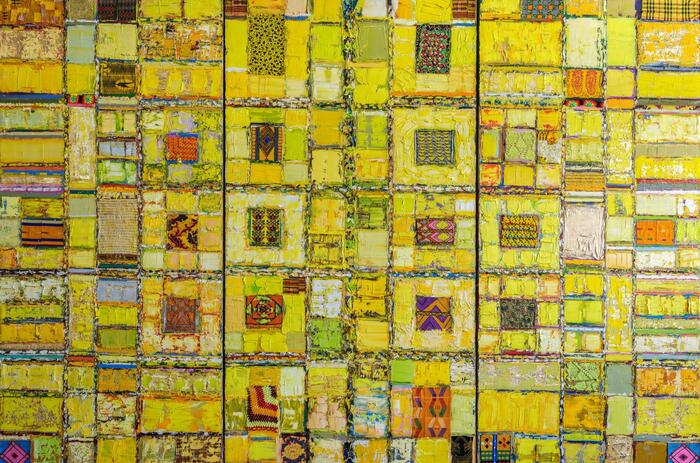
SILENCE HAS MATTER: ETHIOPIA BRINGS THE WORK OF TEGENE KUNBI TO THE VENICE BIENNALE
The exhibition offers a political reading through paintings that bring together sacred, industrial, and domestic textiles within a single visual field.
News
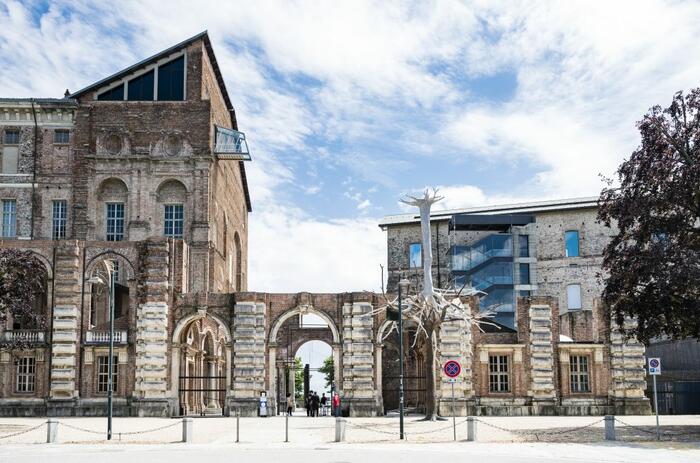
A CONTEMPORARY QUIPU TRAVERSES CASTELLO DI RIVOLI
The Chilean artist Cecilia Vicuña unfolds an intervention connecting ancestral practices, ecology, and shared memory.
News
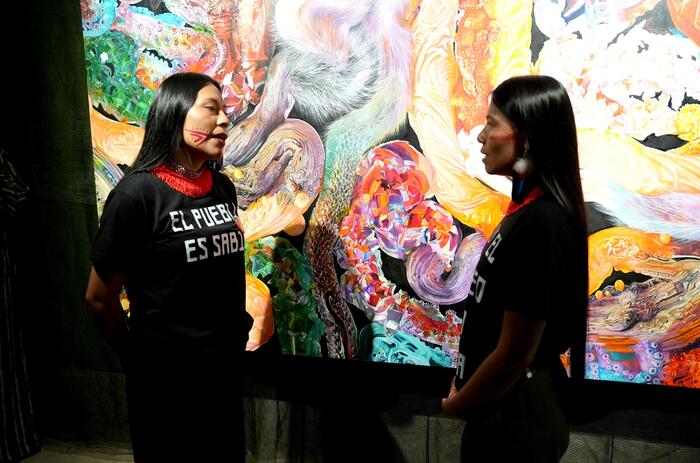
ECUADOR UNVEILS “KANUA” IN THE CANALS OF VENICE
In the run-up to the Venice Biennale, the Ecuador Pavilion project offers solar-powered boat tours and intimate conversations about extractivism, rivers, territories, and ways of life in the Amazon.
News
THE VENICE BIENNALE IN AN EDITION MARKED BY POLITICAL GAMES
The Venice Art Biennale is approaching the inauguration of its 61st edition amid resignations, protests, and controversies. Never indifferent to its time, its launch also converges within an intense context of wars, genocides, and geopolitical crises. From Arte al Día, we ask ourselves: how can we trace the relationships between politics and art?
News
CHILE AT THE 2026 VENICE BIENNALE: NORTON MAZA PRESENTS "INTER-REALITY"
The proposal selected for the Chilean pavilion brings an immersive experience in Venice that addresses contemporary tensions.
News
ROCKS, CEMENT AND THREADS: THE INVISIBLE FORCES OF MATTER AT MAC SANTIAGO
Emilio Fuentes Traverso imagines, in his new exhibition in Chile, possible encounters between the natural, the anthropic and the cosmic through sculptures in unstable equilibrium that compress millions of years of transformation into suspended objects.