SKIN (NOTES ON THE DISAPPEARING PAINTING)
During the last years painting has continued its course in permanent metamorphosis, adapting to the times, reviving from its previous deaths, stripping itself of accessories, undressing and even disappearing. A part of this process has focused on the mechanisms of production; the other, has been accompanied by an intense reflection that goes beyond painting and meditates on the status of image.
Beyond (or very close) the stretcher, the canvas, the pigments and the frame, the image prevails; sometimes in an emphatic way, other times as a detached skin from that provisional architecture that supported and framed it; that forced it to a perennial tension, proper to its condition as a false window in the rooms of art.
The problem of the image has always been that of making the visible appear; not that of its way of being or of presenting itself to the world. Thus, that objectual condition that reduced it to a frame is something transitory that conceals an increasingly evident reality: painting is nothing more than a flexible layer to which an image adheres, even when it seems to be absent.
In 1958 the Argentine artist Lucio Fontana (Rosario, 1899 - Comabbio, 1968) began his paintings with slashes and perforations as part of his spatialist doctrine. He does not use brushes but sharp instruments to pierce the surface. There are no contours but incisions. When the fictitious window of the painting is violated, the only reality that constitutes it appears and that derives precisely from the emptiness that emerges behind the cracked skin of the painting. These cuts and orifices pierce the illusoriness of the pictorial plane, revealing the torn veil of a fictitious reality. Instead of the false depth of traditional representations, what is there is the emerging imprint of a criminal gesture; an open scar on the body of the work.
-
Lucio Fontana. Concetto spaziale, Attese,1965. Water-based paint on canvas, white. 51 3/16 x 38 3/16 inches. The Solomon R. Guggenheim Foundation Gift, Fondazione Lucio Fontana,1988.
-
Lucio Fontana. Manifiesto Blanco, 1946.
-
Portrait of Lucio Fontana by Ugo Mulas, L’Attesa, 1965. Gelatin silver print on baritated paper on board, 18” x 13".
-
Lucio Fontana piercing the work of his friend Jef Verheyen. Belgium, 1962.
In a later gesture, the Brazilian Vik Muniz (São Paulo, 1961) questions Fontana's presumption by converting the cracked canvas into a photograph where the depth of the cut is suppressed. Muñiz's operation brings us back to the illusory surface that Fontana wanted to transcend, thus putting the utopian model that sustained him in quotation marks. If penetrating the plane meant abandoning the limits of the painting, the photograph ironically restores the idea of painting as artifice. Everything remains on the surface, as if every effort to go beyond conventional vision ends up becoming the simulacrum of an impossibility. Is this not the failed destiny of modern painting?
-
Vik Muniz. Spatial Concept, Expectations, after Lucio Fontana (Pigment Paintings), 2007. From an edition of 6 + 4 AP. Chromogenic print, 71 x 71.5 inches. Jiménez - Colón Collection.
-
Vik Muniz. Pictures of Magazine: Origin of the World, after Courbet, 2013. Digital C-print, Edition of six. 180 x 220 cm, 70 7/8 x 86 5/8 inches.
-
Vik Muniz Double Mona Lisa (Peanut butter and Jelly), from the series After Warhol, 1999. Digital C-Print 49.6 x 61.4 x 1.9 inches © Vik Muniz / Galerie Xippas, Paris.
Other attempts have reiterated that definitive truth in which painting is not the "painting" but the skin that clings to any physical surface or levitates in the ungraspable space of an idea. Everything else-frame, stretcher, wall-is accessory, ornament, parergon; that is, the periphery of a disembodied edge.
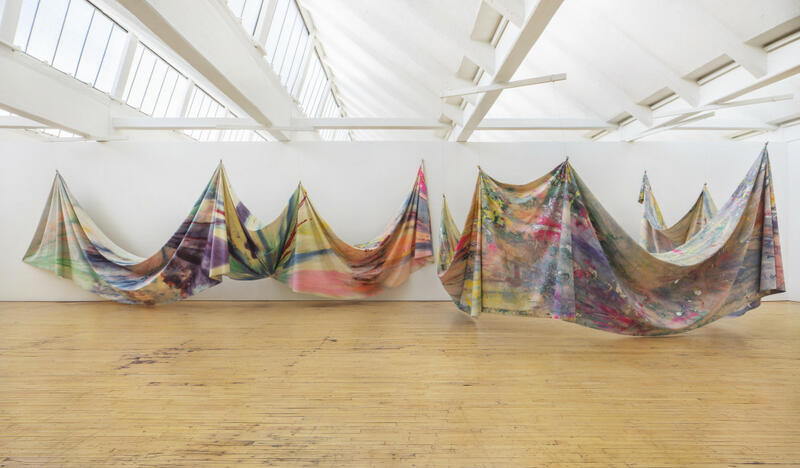
For Sam Gilliam (Mississippi, 1933- Washington, D.C., 2022) the frame of the painting is not the frame that delimits the stretcher but the space where the work is located. His drapes canvases, begun around 1965, unfold like skeletonless skins. In this way Gilliam makes a leap from the conventional support of painting to the three dimensions, remaining only with the surface; that weightless piece of skin that floats in space without a rigid structure that sets a limit. The suspended canvas, free of tension, forms the flexible body of the work. Its extension is variable, capricious. Docile to the canvas’ folds, the painting molds itself to the flaccidity of the support. More than a veil, it is a shroud; a record of the artist's activity, a document of a ritual.
-
Sam Gilliam. Light Depth, 1969. Draped canvases. Hirshhorn Museum and Sculpture Gallery.
-
Sam Gilliam. Double Merge,1968. Installation view, Dia-Beacon, Beacon, Nueva York, 2019. Photo: Bill Jacobson Studio, Nueva York.
-
Sam Gilliam. Carousel, 1969. Acrylic on canvas, Walker Art Center.
-
Sam Gilliam’s Carousel Form II, 1969. Acrylic on canvas. Photograph: Courtesy of the Speed Art Museum.
-
Sam Gilliam with his 1973 painting “Autumn Surf”. Source: ArtNews.com
Another example of the gradual abandonment of the objectuality of the painting and the progressive liberation of the image is the case of Venezuelan artist Eugenio Espinoza (San Juan de los Morros, 1950) with his seventies grids and the "veiling" works of the Orla series in the mid-nineties, as well as the sustained and "aluminized" paintings he produced years later. Everything there takes place on the surface, whether on the undulating weave of a canvas or on the rigid texture of the wall, where the work and the support are almost the same thing, making it clear that what is usually recognized as a painting is only a film clinging to a surface. The rest is dispensable.
-
Eugenio Espinoza. Untitled, 1973. Performed as part of Textiles grids post cards. Conkright Gallery.
-
Eugenio Espinoza. Untitled (Circunstancial) [12 coconuts], 1971. Installation view of the Salón Nacional de Jóvenes Artistas, Casa de la Cultura, Maracay, 1971. Acrylic on canvas, coconuts and rope.
-
Eugenio Espinoza. Walking in progress, 2018, Le Scalze, Napoli, Italy. In situ installation. Dimensions variable.
-
Eugenio Espinoza. Walking in progress, 2018, Le Scalze, Napoli, Italy. In situ installation. Dimensions variable.
In the previous proposals, the canvas is free from the frame, presenting itself "naturally", assuming the soft gravitation that its weight allows it. And on it, the image -transferred, painted or drawn- sits docilely. Besides, the image lays as a disembodied contraption, its thin matter is almost the same as that of its temporary vehicle.
We could say then that the painting is only the humble facilitator of the image, its discreet servant, so that the latter has a receptacle to hold on to momentarily. It is true that this lapse of temporariness can last for centuries, as it happens with the presumed shroud that retains the face of Christ. However, this is a theorem that we will not discuss here. For the moment it is enough for us to know that all that stripping, that nakedness, forces us to rethink painting as the support of a bodiless entity, always in transit to another part.
Related Topics
May interest you
REVISING THE CANON AND RESHAPING ACADEMIA
The NSU Art Museum in Fort Lauderdale exhibits Lux et Veritas. This collective show illustrates some of the facets in contemporary art which are in processe of reshaping and reframing.
SUEÑOS ILUSTRADOS BY ÁLVARO BARRIOS: A COMBINATION OF ARTISTIC LANGUAGES
Fundación Canaria para el Desarrollo de la Pintura (FCDP) presents for the first time, an exhibition by the Colombian artist Álvaro Barros in the Canary Islands. Barros' work is a fusion of different expressions and traditional modern art techniques placed at the service of conceptual art.
CARMELO ARDEN QUIN’S PAINTINGS AND TRANSFORMATIONS
Buenos Aires - The Museo Nacional de Bellas Artes inaugurated the exhibition "Carmelo Arden Quin, in the plot of constructive art", which offers an overview of the Uruguayan master's production through a hundred works from different periods of his career, exhibited along with pieces by colleagues with whom he forged links and joined artists groups. Curated by Cristina Rossi and open until November 20.
THE INSEPARABILITY OF ART AND POLITICAL ACTION – LEÓN FERRARI AT THE POMPIDOU
The Centre Pompidou hosts for the first time the sculptures, collages, artist's books, drawings and assemblages by the artist León Ferrari (1920-2013), considered one of the most influential in Latin America.
CHOREOGRAPHIES OF THE IMPOSSIBLE: THE CURATORIAL TEXT OF THE 35TH SÃO PAULO BIENNIAL
The 35th edition of the São Paulo Biennial, the largest contemporary art exhibition in Latin America, will take place in 2023 and the Fundação Bienal launched the first curatorial text. CHOREOGRAPHIES OF THE IMPOSSIBLE presents the key concepts and ideas.
16TH BIENNIAL OF LYON - MANIFESTO OF FRAGILITY
Conceived between a pandemic and a war in Europe, the 16th edition of the Biennale de Lyon "Manifesto of fragility", affirms fragility as intrinsically linked to a form of resistance initiated in the past, in tune with the present and capable of facing the future.
NARRATIVES: FROM META-STORIES TO POSTART
The rise of the philosophy of language in the middle of the last century impacted all areas of humanistic culture, especially theoretical thought and the arts. The notions of discourse, story and narrative are part of that linguistic turn in which culture is perceived as a text. This approach has also influenced the conceptualization, appreciation and evaluation of the visual arts, even in the face of the programmatic reluctance of art-purism and its rejection of the anecdotal. Basically, the discursive subjects, the story and the narration displaced the old leading role of the "retinal" aesthetics. Since then, a large part of the artistic questions are aired in the verbal sphere and not in the strictly sensible plane.