
By
Jorge Luna Ortuño
Part 1
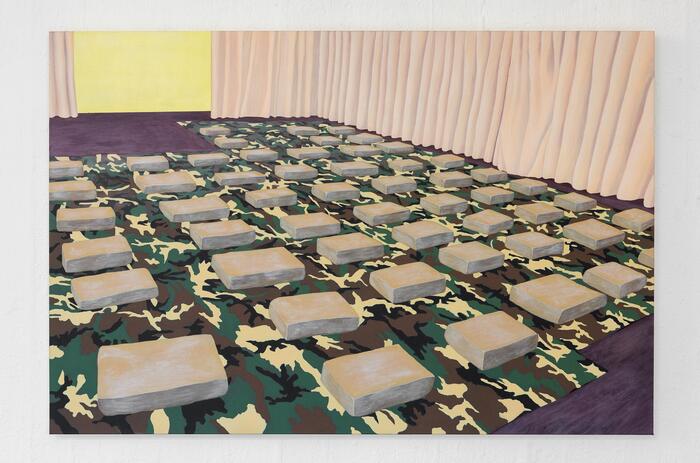
“From a distance (while living in Europe), I saw another Bolivia through the ways it was (self-)represented on social media and in the press, and I consumed images produced in the country that did not fall within the sphere of ‘culture,’ yet in my view revealed a much richer complexity. The Cedición projects emerged from these collections of images, or from texts and representations that were not official, so to speak.” (Coloma, 2025).
1. The milestones of the exhibition
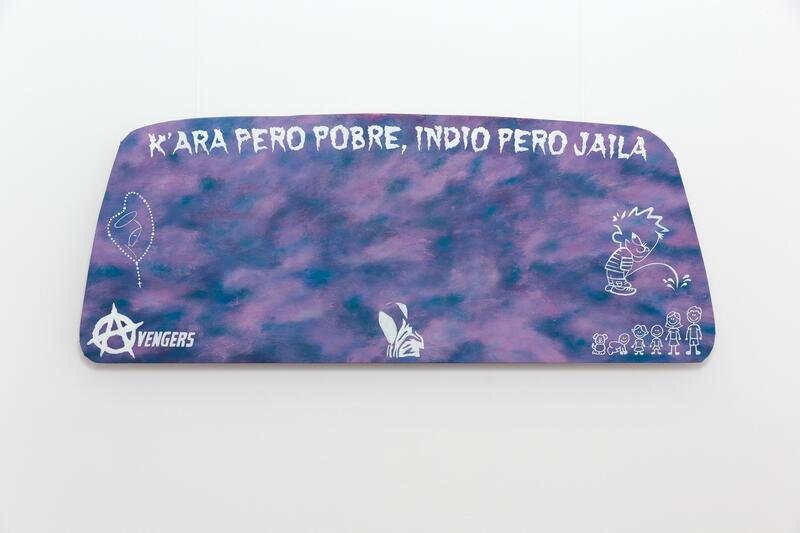
Initially presented at Centro Cultural de España (CCELP) in La Paz (2023–24) and later at Nube Galería, Santa Cruz (2025), Cedición stands as one of the most incisive interventions in recent Bolivian contemporary art. Having received support from a CCELP visual arts production program, this exhibition by Coloma—installed across three contiguous rooms—constructed a visual dispositif that challenges the languages of state power and its symbolic grammars.
Its presentation during the period of national elections in Bolivia last year further intensified its critical reading of the Plurinational State and its effects on the instrumentalization of images and the ethnic extractivism it points to. Rather than engaging in the folklorizing aestheticization of the “state Indian”—so prevalent in the plurinational imaginary—Cedición operated as a critique of the Andinocentric modes of representation that have monopolized Bolivian political iconography over the past two decades.
• Alfredo Coloma (La Paz, 1984), a Bolivian artist holding master’s degrees in visual arts from HEAD–Genève (Switzerland) and ENSP–Arles (France), foregrounds in his work a questioning of the representation of “the Bolivian” and the symbols that define cultural identity through official discourses. His recent exhibitions include Cedición (bis) and Fin de Ciclo, where he employs mediated images (often sourced from the internet) as the basis for his artistic projects, exploring Bolivian visual archetypes.
• Production context: The artist noted that most of this exhibition was conceived and developed starting in 2015, while he was still pursuing his studies in Europe. Cedición stems from those years of remaining connected to Bolivia through online news and social media, a period during which he collected images, press photographs, memes, and other materials that became the documentary basis for proposing another perception of the Bolivian. It pointed toward a far richer and more complex imaginary than that exported by the official discourse of the MAS government under the aesthetics of Plurinationalism, which promoted a folklorizing aestheticization of the “state Indian” alongside a rhetoric of the ancestral that was inconsistent with its actual governance practices.
• Political context: Significantly, Cedición was presented in Santa Cruz de la Sierra shortly after the first electoral defeat of MAS in Bolivia (August 2025), marking—at least in appearance—the end of a cycle and a moment of transition for the country. This context of rupture expanded and intensified the possible readings of the exhibition. It is worth recalling that the socialist narrative—combined with a statist and national-developmentalist model—of MAS governments remained in power for nineteen years, defining an era in Bolivia that profoundly altered the country’s political, symbolic, and social order. Those two decades formed the horizon of visibility within which Cedición by Alfredo Coloma was conceived, produced, and ultimately exhibited.
• The encounter: I met Alfredo three years ago, on the occasion of the exhibition’s opening in La Paz (2023). Since then, we have had several long conversations about his work and the place Cedición occupies within the regime of visibility and enunciation shaping Bolivia’s artistic field. I was able to access the extensive documentation the artist compiled on the exhibition, as well as the details of each of the projects that compose it—conceived as lines of inquiry he continues to explore. With the exhibition’s presentation in Santa Cruz this year, Cedición’s problematizing drive became even more pronounced, with works that reveal a more grounded Bolivia in everyday perception, contradicting the constructed national image promoted by the hegemonic party, funded through state propaganda and sustained by official rhetoric.
2. The battlefield
Cedición can be understood as an aesthetic counter-movement to the regime of visibility established by the Bolivian Plurinational State. The doctrinal regime of Plurinationalism saturated public space iconography through murals, billboards, posters, color typologies, clothing, bodily gestures, slogans, as well as informational manipulation via state media; at the same time, it was imposed as a criterion for selecting those who could represent the country’s visual arts on international platforms such as the Venice Biennale. Crucially, this was not merely a hegemonic aesthetic aimed at decorating or enlivening space, but one that sought to produce a political subject (the plurinational subject) by fabricating an idealized indigenist narrative.
What this regime of visibility established was a highly controlled iconography and rhetoric, bearing parallels to the logic articulated in George Orwell’s dystopian novel 1984. At least in terms of the monopoly of symbols (whipala, chakana, Andean rituality…), the omnipresence of Andean iconography, the control of historical narrative (from long colonial oppression to the first Indigenous president), the repetition of doctrinal totemic terms (process of change, decolonization, plurinationality…), and the idealized image of a morally superior subject: the state Indigenous figure. As Orwell aptly stated, “who controls the past controls the present, and who controls the present controls the future.”
Faced with this iconographic saturation, Coloma deploys in Cedición a fragmentary, oblique visual language infused with strong doses of irony, aiming to deactivate the rhetorical devices of Plurinationalism from within, by appropriating its own symbolic operations. The strategy he employed for this intervention was the institutional visibility of the exhibition space itself—specifically, two private institutions independent from the Bolivian State: Centro Cultural de España and Kiosko Galería.
It is no coincidence that in one of his works Coloma alludes to another of Orwell’s novels, Animal Farm. Presented as an artist’s book, Uywa Yapuchaña (2023) consists of an externally designed book that cannot be opened, purportedly Orwell’s novel written in Aymara. The background of Uywa Yapuchaña is a critique of another Bolivian artist’s work, as framed by Coloma:
“it is a satire of a book made by Bolivian photographer River Claure, who translates from French into Aymara The Little Prince, a classic of ‘universal literature.’ The irony lies in the fact that this largely oral language is spoken by a very small percentage of the population, which would hypothetically be its readership. Claure’s book, and particularly the images he produced to illustrate it, are in my opinion the clearest example of ethnic extractivism and the (self-)exoticization of Aymara aesthetics and culture, as Claure self-identifies as Aymara.” (Coloma, 2023).
Coloma refers to Claure’s project imagining the journey of Antoine de Saint-Exupéry’s Little Prince to the Andes. Writer Alba Balderrama described the proposal as follows:
“the Little Prince continues traveling and has arrived in this flat, Bolivian world. Through Saint-Exupéry’s character, Claure presents a new imaginary world enriched by the popular iconography of the Altiplano: braids with roses, sheep painted through Andean rituals, wool ponchos, and a beautiful brown-skinned child—our Little Prince.” (Balderrama, 2024).
As mentioned, Claure was invited as Bolivia’s representative to the Venice Biennale 2024, titled Foreigners Everywhere, and has also participated in other international festivals. In his photographic project Warawar Wawa, an image shows a man wearing an Andean poncho and a virtual reality headset, juxtaposing cutting-edge technology with a rural Andean environment.
Coloma considers such approaches forms of ethnic extractivism and exoticization—operations frequently seen in the international art world. This critical stance remains consistent throughout Cedición, allowing us to situate his work as a counter-movement within local Bolivian artistic practice. He observes how this aesthetic has also permeated artistic production in the country at large, which is why he finds it necessary to reference the work of other contemporary Bolivian artists. In this sense, Cedición is not merely a visual exhibition but also an epistemological intervention within the prevailing regime of visibility in Bolivian art spaces.
3. The site of enunciation
Entering the terrain of parody, in Cholitrans (2020), Coloma invents his own character: the “trans skater cholita.” In this video, the artist appears dressed in a skirt and a small white hat; riding a skateboard, he glides through the streets of his neighborhood. Ironically, as in many costumbrista paintings found on the market, he also poses with his back turned, gazing at the mountains of La Paz. Rather than depicting a cholita or another local figure, he himself adopts the attire—satirizing what he describes as Indigenous cosplay.
While it is a parody, on a formal level he carefully reproduces the aesthetic patterns he references—in this case, skate videos produced for social media. On the level of language, the artist’s voice is heard in voice-over, also mocking the discourse that often accompanies this kind of superficial visibility of the Indigenous:
“this character was created with the aim of raising awareness and empowering, especially new generations…,” “one of the character’s goals is to showcase our true culture”; “I am interested in exploring our rituality and ancestry”; “this is my way of supporting struggles against patriarchy…” (Coloma, 2023).
Thus, moving through the exhibition, Cedición emerges as a kind of inventory of critical observations. Yet its critique is not articulated from an external position, nor from an opposing ideology; rather, it operates from within the material conditions established by that state regime of visibility: the discourse of the pluri-multi-inclusive-diverse-cultural, which the artist exposes as idealistic and as producing a distorted visual truth in the service of power.
It is quite possible that a sudden burst of laughter may escape a viewer while walking through the exhibition—an indicator of the type of experience Coloma invites, charged with a dense sense of humor. Returning to Cholitrans, Coloma suggests that the “ancestral” is not a fixed meaning but a floating signifier, instrumentalized according to the needs of the moment. In doing so, he reframes the Indigenous not as an identity but as a surface effect replicable for gaining visibility on social media—a powerful critique of identity politics under the socialist regime of Plurinationalism.
However, this is not an exhibition solely concerned with the symbolic weight of the Indigenous; it also rebels against the broader climate of identity that has permeated artistic practice in Bolivia. This refers to the constraints imposed by identity-based categorization in artistic production. Coloma does not evade this framework; instead, he incorporates it into his self-examination and then uses it as material in his works, pushing it to the point of absurdity.
“For me, who makes, and for whom, are fundamental questions: why am I doing this, where do I come from, what possibilities do I have to speak about this or that—I always try to problematize these issues; I think in our context this is not done enough.” (Coloma, 2025).
This drive toward a sincere and exhaustive inquiry reveals in Cedición references to the artist’s own biography as raw material, beyond merely positioning him as the authorial subject. Attention is thus drawn to the neighborhood where he grew up—Achumani, in the southern zone of La Paz, one of the city’s most affluent areas. In the project Achumani Aesthetics, the artist formulates a kind of statement on the site of enunciation of his practice: he explores his own material conditions, his middle-class belonging, and its expectations, while exposing the blind spots of perception—what is not so pleasant and does not conform to the stereotype of the Zona Sur. Achumani Aesthetics presents his neighborhood through a rural/popular aesthetic lens, the same one that appears to define the conventional “Bolivian landscape.”
We explored the visions and practices of eleven Latin American galleries to gauge the pulse of the region’s art and its status at ARCO, with proposals that, without ignoring the commercial side, affirm tradition, experimentation, and diversity of languages as a common hallmark.
By Mónica Sotos
What are the successive diasporas of Latin American artists to Spain about, from the final years prior to the turn of the twenty-first century to the present? Article 2 of a series of 3.
The Latin American presence at ARCO is consolidating year after year, establishing itself as a primary guiding thread beyond market trends, becoming a significant part of the identity of the Madrid fair. In this sense, the participating galleries in the various programs showcase well-established names as well as younger or more radical bets, shaping an ecosystem in which various productions can be analyzed.
“I think painting is the possibility of creating and materializing in the physical world something that did not exist before.” — Kate Araoz, 20251
Part 2
“From a distance (while living in Europe), I saw another Bolivia through the ways it was (self-)represented on social media and in the press, and I consumed images produced in the country that did not fall within the sphere of ‘culture,’ yet in my view revealed a much richer complexity. The Cedición projects emerged from these collections of images, or from texts and representations that were not official, so to speak.” (Coloma, 2025).