

By
Julia P. Herzberg
The Marian Goodman Gallery in New York is presenting its inaugural exhibition Ana Mendieta Back to the Source. Thoughtfully and beautifully installed, the exhibition presents a significant body of work from 1972 to 1985 that includes photographs, the installation Ñañigo Burial, designs on leaves, drawings of hands and female figures on paper with ink, graphite and wash, ten films, and two vitrines with diverse personal items.
The Marian Goodman Gallery in New York is presenting its inaugural exhibition Ana Mendieta Back to the Source. Thoughtfully and beautifully installed, the exhibition presents a significant body of work from 1972 to 1985 that includes photographs, the installation Ñañigo Burial, designs on leaves, drawings of hands and female figures on paper with ink, graphite and wash, ten films, and two vitrines with diverse personal items.
One vitrine displays Esculturas Rupestres (The Rupestrian Sculptures) (1983), a suite of eight of the ten photo etchings of female figures carved in the limestone cliffs in Jaruco, Cuba (1983).
Another vitrine displays the books El Sacrifico Totémico en el Baroko Ñañigo (1957) and Cuba y Los Cubanos (1920); invitation cards; a stamp from Egypt; three postcards; an 8 mm film canister of Burial Pyramid (1974); small seashells from Cuba; a Heresies publication (1981) with a reproduction of Venus Negra (1980) with the artist’s account of the 1617 legend; and the “Artist’s Statement” from 1984. The range and diversity of the art work, enhanced as it is by her personal possessions, convey the extraordinary sense of the artist’s creativity.
After entering the United States in 1961, Mendieta led a somewhat peripatetic life—one she expressed with her body or its surrogate form in the earth—in mud, sand, water—and in the air. She emerged under stones and grass; she burned her image with gunpowder on trees and on the ground; she covered herself with paint or feathers. In her search for universal connection to life, Mendieta formed profound relationships with Mexican culture, Afro-Cubans’ spiritual and syncretic beliefs, Native American histories, pre-historic forms, and Neolithic traces.
The artist began her career in painting, then quickly embraced the new conceptual forms of body art and earth work, important genres at the time. She developed these in ever-expansive visual and thematic modes. The Marian Goodman Gallery exhibition presents works that enthrall the viewers with her enormous inventiveness in Iowa, Mexico, New York, Miami, Cuba, Ireland, and Rome, among other places. The installation evokes a sense of wonderment due to the artist’s passionate repetitions of female forms, her selection of unusual geographical places and natural materials, together with the embodiment of historical and autobiographical references.
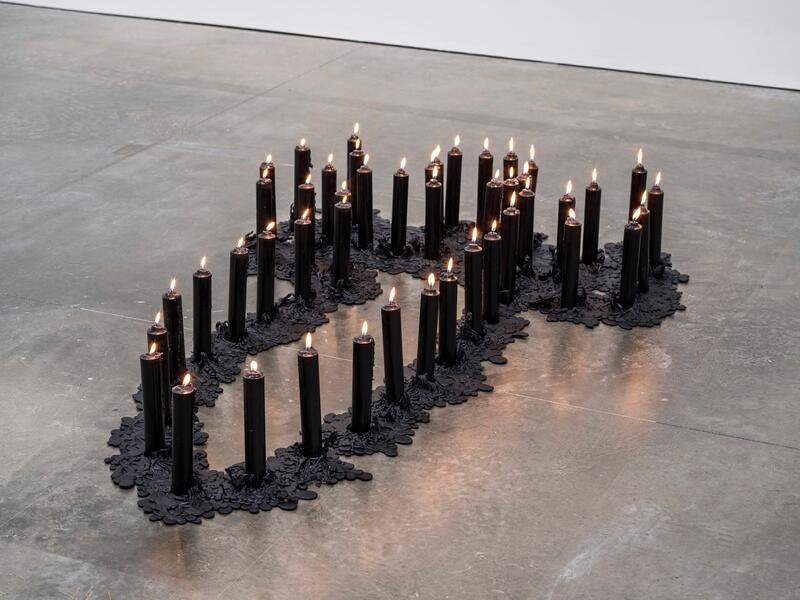
At the opening, Mendieta’s niece inaugurated the exhibition with Ñañigo Burial, an iconic installation of forty-seven tall black candles in the form of the artist’s silueta (silhouette). Over time the installation has become an homage. Mendieta was living in Iowa when she went to New York in February 1976 and showed Ñañigo Burial at 112 Green Street, a well-known alternative artists’ space in Soho. Mendieta had become interested in Afro-Cuban religions and spirituality and had probably begun reading Lydia Cabrera, the leading Cuban writer and ethnographer whose work documented the Abakuá, a secret male society known as Ñañiguismo. Whereas Mendieta did not attempt to adopt hand-drawn signs used in actual religious ceremonies, she inserted her body as a presence in referencing the historical group of black Cuban’s whose survival is still present.
In composing the installation, Mendieta bought the candles from a local bodega, had her outline drawn, and then placed the candles on the floor and lite them. The gallery lights them every Friday and Saturday so visitors may experience a sense of magic, even awe, similar to what she must have felt when she exhibited the work in New York.
Untitled (El Corazón) (1973) was created in a niche in the colonial Cuilapan church in Oaxaca. Mendieta had gone to Mexico with a few of her graduate colleagues and professor from the Multimedia class at the University of Iowa to explore archaeological sites in Monte Alban, Mitla, Yagul, Dainzu, and Tlacolula. The overall goal of the trip was to explore the richness of Mexican indigenous cultures and their inherent mystery and mysticism, which hopefully would inspire the group to create work reflective of the magic of the culture, place, and its zeitgeist. Mendieta returned to the 16th century Cuilapan church to create works. For El Corazón she bought an animal’s heart and thin branches to hold the piece upright in a niche where it symbolized the bleeding heart of Jesus, a popular motif in Catholic worship visible in many places in Oaxaca. Mendieta already had a strong academic background in Mexican art from earlier history classes and more recently from the course Field Research in Archaeology in San Juan Teotihuacán (1971) where she learned to identify Pre-Colombian artifacts from surface excavations. Noteworthy of mention is the iconic work Imagen de Yagul (aka Flowers on the Body) (1973), not in this exhibit. Mendieta placed herself in an empty tomb, one of many in the Valley of Oaxaca. She bought several bouquets of white September weeds and had them spread over her body. The white flowers, a sign of life, were conjoined with one of death. Through that syncretic blending of the symbols of life and death, Mendieta reenacts a Pre-Columbian belief that the soul or life force lives on in the afterlife.
Silueta del Laberinto (Laberinth Blood Imprint) (1974), is a film of Mendieta on the floor of the Palace of the Six Patios in Yagul. The image initiated her silueta series. By means of her silueta in Yagul, she inserted herself into the history of a given place, embodying the notion of the bodies’ trace, as a marker of presence.
Body Tracks is a suite of nine prints that features the artist with her arms raised against the wall before she slowly drags them down. The work was viewed simultaneously as painting, body work, and performance. It was one of Mendieta’s favorite pieces, which she showed to Lucy Lippard, who visited the university in 1975. Body Tracks were also performed in Antwerp in 1966 and at Franklyn Furnace in New York in 1982. Mendieta’s red body markings owe a debt to Yves Klein whose models pressed their bodies against different supports with his eponymous blue paint to register their imprints.
Grass Breathing (c. 1975) in the film series features her body barely moving under a low mound of grass. Her breathing moves the grass as it confirms the life-giving force of mother nature—a source of life.
Although Mendieta moved to New York in 1978, she frequently visited Iowa where she created work. Untitled: Silueta Series (1978) is one of several works created with fire. The artist’s interest in gunpower and other pyrotechnics provided her with an element that was visually dramatic and symbolically purifying.
After Mendieta's move to New York in 1978, she often visited Iowa to work; she also worked in Mexico until 1979. In the early 1980s Miami and Cuba became important landscapes. At the American Academy in Rome (1983-4) she created a large body of drawings of archetypal female figures. I end with Untitled (1981) carved in the sand in Guanabo, a beach town in Havana. The image is near the water’s edge where the changing tides would reclaim it. The sand figure is paradigmatic of the universal flow of life and Mendieta’s self-proclaimed “search for origin”.
Ana Mendieta Back to the Source is on view at Marian Goodman Gallery from November 7, 2025 to January 17, 2026, located at 385 Broadway New York, NY 10013.
*Julia P. Herzberg, Ph.D., is an Art Historian and Curator whose scholarship has shaped discussions on Ana Mendieta’s work.

Frida Kahlo has entered a new chapter of global recognition. The sale of El sueño (La cama) for $54.66 million at Sotheby’s marks the highest price ever achieved by a woman artist at auction and the strongest result for any modern Latin American artist.

Signs of caution in a market seeking stability.
The 82nd edition brings together 56 artists and collectives in an exhibition that privileges atmosphere, sensibility, and contemporary forms of coexistence. Within this framework, Latin American artists play a key role, weaving together memory, technology, body, and territory.
The exhibition presented at the Irish institution showcases an artist who reflects on the interrelation between humanity and nature and advocates listening as a path toward transformation through memory and connection.