
SANTIAGO YAHUARCANI: LIVING MEMORY OF THE ÁIMENI CLAN IN NEW YORK
The exhibition of the Uitoto artist intertwines territory, technique, and spirituality in a dialogue of history and resistance.
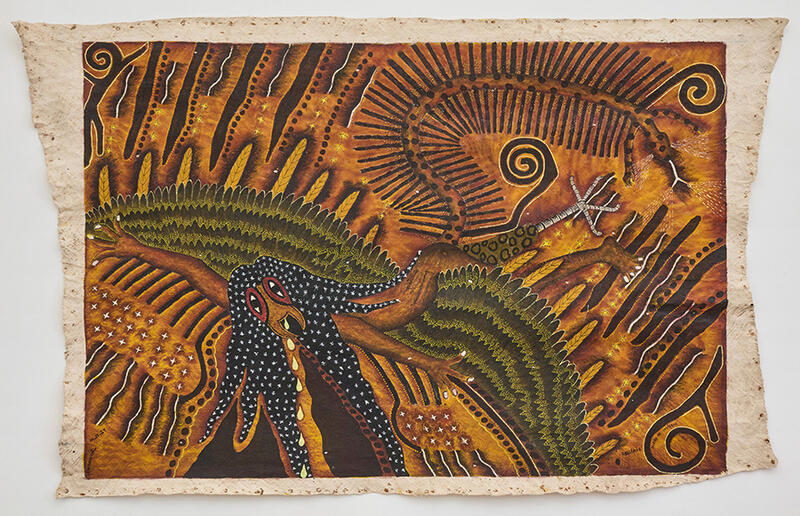
CRISIS Gallery, in collaboration with Stephen Friedman Gallery, presents the first New York solo exhibition of Santiago Yahuarcani: Flight of the White Heron Clan. The show brings together a selection of recent works by the Uitoto artist which, as curator and writer Horacio Ramos Cerna notes, “consolidate decades of experimentation and care, introducing New York audiences to a living practice in which technique, land, and memory speak with urgency to the present.”
Born in 1960 in Pucaurquillo, Peru, Yahuarcani belongs to the Áimeni clan of the Uitoto Nation. His work combines painting, oral storytelling, and ancestral knowledge transmitted by his mother and grandfather, Martha and Gregorio López. Since the 1980s, he has painted on llanchama, a bark cloth that he harvests and prepares by hand, transforming this surface into what Ramos Cerna describes as “a counter-archive for memory and repair.”
-
Santiago Yahuarcani. Courtesy of Stephen Friedman Gallery
The stories that run through his work recover episodes of violence endured by Amazonian peoples—such as the slavery and genocide perpetrated by rubber barons in the early 20th century—while celebrating the spiritual resistance of Indigenous communities. In pieces like La savia que se transformó en llanto de sangre (The Sap that Became a Weeping of Blood, 2025) and La selva está moribunda (The Amazon Is Dying, 2019), Yahuarcani evokes environmental and human devastation without centering the perpetrators: his mythological and spiritual figures register loss while also affirming the continuity of life.
The ritual dimension of his practice becomes evident in works such as El vuelo del bamco (Flight of the Shaman, 2023), where a shaman transforms into an eagle through a process of metamorphosis inspired by visions that his mother—a healer—associated with the consumption of ampiri (a tobacco-based paste). In Uitoto culture, this substance also guides the recounting of origin stories and the act of storytelling inside the maloca, the communal longhouse.
-
Santiago Yahuarcani. La savia que se transformó en llanto de sangre, 2025. Natural dyes and acrylic on llancha, 320 x 118 cm. Courtesy of Stephen Friedman Gallery
-
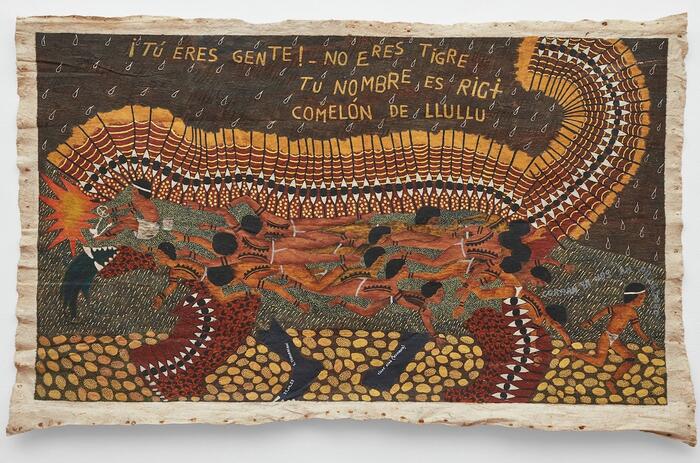
Santiago Yahuarcani. Rollim+e. Dueño del invierno, 2025. Natural dyes, acrylic on llanchama, 118 x 186 cm. Courtesy of Stephen Friedman Gallery
Every element in Yahuarcani’s painting maintains a direct link to the land: he applies color using hand-carved branches instead of brushes and uses natural pigments extracted from local plants—such as guisador (Curcuma longa) and achiote (Bixa orellana). For the artist, technique and material “are never merely formal; they sustain a living dialogue with nature and with the cultural practices that emerge from it.”
The llanchama, central to his work, preserves visible traces of the manual process: holes, rough textures, and irregular fibers that remind us that Western painting represents only one chapter in a long Indigenous history of working with fiber. “Llanchama is never merely a support—it is a living collaborator,” writes Ramos Cerna, underscoring the organic character of the artist’s practice.
Yahuarcani, whose work is held in collections such as the MoMA, Tate, and Museo Reina Sofía, continues to consolidate a trajectory that intertwines memory, territory, and contemporary art from a profoundly Amazonian perspective.
The exhibition will be on view from November 14, 2025, to January 17, 2026, at Stephen Friedman Gallery, 54 Franklin Street, New York (United States).
Related Topics
May interest you

POROUS BODIES, THOUGHT IN ACTION: CAROLINA PAZ IN NEW YORK
MYTH AND RESISTANCE IN NEREYDA LÓPEZ AND SANTIAGO YAHUARCANI, AT THE CBA
The Círculo de Bellas Artes in Madrid presents Somos raíces (We Are Roots), an exploration of the creative worlds of Santiago Yahuarcani (Pucaurquillo, Peru, 1960) and Nereyda López (Pebas, Peru, 1965), two of the most prominent figures in contemporary indigenous art. Both artists draw from the oral traditions and cosmologies of their respective peoples—the Uitoto in Yahuarcani’s case, and the Tikuna and Cocama in López’s—to give voice to languages of resistance.
SANTIAGO YAHUARCANI ENTERS THE MoMA COLLECTION
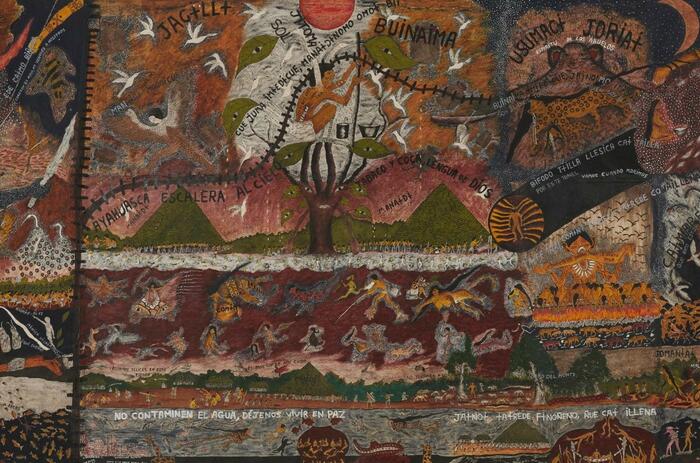
Crisis Galería announced the recent acquisition of the painting Cosmovisión Huitoto (2022) by the outstanding indigenous artist Santiago Yahuarcani by the Museum of Modern Art of New York (MoMA). This extraordinary large format work, made with natural dyes and acrylic paint on llanchama, is one of the largest produced by the artist with more than two meters high and four meters wide.
ANA MENDIETA BACK TO THE SOURCE
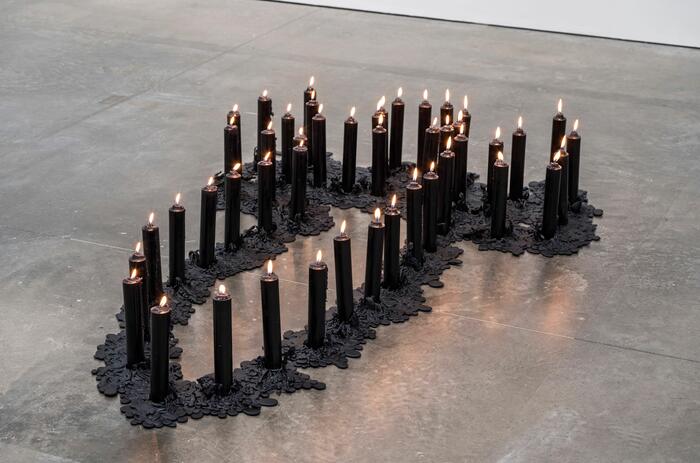
The Marian Goodman Gallery in New York is presenting its inaugural exhibition Ana Mendieta Back to the Source. Thoughtfully and beautifully installed, the exhibition presents a significant body of work from 1972 to 1985 that includes photographs, the installation Ñañigo Burial, designs on leaves, drawings of hands and female figures on paper with ink, graphite and wash, ten films, and two vitrines with diverse personal items.