
MIAMI REVISITS MOMA'S HISTORIC 1944 EXHIBITION OF CUBAN PAINTERS
The exhibition brings together works by Wifredo Lam, Amelia Peláez, and Mario Carreño, preserved by private collectors for more than 80 years.
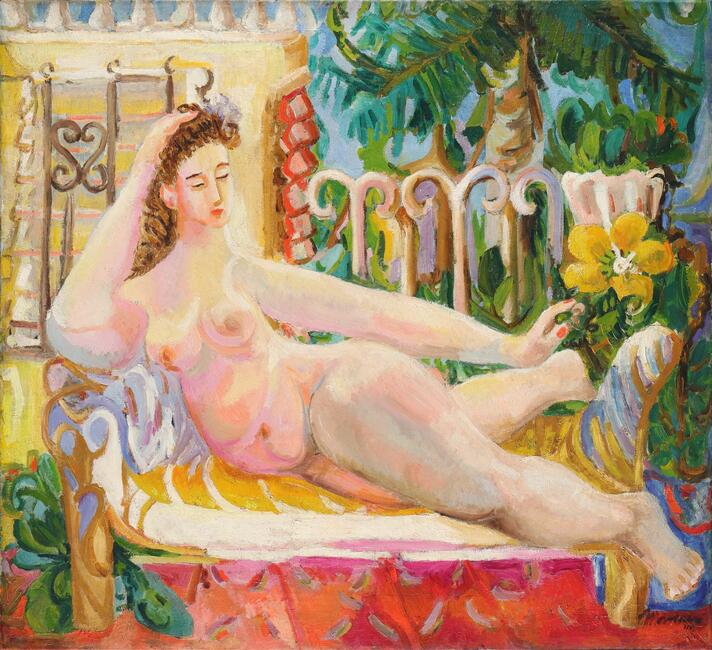
The Frost Art Museum at Florida International University in Miami presents Modern Cuban Painters from Havana to New York – Revisitada, on view through October. The exhibition, curated by Elizabeth T. Goizueta and Cristina Figueroa Vives, recalls a defining moment in 1944, when modern Cuban art entered the U.S. cultural landscape through the Museum of Modern Art in New York (MoMA).
Among the artists represented are Mariano Rodríguez, Mario Carreño, Carlos Enríquez, Roberto Diago, Cundo Bermúdez, René Portocarrero, Wifredo Lam, Fidelio Ponce, and Amelia Peláez. All of them were pivotal figures whose work helped define the island's modern artistic identity and expand its international reach in the mid-twentieth century.
-
Installation view. Courtesy of Frost Art Museum FIU
The exhibition brings together every work that was part of MoMA's 1944 show, made possible through the collaboration of collectors and galleries—mostly based in Miami—who have preserved these pieces in their collections for more than 80 years.
Expressions of Cuban Modernism
In the late 1930s, a generation emerged in Cuba interested in renewing artistic language. These artists reinterpreted the Baroque and developed an iconography inspired by Afro-Cuban culture, rural life, and underrepresented aspects of their society.
Portraiture, spirituality, sensuality, and interior scenes took on new importance. Decorative depictions of white society were replaced by landscapes, animals, Afro-Cuban ceremonies, still lifes, and intimate spaces.
-
Amelia Pelaes. Vase with Flowers, 1945. Gouache on paper laid down on board 28 x 28 in. Courtesy of Frost Art Museum FIU
New York and the Cuban Modernists, 1939–1949
With the outbreak of World War II, New York established itself as a new center of Western art. Its position between Europe and Latin America encouraged exchange among diverse artists and movements. Within this context, Cuban modernists engaged in dialogue with Mexican muralism, Surrealism, Latin American Baroque, and European avant-gardes, all while pursuing their own artistic identity.
In 1939, the New York World's Fair featured a Cuban pavilion and an exhibition of Latin American art. That same year, Wifredo Lam had his first exhibition in the United States alongside Pablo Picasso at Perls Galleries. Over the following decade, modern Cuban art gained a growing presence in major galleries across the city, including Pierre Matisse, Perls, Feigl, Norte, and Julien Levy, among others.
-
Wifredo Lam. Phenomenie Phaline, 1944. Oil and gouache on paper, 37 x 29 in. Courtesy of Frost Art Museum FIU
Modern Cuban Painters at MoMA (1944)
In 1942, Alfred H. Barr Jr., MoMA's founding director, and curator Edgar Kaufmann Jr. traveled to Havana with the goal of acquiring works for the museum. During their visit, they were received by patron María Luisa Gómez Mena; her husband at the time, painter Mario Carreño; and art critic José Gómez Sicre. Together they toured artists' studios. That encounter proved decisive: it laid the groundwork for Modern Cuban Painters (1944), the first institutional exhibition in the United States devoted to modern Cuban art. With it, MoMA broadened the narrative of modernism beyond Europe, the United States, and Mexico.
The Independents: Wifredo Lam and Fidelio Ponce
Wifredo Lam declined the invitation to take part in MoMA's 1944 exhibition. Although connected to the Cuban modernists, he forged an independent path marked by the fusion of European Surrealism and Afro-Cuban culture. After returning to Cuba in 1941, his ties to figures such as Pablo Picasso and Pierre Loeb helped drive his international recognition.
-
Fidelio Ponce De Leon. Saint Ignatius of Loyola, (San Ignacio de Loyola), 1940.Courtesy of Frost Art Museum FIU
Fidelio Ponce de León also occupied a singular place. In contrast to other artists' use of intense color, he worked primarily in whites, grays, and ochres. Admired by Alfred H. Barr Jr., he made a decisive contribution to the international recognition of Cuban modernism, even though he never left the island.
Modern Cuban Painters from Havana to New York – Revisitada can be seen through October 18, 2026, at the Frost Art Museum at Florida International University in Miami, 10975 SW 17th St, Miami, FL 33199, United States.
Related Topics
May interest you
THE JUAN CARLOS MALDONADO COLLECTION ANNOUNCES A NEW CHAPTER: IT IS CLOSING ITS SPACE IN MIAMI
After a decade in the Miami Design District, the institution shifts its focus toward collaborations with museums, universities, and cultural organizations worldwide.
FROM THE SUBTERRANEAN TO THE COSMIC: TERESITA FERNÁNDEZ REAWAKENS A DORMANT HOUSTON LANDMARK
After nearly a decade closed, The Menil Collection's Fresco Building reopens with a meditation on spirituality and matter.
MODELS OF GALLERY COLLABORATION MARC STRAUS AND NUEVEOCHENTA: AN ALLIANCE BETWEEN COLOMBIA AND NEW YORK
By Maria Paula Suarez and Montserrat Miranda Ayejes
LATIN AMERICAN TEXTILE ART AND KINETICISM CONVERGE IN CALERO'S EXHIBITION IN MIAMI
Curated by Katherine Chacón, Movement in Suspended Time activates a surface that evokes the loom as originary matrix, transposing onto the picture plane the tension between artisanal tradition and abstract modernity.
CROCERI AND VIDAL MACKINSON SELECTED FOR RESIDENCY AT EL ESPACIO 23 IN MIAMI
The first collaboration between El Espacio 23 and Fundación Ama Amoedo places two Argentines at the heart of one of the most dynamic ecosystems for Latin American art.
PAMM INVESTIGATES CARIBBEAN PERFORMANCE ART PRACTICES AND THEIR DIASPORAS IN “BEYOND REPRESENTATION”
The ongoing project, curated by Iberia Pérez González and presented by the museum's Caribbean Cultural Institute, combines live art events with a digital video-performance platform.
MEMORIA STRATA: A MATERIAL STUDY AS A TRIGGER FOR LATIN AMERICAN MIGRATORY MEMORY
"The spiral is a form of transit, a structure that transforms whoever moves through it." With that statement, curator Enzzo Hernández opened the presentation of Memoria Strata, the new artistic research project by Elmer Castillo, inaugurated on August 7 at Estudio-Galleria Mansión Castillo, in Havana.