
By
Daniella Dalmasso
MEMORIA STRATA: A MATERIAL STUDY AS A TRIGGER FOR LATIN AMERICAN MIGRATORY MEMORY
August 27, 2026
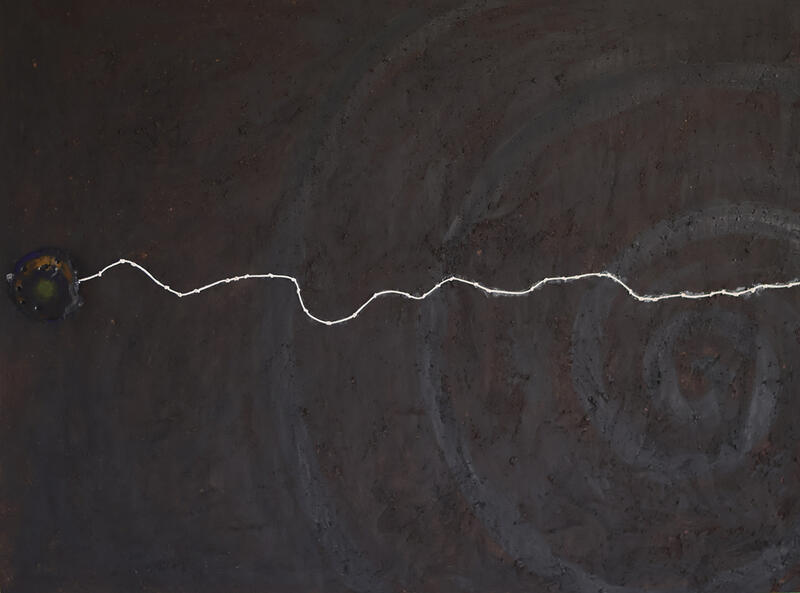
Elmer Castillo. Tapón del Darién, 2026. Acrylic and earth on canvas, cast glass, and jute fiber, 90x120 cm. Photo credit: Marcos Caballero Viel, Mansión Castillo Studio-Gallery
"The spiral is a form of transit, a structure that transforms whoever moves through it." With that statement, curator Enzzo Hernández opened the presentation of Memoria Strata, the new artistic research project by Elmer Castillo, inaugurated on August 7 at Estudio-Galleria Mansión Castillo, in Havana.
Rather than positioning itself as a retrospective exhibition, Memoria Strata brings together just twelve works. That apparent modesty, however, responds to the artist's conscious decision to show the beginning of a research process that shifts the center of his work from the metaphor of the contained Spiral toward the material memory of migration.
Enlarge image
-
Público Opening. Créditos fotográficos: Marcos Caballero Viel. Estudio-Galería Mansión Castillo
The atmosphere at the opening reinforced that intention. Havana-based artists, students, and other visitors remained gathered around several pieces long after the presentation had ended. What prevailed was not the usual rhythm of an opening reception, but that of an unhurried conversation, in which each work — especially the sculpture titled Tu Legado — seemed to activate personal experiences tied to uprootedness, family separation, or permanence.
For some years now, the spiral has served as the conceptual axis of Castillo's research. Initially inspired by the Polymita picta, an endangered mollusk endemic to eastern Cuba, the form has evolved into a metaphor for interrupted growth and containment, while also signaling the tensions of contemporary Cuban life and experience. In Memoria Strata, however, the spiral ceases to be merely a formal symbol and begins to seep into the skin — and into the very substance — of the painting.
Enlarge image
-
Barco a la deriva. Mixed Media. Cristal de Murano sobre panel de madera. Acrilico, 85x85, 2026.. Créditos fotográficos: Marcos Caballero Viel. Estudio-Galería Mansión Castillo
In his opening remarks, Enzzo Hernández situates that transformation within a much broader tradition. He recalls that the spiral appears in the helical structure of DNA, in hurricanes, in mollusks, in the whirling of dervishes — where it simultaneously represents movement and enclosure.
The portraits gathered in the show appear to be built from successive layers of time. Pigments, barely visible writing, plant fibers, stitching, fragments of earth, and traces of earlier interventions accumulate over the faces. The surface stops functioning as a mere support and becomes a true visual sediment — a material archive capable of activating memory and new cognitive processes.
In Corazón en diáspora, a spiral woven from vines and jute sits at the center of the chest. It appears as a restrained, tethered structure, unable to expand freely. The piece engages in direct dialogue with the artist's earlier research while introducing a deeply human dimension in which the body becomes a territory of memory.
Enlarge image
-
Corazón en Diáspora. Acrílico sobre lienzo, tierra y espiral de raíces. 160x120cm. 2026. Créditos fotográficos: Marcos Caballero Viel. Estudio-Galería Mansión Castillo
-
Pedro Pan. Acrílico sobre lienzo, tierra y materia. 100x70cm. 2026. Créditos fotográficos: Marcos Caballero Viel. Estudio-Galería Mansión Castillo
-
La Mitad que se quedó. Acrílico sobre lienzo, tierra y fibras. 100x70cm. 2026. Créditos fotográficos: Marcos Caballero Viel. Estudio-Galería Mansión Castillo
La mitad que se quedó poses a different kind of fracture. The portrait is split by a long vertical seam. One side retains the physical presence of the paint; the other begins to dissolve into a barely perceptible silhouette. The seam holds the image together through a fragile act of repair. In the artist's own words: "...that seam is a cry, a constant moan that reveals the uncertainty of when that other half might become whole again."
The reference to Operation Pedro Pan emerges through an equally restrained register. Rather than turning to historical illustration, Castillo presents the aged face of someone who has carried an early separation for decades. Memory here is understood not as recollection but as wear — as matter accumulated on the body. A stone from the Santuario del Cobre tied to the canvas reinforces the discourse of sustained faith, while a small red pencil reveals the nostalgia of a childhood cut short.
The works do not depict only the migratory experience. They also incorporate the perspective of those who remain. That tension appears condensed in pieces where human representation nearly disappears altogether, giving way to lines of movement, contained spirals, or crystalline structures held in place by tensioners — as if even motion had to constantly negotiate with the forces containing it, a clear allusion to a political situation without ever becoming a pamphlet.
Enlarge image
-
Tu Legado. Paneles de puertas con cristales 240x40x30cm. Espiral 180cm diámatro. 100x70. 2026. Créditos fotográficos: Cortesía del Curador Enzzo Hernandez
In his curatorial text, Hernández describes Memoria Strata as a stratified territory where writing, pigment, earth, fibers, and found objects function as a vast visual palimpsest. Each layer retains traces of the one before it, turning the surface into a space where the visible never quite manages to erase what remains hidden.
That may well be the greatest achievement of this first public presentation of the project. At a time when migration is so often reduced to numbers, routes, or political events, Memoria Strata proposes instead to observe what remains attached to people after the journey — the physical traces of time, the invisible seams of separation, and the emotional sediment that continues to accumulate long after leaving one's homeland behind.
More than a finished exhibition, the show — on view through August 30 — functions as the opening of a research process that, by its very nature, seems destined to keep growing. The twelve pieces presented at Estudio-Galleria Mansión Castillo invite viewers to witness the birth of an archive built through painting, where matter ceases to be represented as such and becomes memory instead — an archaeology of the present in which the personal becomes a collective archive of the Cuban and Latin American diaspora.
Related Topics
May interest you
News
MIAMI REVISITS MOMA'S HISTORIC 1944 EXHIBITION OF CUBAN PAINTERS
The exhibition brings together works by Wifredo Lam, Amelia Peláez, and Mario Carreño, preserved by private collectors for more than 80 years.