MASP PRESENTS INTERNATIONAL GROUP EXHIBITION “HISTÓRIAS LATINO-AMERICANAS”
Spanning five floors of the Pietro Maria Bardi Building, the exhibition brings together works by 148 artists, including previously unseen works, to examine how the idea of Latin America was constructed and continues to be contested today.
Museu de Arte de São Paulo Assis Chateaubriand (MASP) opens the international group exhibition Histórias latino-americanas [Latin American Histories] on September 4. Occupying five exhibition galleries in the Pietro Maria Bardi Building, the show features 187 works by 148 artists from 20 countries. It examines how colonization, migration, resistance movements, and nation-building projects have contributed to the creation of different narratives about Latin America.
Curated by Amanda Carneiro, curator, MASP, and Julieta González, associate curator, MASP, the exhibition places works ranging from the pre-colonial period to the present day in dialogue around shared concerns, including colonization, extractivism, projects of progress, forms of collective organization, migration, diasporas, and aspirations for the future.
-
Daniel Lind-Ramos. El Viejo Griot, 2018-22. Boat bow, burlap sacks, plastic lid, hat, wood, bugle, wood oars, cardboard, painted fiberglass, plastic and synthetic textiles, dried and lacquered coconuts, PVC bucket, tambourine, conga drum, gloves, wire, metal fasteners, mirror, sewing pins, marine rope, plastic wrapping material and rope, 269 × 526 × 282 cm. Collection of the artist, courtesy of Max Levai Gallery, New York
Paintings, documents, maps, sculptures, photographs, installations, textiles, and videos reveal how imaginaries and symbols have been used to invent, govern, and contest the region over time.
The exhibition is organized into five sections: The World Upside Down, The Rhetoric of Progress, American Societies, We're in a Bind, and The Fall of the Sky.
The World Turned Upside Down draws on the Andean concept of pachakuti, which names a radical reversal of the order of the world. For numerous Indigenous peoples, the European invasion of the Americas produced a rupture of this kind, altering relationships with territory, time, and knowledge. The group of works reflects on how colonization invented a myth of a tropical paradise filled with natural riches that were supposedly available for exploitation by Europe, as well as the Latin American version of the Baroque.
-
Miguel Covarrubias. Paisaje exuberante o Jungla, 1935. Gouache and watercolor on paper, 50 × 35 cm. Museo de Arte Latinoamericano de Buenos Aires, dinitial gift, 2001. Photo: Oscar Balducci
Rhetoric of Progress examines how urbanization and industrialization projects shaped a twentieth-century Latin American narrative, revealing both its promises and contradictions. The city, the factory, the highway, architecture, and urban planning emerge as showcases of a promised modernity, but also as instruments of control, inequality, and environmental devastation. The exhibition design allows one of the windows of the Pietro Maria Bardi Building to reveal a view of Avenida Paulista, establishing a dialogue between São Paulo and the show. In this section, the commissioned work Nuremberg Map of Tenochtitlan, by Mexican artist Mariana Castillo Deball, occupies part of the gallery floor. The installation reproduces on a large scale one of the first European maps of Tenochtitlan—then the capital of the Aztec Empire and present-day Mexico City. Deball highlights how cartography contributed to classifying, administering, and dominating Indigenous territory. The exhibition also features other commissioned works by JAMAC (Jardim Miriam Arte Clube), Marcela Cantuária, Marcelo Cidade, Manuel Chavajay, Maurício Lupini, and Podeserdesligado.
In American Societies, the exhibition looks at forms of community organization, such as quilombos, cooperatives, peasant movements, and popular pedagogies, that envision the construction of concrete alternatives to the unfulfilled promises of development.
-
Manuel Chavajay. Ch’umil kaj / estrellas en la Via Láctea, 2024. Ceramic, acrylic and spray, 49 × 400 × 40 cm. Collection of the artist, courtesy Galeria Pedro Cera, Lisbon, Madrid
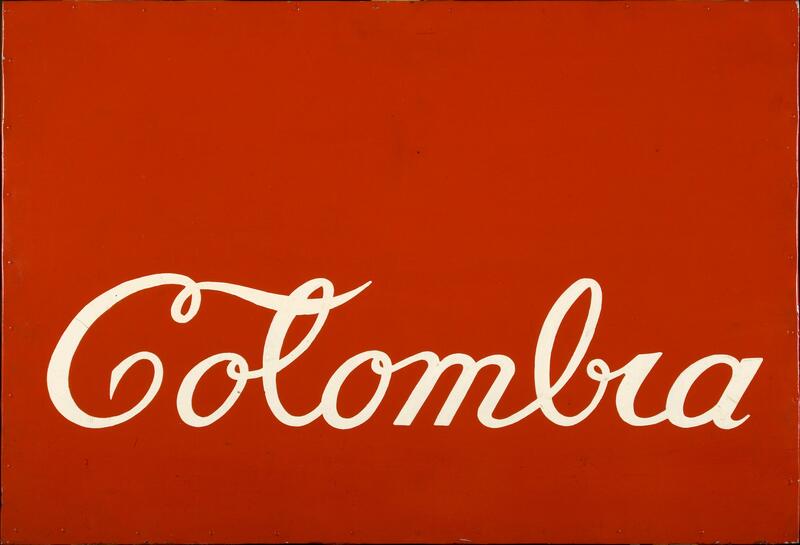
We're in a Bind refers to the song of the same name released in 1978 by New York musician of Puerto Rican descent Wayne Gorbea. Rooted in Afro-Caribbean traditions, the musical style emerged from encounters among migrants, record labels, dance halls, and Latino communities, becoming established in New York. Works such as Inserções em circuitos ideológicos: Projeto Coca-Cola (1970), by Cildo Meireles, and Colombia (1980), by Antonio Caro, address the relationship between economic dependency and cultural repertoire through products such as Coca-Cola, oil, bananas, palm oil, corn, and tacos. Meireles inscribes political messages on returnable bottles and places them back on store shelves, infiltrating retail logistics with his critique. Caro, in turn, subverts the soft drink’s logo, forcing his country’s identity to conform to the signs of a global commodity.
The final section, The Falling Sky, takes its name from the book written by Davi Kopenawa and Bruce Albert. Published in 2010, the book reveals how the destruction of the Amazon rainforest through the advance of illegal mining triggers a catastrophe that goes beyond the notion of an environmental crisis and names the concrete collapse of the relationships that sustain life. The section brings together dream and myth, understood as forms of knowledge that offer alternatives to the utopias of progress. The coexistence and overlapping of territories and timelines also informed the exhibition design. Visitors may follow the proposed sequence or establish their own paths, creating different associations and readings. Hélio Oiticica’s painting Metaesquemas (1956–1958) served as a reference for the panels, blocks of color, and diagonal cuts that avoid a rigid separation between the sections, fostering continuity and dialogue among different works.
Related Topics
May interest you
CAROLINA CAYCEDO: BETWEEN VENICE AND SÃO PAULO, RIVERS AND RESISTANCE
The Colombian-British artist participates in the current Venice Biennale and opens Confluences at MASP on July 3.
WHO ARE THE CURATORS THAT WILL LEAD THE NEXT BIENAL DE SÃO PAULO
For the second time in its history, two Brazilian curators take on the artistic direction of Latin America's largest visual arts event.
EFG LATIN AMERICA ART AWARD PRESENTS THE NOMINATED ARTIST AT SP-ARTE 2026
Cristiano Lenhardt was selected for his series of works born from his encounter with the environmental tragedy of the 2024 floods in southern Brazil.
WAYS OF REMEMBERING: YAHUARCANI AND MUÑOZ AT MASP
The Brazilian museum presents works by Santiago Yahuarcani and Oscar Muñoz, exploring ancestral knowledge and the fragility of images in Latin America.
MASP: CONTESTED NARRATIVES BETWEEN REPLICA AND WEAVING
Two parallel exhibitions revisit dominant narratives through practices that interrogate archive, materiality, and community in Latin America.
MARCO NAMES SOFÍA HERNÁNDEZ CHONG CUY AS CURATOR-AT-LARGE
With a career spanning more than two decades, Hernández Chong Cuy joins the museum tasked with developing a critical curatorial vision for its permanent collection.
INSIDE MASP'S NEW UNDERGROUND PASSAGEWAY: 98 METERS OF BEATRIZ MILHAZES
Pietrolina borrows the rhythm of a Carnival parade, brought to life in 33 acrylic shades.