
MASP: CONTESTED NARRATIVES BETWEEN REPLICA AND WEAVING
Two parallel exhibitions revisit dominant narratives through practices that interrogate archive, materiality, and community in Latin America.
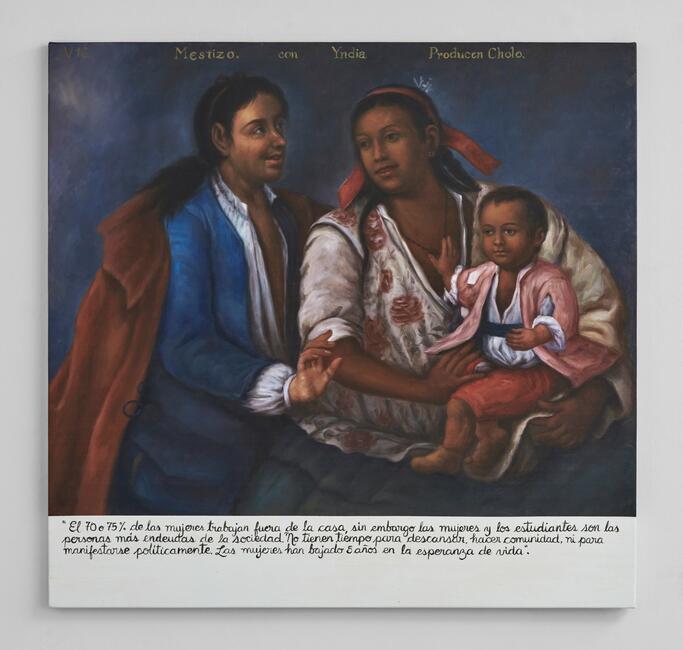
The Museu de Arte de São Paulo Assis Chateaubriand presents, simultaneously, two exhibitions that address a shared concern from different perspectives: how narratives in Latin American art are constructed and legitimized. On one hand, Sandra Gamarra Heshiki’s first retrospective exhibition, titled Réplica (Replica), critically revisits art history and its exhibition dispositifs; on the other, Vivir, tejer (Living, Weaving) brings together the work of Claudia Alarcón alongside the Silät collective, foregrounding ancestral knowledge and collective modes of creation from the Wichí people.
With more than 70 works produced over 25 years, Réplica (Replica) unfolds a sustained strategy of appropriation and displacement. Gamarra Heshiki reproduces, reinterprets, and alters historical pieces to expose the mechanisms of selection, exclusion, and hierarchy that structure museums. This inquiry also materializes in the creation of LiMac—a fictional museum founded in 2002—which operates both as archive and institutional critique. By replicating the authority of the museum, the artist introduces a fissure in its apparent neutrality: if the museum dictates history, it can also rewrite it.
-
Sandra Gamarra (Lima, Peru, 1972). Imágenes sueltas en la Historia Occidental III (Retratos) [Loose Images in Western History III (Portraits)], 2017. Oil on paper, 140 × 161 cm. Collection of Luis Oganes, Lima. Photo: Oak Taylor-Smith
-
Sandra Gamarra (Lima, Peru, 1972). El que no tiene de inga tiene de mandinga I [Those Who Don't Have Inga Have Mandinga I], 2007. Oil on canvas, 162 × 195 cm. MAR - Museu de Arte do Rio, Secretaria Municipal de Cultura da cidade do Rio de Janeiro, Fundo Galeria Leme. Photo: Thales Leite
The exhibition adopts classical chronology—“Pre-colonial,” “Colonial,” “Post-independence,” “Modern,” and “Contemporary”—only to subvert it from within. Works such as Recurso VII (Resource VII) (2019) reinterpret Frans Post’s colonial landscapes through the use of iron oxide, evoking both Indigenous practices and the violence of colonization. In Doble (Double) (2023), the artist replicates a painting by Francisco Laso but inverts the depicted figure, introducing the Andean concept of Pachakuti—“the world upside down”—as a gesture that destabilizes the museographic order.
In parallel, Vivir, tejer (Living, Weaving) proposes a reflection from another standpoint: not the institution, but territory and community. The exhibition brings together 25 works made from chaguar fiber by Claudia Alarcón & Silät, a collective of more than one hundred Wichí women weavers from the Gran Chaco. Drawing on traditional techniques linked to the production of yicas—everyday-use bags—the artists expand the textile language into contemporary formats while maintaining a strong cultural grounding.
Far from an individualistic logic, Silät’s practice is organized through collaboration: multiple weavers intervene in a single piece, generating compositions where different formal decisions converge. This collective dimension not only redefines modes of production but also introduces a political reading of authorship and the circulation of art. In works such as Hilulis ta llhaiematwek — Un coro de yicas (A Chorus of Yicas) (2024–25), more than one hundred individual pieces are presented together, functioning as a choral dispositif in which each variation of color or pattern points to a singular voice within a shared structure.
-
Claudia Alarcón & Silät. Honatsi — La noche, 2023. Hand-spun chaguar fiber, dyed with natural pigments and aniline, woven in yica stitch,145 × 127 cm. Private collection
-
Claudia Alarcón & Silät. Hilulis ta llhaiematwek — Un coro de yicas [A Chorus of yicas], 2024-25. Installation of 100 yica bags, variable dimensions. Private collection. Photo Courtesy James Cohan Gallery/Izzy Leung
Wichí mythology informs much of the production. In Kates tsinhay — Mujeres estrellas (Star-Women) (2023), Alarcón draws on an ancestral narrative in which women descend from the sky through woven threads, combining traditional geometries with figurative elements. Here, textile emerges as a language that, even in silence, conveys memory, worldview, and history.
Although they stem from different contexts and materialities, both exhibitions converge in a shared critical operation: to question the ways in which hegemonic narratives are constructed. While Gamarra Heshiki intervenes in the archive and the institution to expose their fissures, Alarcón & Silät activate a situated practice that affirms other forms of knowledge. In this intersection, the museum ceases to function as a site of univocal legitimation and instead becomes a contested field, where history, memory, and contemporaneity intertwine and are rewritten.
Both exhibitions are part of MASP’s annual program dedicated to Latin American Histories.
May interest you
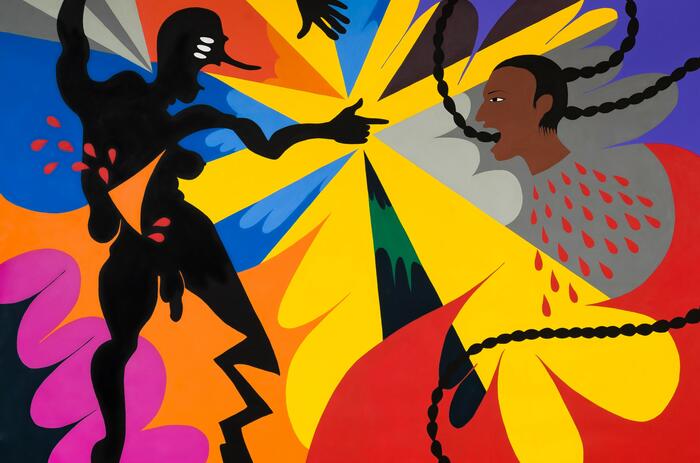
LA CHOLA POBLETE PRESENTS HER FIRST SOLO SHOW IN BRAZIL
With references to Baroque, Pop Art, Andean cosmology, music, fashion, and political protest, the exhibition at MASP encourages reflection on gender, colonialism, and the Chola identity.
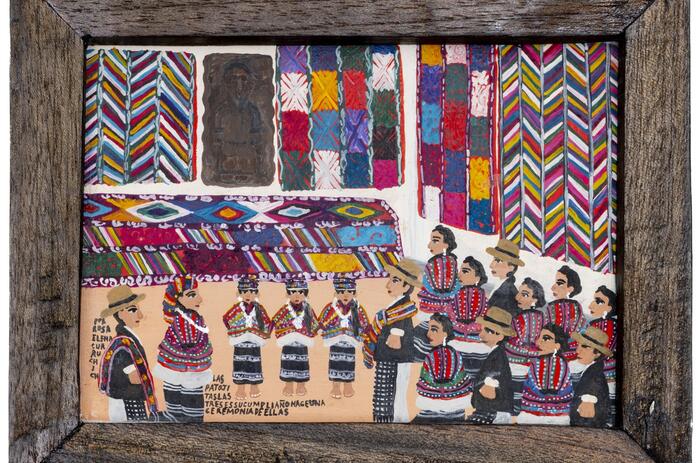
LATIN AMERICAN HISTORIES: MASP PRESENTS ITS 2026 PROGRAM
The museum explores the construction of the region’s identity through a major group exhibition and solo presentations by Jesús Soto, Damián Ortega, Sandra Gamarra, La Chola Poblete, among other artists.
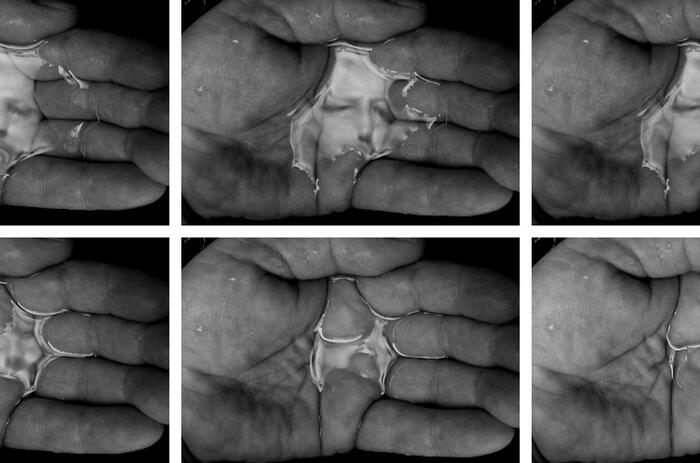
WAYS OF REMEMBERING: YAHUARCANI AND MUÑOZ AT MASP
The Brazilian museum presents works by Santiago Yahuarcani and Oscar Muñoz, exploring ancestral knowledge and the fragility of images in Latin America.
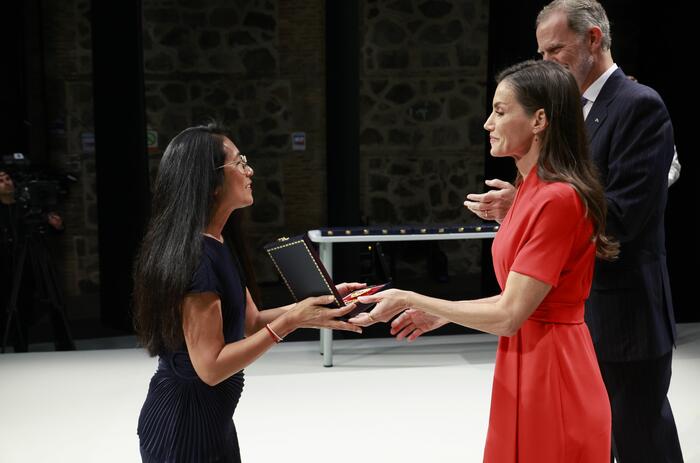
SPAIN HONORS SANDRA GAMARRA HESHIKI WITH ITS MOST PRESTIGOUS CULTURAL AWARD
The Lima-born, Madrid-based artist received the Gold Medal for Merit in the Fine Arts from King Felipe VI and Queen Letizia at a ceremony in Toledo.

MASP PRESENTS INTERNATIONAL GROUP EXHIBITION “HISTÓRIAS LATINO-AMERICANAS”
Spanning five floors of the Pietro Maria Bardi Building, the exhibition brings together works by 148 artists, including previously unseen works, to examine how the idea of Latin America was constructed and continues to be contested today.