
DEBORAH CASTILLO AND A CLOSING PERFORMANCE IN MEXICO CITY
As part of the exhibition Gran Basamento at the Chapel of Laboratorio Arte Alameda in Mexico City, artist Deborah Castillo and composer Lanza present on October 10 the nano-opera Discursos para las masas (Speeches for the Masses) as the closing act of the show.
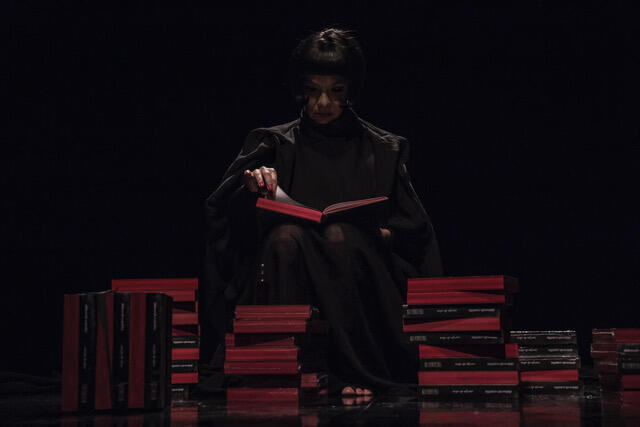
More than sixty voices perform scores that dissolve and recompose the discourses of power, inviting the audience to reflect on historical and political memory, with ruin as a symbol of transformation.
Gran Basamento is a project that politicizes and expands historical memory, inviting the audience to rethink the mechanisms of power and its inevitable fate: ruin. Castillo’s work stems from the extremes of power—political, ideological, civilizational—to serve as a reminder that every monument to power is, ultimately, destined to disappear.
The project emerged from an invitation by the Laboratorio Arte Alameda team, who sought to establish a dialogue with the Chapel through a site-specific work. Castillo’s proposal reverses the gesture of Spanish conquest: instead of building churches over the “stone demons” described in colonial chronicles, Gran Basamento resurrects an ancient ruin—the first of its scale in Mesoamerica—reviving the Cuicuilco pyramid as a community center and a site for critical reflection.
Laboratorio Arte Alameda, housed in the former Convent of San Diego—built in 1591 on the Alameda Central—has been reimagined as a meeting point between history and contemporary experimentation. Its architecture retains echoes of the sacred and the colonial, yet today opens itself as a laboratory for critical thought and expanded art. This tension between the monumental and the ephemeral, the devotional and the political, makes it an ideal setting for projects that question narratives of power. In this context, Gran Basamento does not merely occupy the space—it rewrites, resignifies, and reactivates it as a symbolic territory.
Castillo emphasizes that reconstruction is not meant to evoke nostalgia but to highlight the fleeting nature of power. The pyramid reemerges as a ruin, reminding visitors that all political grandeur, with time, is doomed to vanish. “Every monument to power is, in fact, a monument to the ruin of power,” the artist affirms.
The dialogue between past and present deepens through the relationship with Federico Cantú’s mural Los informantes de Sahagún (Sahagún’s Informants). The mural portrays the encounter between Sahagún and the Indigenous informants during the writing of The General History of the Things of New Spain—a violent and unequal exchange. Castillo underscores that history is not a single tale of winners and losers but an ongoing dispute; the scores accompanying the project function as a palimpsest, layering inscriptions that reveal the tensions between historical versions.
Castillo’s work does not confine itself to the past. Her reflection on the discourses of power extends to contemporary figures, such as Donald Trump, and their performances in international arenas. Through writing, graphics, and music, the artist dismantles these speeches, exposing how they operate as historical theater to enforce obedience. Memory, in this sense, becomes a political act and a tool for critical analysis.
The performance Discursos para las masas, created in collaboration with composer Lanza, expands this reflection into a sonic register. Conceived as a dramatic oratorio, the composition features a choir of more than sixty voices accompanying the live reading of the scores displayed alongside the monument. Within this space, opposing speeches dissolve and recompose amid cries, shouts, and noise—creating a sound sculpture that invites us to rethink political memory and the ways in which history is constructed and preserved.
Related Topics
May interest you

THE SOCIOPOLITICS OF THE SYMBOL IN EDUARDO SARABIA, AT VETA

THE HUMAN CONDITION AT FUNDACIÓN PROA: TWELVE LENSES ON CONTEMPORARY URGENT ISSUES
The tenth edition of the Prix Pictet brings together in Buenos Aires twelve international photographers who address the major social and environmental challenges of our time.

LATIN AMERICAN ARTISTS IN SPAIN: NOTES FROM A RESEARCH PROJECT
By Mónica Sotos
What are the successive diasporas of Latin American artists to Spain from the final years before the beginning of the 21st century to the present about? Article 1 of a 3-part series.

GABRIEL DE LA MORA’S SURFACES OF DESIRE AT MUSEO JUMEX
Opening on September 25, 2025, the exhibition examines drive, loss, and material transformation in the artist’s work.
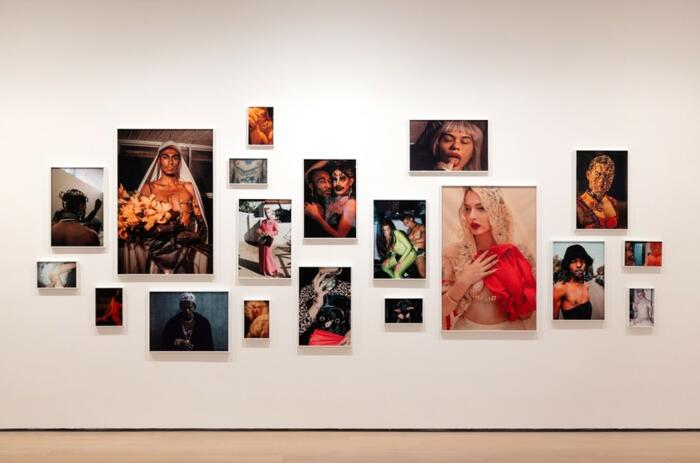
LINES OF BELONGING AT MoMA: MEMORY, COMMUNITY, AND FUTURE THROUGH CONTEMPORARY PHOTOGRAPHY
The show brings together 13 artists from Mexico City, Johannesburg, Kathmandu, and New Orleans to explore the power of connection across generations and geographies.