IMPACT, RECOVERY AND STRUGGLE ON THE FIFTH ANNIVERSARY OF MEMORIA
By Álvaro de Benito
(S)Obras Completas is the exhibition with which MEMORIA celebrates its five years of activity. This exhibition, presented simultaneously in the two spaces the Madrid gallery maintains in the Spanish capital, seeks to open a space for reflection on this time and the impact of its activity, rather than to function as a retrospective or a gesture of self-congratulation.
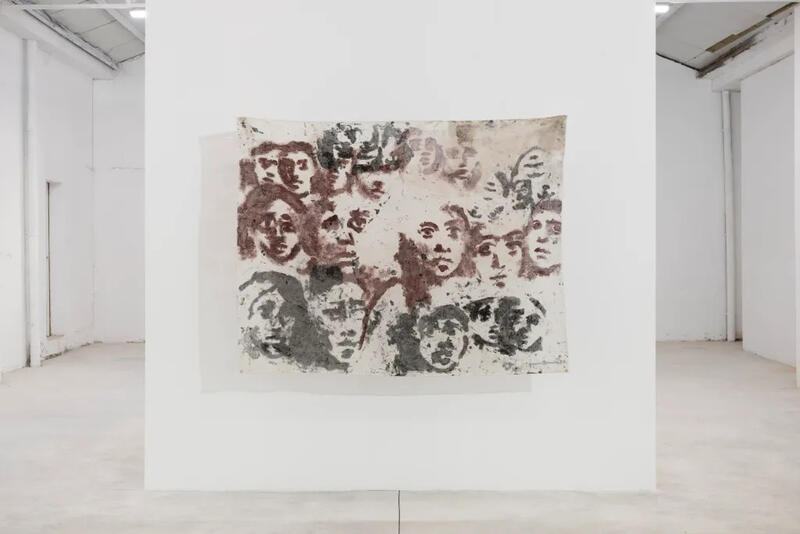
Taken as a whole, the exhibition establishes diverse approaches that tend to complement each other under the conceptual umbrella of memory and dissent as instrumental elements of struggle and the reimagining of the present through the generational past. Within this, the Latin American presence is significant.
The first section, Saberes de la Tierra, located at the downtown venue, highlights the importance of ancestral knowledge and manual labor, reframing part of the semantic debate around craft and art, and advocating for the recognition of spirituality as an essential part of production.
Social justice and a certain mysticism appear in the sculptures of Ernesto Cardenal (Granada, Nicaragua, 1925 – Managua, Nicaragua, 2020) and in the work of the Solentiname Community and its proposal of resistance. The ceramics of Gustavo Pérez (Mexico City, Mexico, 1950) amplify the meaning of the artisanal as a processual gesture, reiterating in his work the union of the corporeal with the ethereal.
Antonio Pichillá Quiacaín (San Pedro La Laguna, Guatemala, 1982) reclaims and revitalizes the Mayan textile tradition, turning it into a tool in the service of memory and resistance to colonialist policies. Meanwhile, Marta Palau (Albesa, Spain, 1934 – Mexico City, 2022) also employs the possibilities of textile experimentation to endow, from an exilic perspective, the cultural insurgency of an indigenous and spiritual identity with instrumental force.
At the venue in the popular neighborhood of Carabanchel, Cuerpos desobedientes unfolds, focusing on struggles in contexts of repression and on gender reaffirmation. Against political violence stand the actions of Guillermo Núñez (Santiago, Chile, 1930 – ibid., 2024), who transformed torture and detention into visual metaphors. The members of the Grupo Signo, José Balmes (Montesquiú, Spain, 1927 – Santiago, Chile, 2016) and Gracia Barrios (Santiago, Chile, 1927 – ibid., 2020), render the intensity of exile and violence—Balmes with visceral urgency, and Barrios with the memory of the disappeared in a gestural mourning.
Among the conceptual strategies developed in the 1970s, the actions of the Chilean collective C.A.D.A. stand out for their importance, as do those of the Mexican group Peyote y la Compañía, who denounced the trivialization of violence and pain by the media through interventions in newspapers. Antonio Romero (San Salvador, El Salvador, 1978), with a more contemporary language mediated by the influence of the digital, reflects in his proposal the violence circulating through social networks.
In another approach, Paz Errázuriz (Santiago, Chile, 1944) and Yolanda Andrade (Villahermosa, Mexico, 1950) turn to documentary photography with a more intimate focus on the body. Their images capture the everyday lives of transsexuals and transvestites, probing affectivity within a narrative that transcends marginalization. In this vein, Maya Goded (Mexico City, Mexico, 1967) and Terry Holiday (Mexico City, Mexico, 1955) also claim an empathetic stance against social exclusion.
-
Peyote y la Compañía. “(S)Obras Completas”, 1980. Cortesía de MEMORIA
-
Juan Castillo, Frankenstein, 1996. Cortesía de MEMORIA
-
Terry Holiday, “El espejo”, 2025. Cortesía de MEMORIA
-
Roser Bru. “Dos veces Frida”, 1979. Cortesía de MEMORIA
-
Maya Goded. "Untitled. Tamaulipas, México” 2009, de la serie “Welcome to Lipstick”. Cortesía de MEMORIA
-
Paz Errázuriz. “La Palmera”, 1982-1987, de la serie “La Manzana de Adán”. Cortesía de MEMORIA
Armando Cristeto (Mexico City, Mexico, 1957) portrays the vulnerability of the sexualized, objectified male body, while the master Graciela Iturbide (Mexico City, Mexico, 1942) represents in her series Los Cholos the complexity of Mexican-American border identity and culture.
With regard to transgenerational memory and a certain insurgent feminism, Roser Bru (Barcelona, Spain, 1923 – Santiago, Chile, 2021) delves into the reexamination of combative traditions in Latin America from a feminist, exilic perspective—a line later taken up by the Chilean collective Las Yeguas del Apocalipsis in some of their actions, representing insurgency and political struggle.
(S)Obras Completas can be seen until November 15 at the two MEMORIA venues, located at Piamonte 19 and Morenés Arteaga 18, Madrid, Spain.
May interest you


CRITIQUE AND CONCEPTUALISM OF CARTOGRAPHY IN KARLO ANDREI IBARRA

LATIN AMERICAN ARTISTS IN SPAIN: NOTES FROM A RESEARCH PROJECT
By Mónica Sotos
What are the successive diasporas of Latin American artists to Spain from the final years before the beginning of the 21st century to the present about? Article 1 of a 3-part series.

DEBORAH CASTILLO AND A CLOSING PERFORMANCE IN MEXICO CITY
As part of the exhibition Gran Basamento at the Chapel of Laboratorio Arte Alameda in Mexico City, artist Deborah Castillo and composer Lanza present on October 10 the nano-opera Discursos para las masas (Speeches for the Masses) as the closing act of the show.

AN “ANTI-ARCHIVE” MADE HOME: ANGIE SAIZ AT THE BIENNIAL OF MEDIA ARTS
What turns a place into a home? Chilean artist presents the immersive installation Bemol, which through sound and visuality builds an intimate and subjective cartography of inhabiting again a familiar environment.