ADRIÁN VILLAR ROJAS TRANSFORMS THE ASPEN ART MUSEUM INTO GEOLOGICAL AND MYTHOLOGICAL CAVE
First Gods, Lost Animals, curated by Claude Adjil, traces the symbolic systems humans built to navigate a universe that exceeds their cognitive scale.
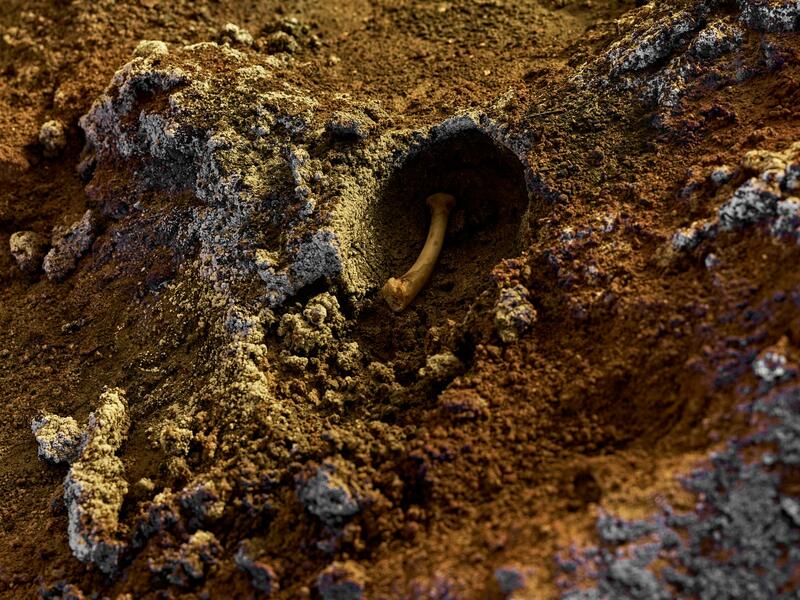
The Aspen Art Museum presents Adrián Villar Rojas: First Gods, Lost Animals, an exhibition spanning two floors of the museum, on view through April 11, 2027. Curated by Claude Adjil, the show evokes both the geological and mythological formation of a cave: a space of double accumulation, shaped through eons of material deposition and mineral consolidation, and culturally layered with human projections, rituals, and symbolic activity.
The exhibition is grounded in the premise that humans, as finite intelligences, confront a universe whose complexity far exceeds their cognitive scale. In this condition, symbolic tools arise — gods, art, mathematics — as adaptive technologies that render the world navigable. Mythology operates as an early interpretive scaffold, mathematics formalizes abstraction, and artificial intelligence marks the newest threshold in this lineage, externalizing thought to meet increasing complexity.
-
Adrián Villar Rojas: First Gods, Lost Animals; 2026. Installation view, © Adrián Villar Rojas &; Jörg Baumann. Photographed by Jörg Baumann. Credit Aspen Art Museum
-
Adrián Villar Rojas: First Gods, Lost Animals; 2026. Installation view, © Adrián Villar Rojas &; Jörg Baumann. Photographed by Jörg Baumann. Credit Aspen Art Museum
-
Adrián Villar Rojas: First Gods, Lost Animals; 2026. Installation view, © Adrián Villar Rojas &; Jörg Baumann. Photographed by Jörg Baumann. Credit Aspen Art Museum
-
Adrián Villar Rojas: First Gods, Lost Animals; 2026. Installation view, © Adrián Villar Rojas &; Jörg Baumann. Photographed by Jörg Baumann. Credit Aspen Art Museum
At the center of the environmental transformation sits a new sculpture co-commissioned by the Aspen Art Museum and Audemars Piguet Contemporary: Untitled (from the series The Language of the Enemy), a life-size triceratops skull. The work imagines a prehistoric encounter between Homo sapiens and Neanderthals as a possible moment when the first gestures of meaning or image-making passed between species. Villar Rojas proposes a theoretical history that challenges prevailing anthropocentric narratives: while symbolic creation has long been attributed to Homo sapiens, recent findings suggest that Neanderthals may have engaged in such practices before us. The birth of art would thus be not a triumph of our species, but a gift from another now vanished.
Adrián Villar Rojas (Rosario, Argentina, 1980) lives and works nomadically.
First Gods, Lost Animals is on view through April 11, 2027, at the Aspen Art Museum, 637 East Hyman Avenue, Aspen, United States.
Related Topics
May interest you
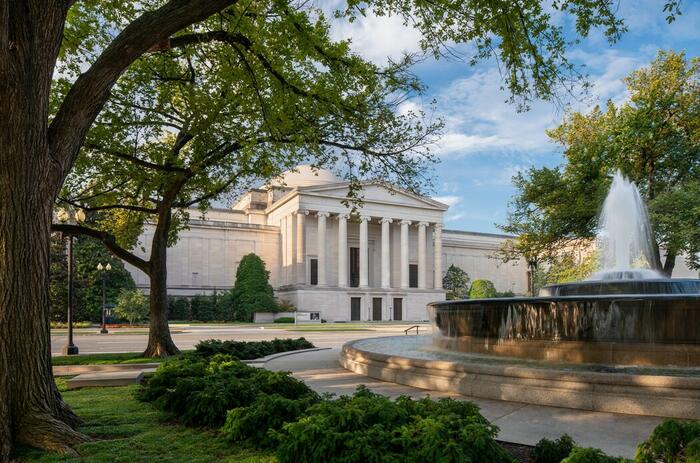
THE NATIONAL GALLERY OF ART RECEIVES NEARLY 50 WORKS FROM THE BEREZDIVIN COLLECTION
The gift by Diana and Moises Berezdivin brings works by Allora & Calzadilla, Rafael Ferrer, Damián Ortega, Chemi Rosado-Seijo, and Rosângela Rennó, among others, to the Washington museum.
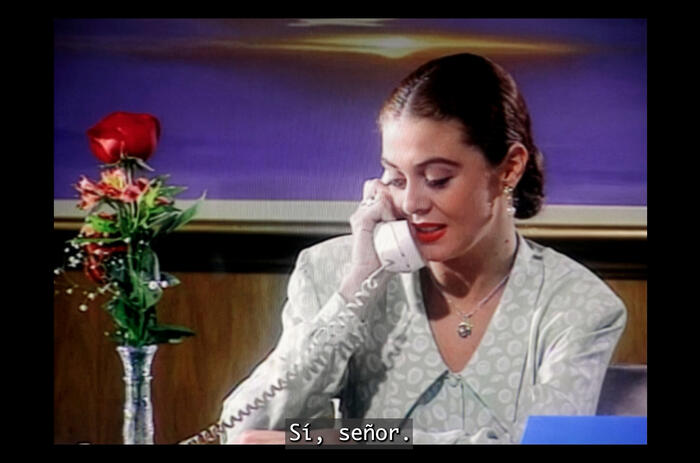
THE TELENOVELA AS A SUBJECT OF RESEARCH AT AMERICAS SOCIETY
The exhibition in New York will feature more than 50 works from the 1970s to the present, including an installation commissioned from Mexican artist Pablo Helguera.
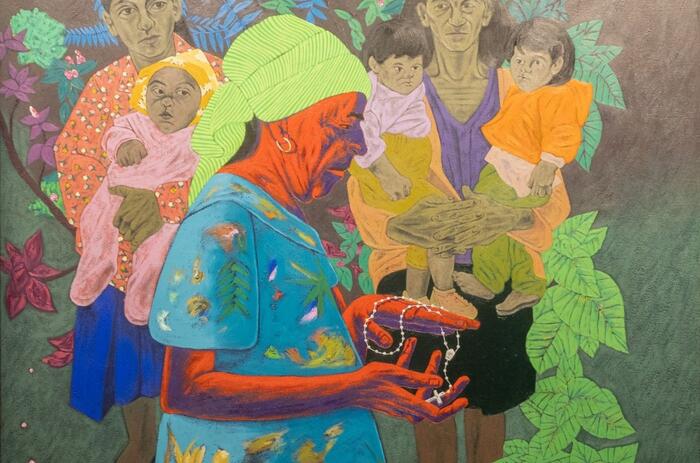
WHEN ART EXPANDS THE MEANING OF DEVELOPMENT: THE INTER-AMERICAN DEVELOPMENT BANK COLLECTION
When discussing the growing international recognition of Latin American and Caribbean art, attention often turns to museums, galleries, art fairs, and collectors. Yet some of the earliest and most sustained initiatives emerged outside the traditional art world. This is the case of the art collection of the Inter-American Development Bank (IDB), which, with a history spanning nearly seven decades, today brings together close to 1,800 works from Latin America and the Caribbean.
MODELS OF GALLERY COLLABORATION MARC STRAUS AND NUEVEOCHENTA: AN ALLIANCE BETWEEN COLOMBIA AND NEW YORK
By Maria Paula Suarez and Montserrat Miranda Ayejes
POETRY, LANDSCAPE, AND FORM: ELBA BAIRON AND PAOLA VEGA AT EL MAR
On Saturday, July 4, the exhibition biformes bicoloreadas bitremendas bilejanas lejanas lejanas opened at Museo MAR in Mar del Plata, featuring artists Elba Bairon and Paola Vega, curated by Sofía Dourron.
COLORS AND TEXTURES AT PLATEADA, LA PLATA’S ARGENTINE ART FAIR
With a work by Lido Iacopetti presented by Aldo de Sousa at the beginning of the fair, as a La Plata's city grail, as Facundo Belén—artistic director of Plateada alongside Virginia Martin—described it, the fair presents its 2026 edition in the main hall of the Teatro Argentino, in La Plata, Argentina.