
AN ANALYTICAL JOURNEY THROUGH THE HISTORY OF PERU, AT DANIEL CUEVAS
By Álvaro de Benito
The History of Peru. 13 artists, 12 works, presented at Galería Daniel Cuevas and curated by Miguel Aguirre, brings together the work of thirteen Peruvian artists to trace a critical journey through the social and political history of Peru. By revisiting key episodes and moments in the country’s past, the exhibition reveals how the impact of tensions, inequalities and unresolved conflicts continues to shape its structural problems and its social fabric.

The eleven works on view offer a visual narrative that challenges official and officialist accounts, opening a space for visibility, critique, and analysis. The selected artists foreground issues and conflicts that remain open wounds and that have played a decisive role in the formation of Peruvian identity.
Fernando Bryce (Lima, Peru, 1965) presents Obra 100+, a superimposition of recognizable graphic elements and images and texts taken from the internet or generated by artificial intelligence, through which he reflects on capitalism, globalization, and the omnipresence of the economy and corruption. Migrante, a graphite drawing on canvas by Claudia Coca (Lima, Peru, 1970), addresses the colonial semiotics of the “other” in relation to migration and imperial discourse. Sandra Gamarra (Lima, Peru, 1972) contributes a series that juxtaposes classical art texts by historian Corrado Ricci with Peruvian press photographs of vulnerable populations, creating a dialogue that contrasts the classicism of European art with the social realities of contemporary Peru.
Jean Paul Zelada (Trujillo, Peru, 1972) and Alejandra Delgado (La Paz, Bolivia, 1977) collaborate on Just for one day, a depiction of a military scene featuring Francisco Bolognesi and his officers, which is unexpectedly interrupted by the presence of Madonna—an allusion to the ways historical memory and popular culture coexist and transform one another. Nicole Franchy (Lima, Peru, 1977) turns to landscape and territory in Huepetuhe, denouncing environmental devastation through beams of light that fracture space. The painting series of Iosu Aramburu (Lima, Peru, 1986) operates as a tribute to socialist thinker José Carlos Mariátegui, recreating intimate portraits of him from a deeply human and emotional perspective.
Verónica Luján (Trujillo, Peru, 1987) begins with a press photograph taken during the 2023 protests in northern Peru, using painting to evoke the contradictions and complexities of the country’s political climate. The pictorial collage of Raúl Silva (Lima, Peru, 1991) draws from old engravings, baroque painting, comic books and recent photography to reflect on destruction, colonialism, and the relationship between nature and civilisation. Benjamín Cieza Hurtado (Lima, Peru, 1991), in Aquellos años maravillosos I and II, explores how sport and religion operate as fundamental components in the construction of collective and social imagination.
-
Jean Paul Zelada y Alejandra Delgado. Just for one day, 2013-2025. Óleo sobre lienzo 99 x 120 cm
-
Nicole Franchy. Huepetuhe, 2002. Técnica mixta 59 x 91 cm
-
Iosu Aramburu, Despedida (JCM-AO I), 2022. Óleo sobre tela 33 x 26 cm
-
Verónica Luján. La histeria del Perú, 2025. Óleo sobre tela 40 x 50 cm
-
Raúl Silva. S.T, 2022. Óleo y grafito sobre papel adherido a lámina de metal 80 x 100 cm
-
Benjamín Cieza Hurtado. Aquellos maravillosos años I. Óleo sobre tela
-
Fernando Nureña. Sin título (W Retto 01), 2025. Óleo y sobre lino 40 x 50 cm
-
Juan Carlos Catacora. Hay miedo y celebración II, 2025. Óleo y sobre tela 32 x 50 cm
-
Ashly Gómez. El peruano ya aprendió, 2025. Acrílico sobre cartulina 51.5 x 41 cm
Fernando Nureña (Lima, Peru, 1993) employs pictorial recreation as a means to reclaim memory and legacy, while Juan Carlos Catacora (Lima, Peru, 1996), also through painting, questions the catastrophist construction of reality in the media and points to anonymity as an inseparable part of that narrative. In the same vein, Ashly Gómez (Lima, Peru, 2002) presents two works inspired by a sensationalist newspaper to expose the normalization of violence, police repression, and structural violence.
The History of Peru. 13 artists, 12 works can be visited at Galería Daniel Cuevas, Santa Engracia 6, Madrid (Spain), until 16 January 2026.
May interest you
THE QUOTIDIAN GESTURE AS A POLITICAL ACT: ARGOTE AT ALBARRÁN BOURDAIS

GROUP EXHIBITION ON THE RESIGNIFICATION OF CRAFT IN ISABEL HURLEY
THE LATEST EVOLUTION OF BLACK MIRROR / ESPEJO NEGRO BY LASCH, AT CASA DE MÉXICO
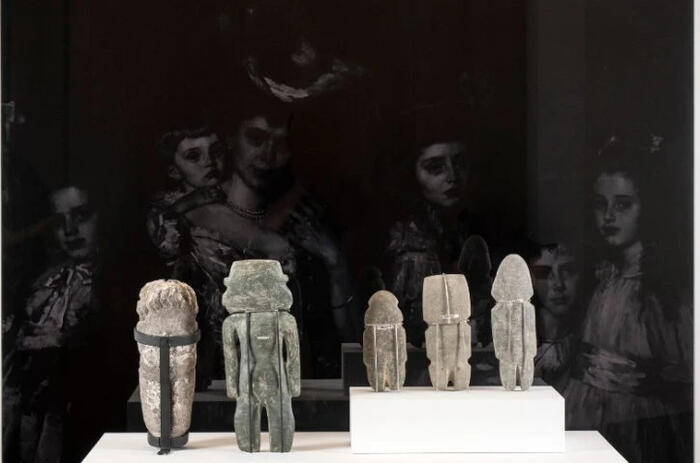
The Fundación Casa de México in Spain hosts Re/Generación, a new installation from the Black Mirror / Espejo Negro series produced by Pedro Lasch (Mexico City, Mexico, 1975) and curated by the National Institute of Anthropology and History of Mexico (INAH). Originating from an initiative originally produced by the Nasher Museum of Art in Durham, North Carolina, in 2007, the series has been transformed through various techniques, evolving its language toward a narrative that makes it impossible to separate past and present, as well as spectator and proposal.

RAUSCHENBERG’S PHOTOGRAPHIC APPROACH AND LATIN AMERICAN ROCI SERIES, AT JUAN MARCH FOUNDATION
The Juan March Foundation in Madrid presents an extensive and analytical exhibition on Robert Rauschenberg (Port Arthur, USA, 1925–Captiva, USA, 2008), focusing on the use of image and photography in his work. The exhibition, structured from a novel curatorial perspective, reinterprets the production of one of the great masters of contemporary art, highlighting it as the outcome of an essentially photographic practice.

THE ART AND SCIENCE OF SIGMAN AND SARDÓN, AT OFF ELBA BENÍTEZ
VIDEO COLLECTIONS FROM CA2M, MAC PANAMÁ AND BIENALSUR JOIN IN MÓSTOLES
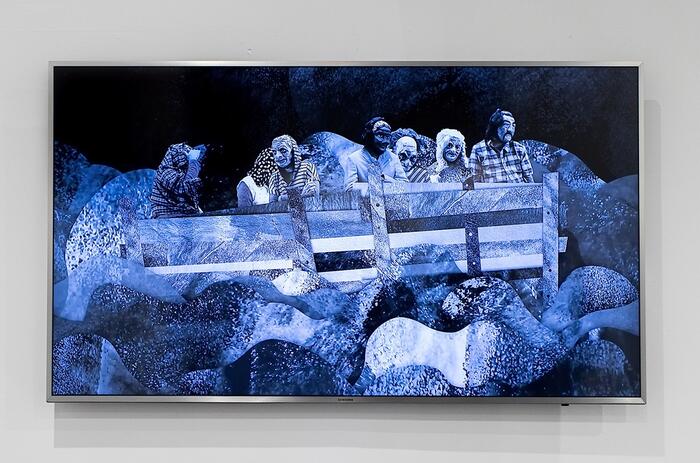
Un visionado a tres voces (A three-voiced screening frames) is the conversation between three video art collections that draw from the languages and dynamics of different Southern contexts. The selections prepared for the occasion by the Centro de Arte Dos de Mayo Museum (CA2M Museum) in Móstoles —which hosts the initiative—, MAC Panamá and BIENALSUR, carried out through MUNTREF in Buenos Aires, also aim to establish synergies among the institutions.
THE CINEMATIC GAZE OF ANA SEGOVIA AT C3A
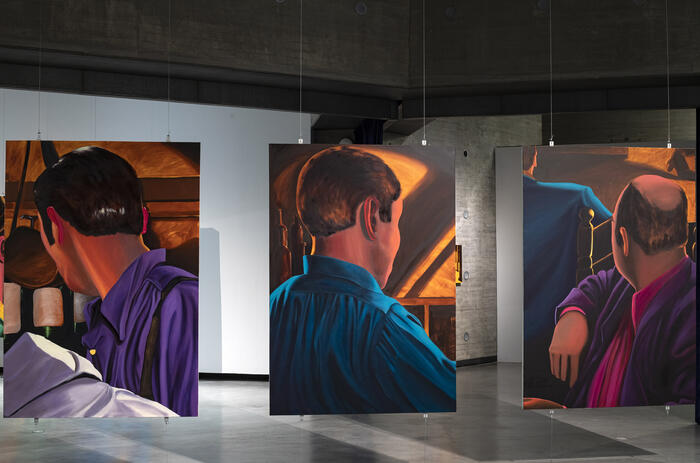
The Centro de Creación Contemporánea de Andalucía (C3A) in Córdoba is presenting Me duelen los ojos de mirar sin verte, the first solo exhibition in Spain by Ana Segovia (Mexico City, Mexico, 1991), on view until January. Curated by Jimena Blázquez Abascal, the show features thirteen oil paintings on canvas and one work on wood, all created expressly for the occasion.
MARTIEL AND THE BODY AS ACTION AGAINST EXCLUSION, AT CENTRE DEL CARME
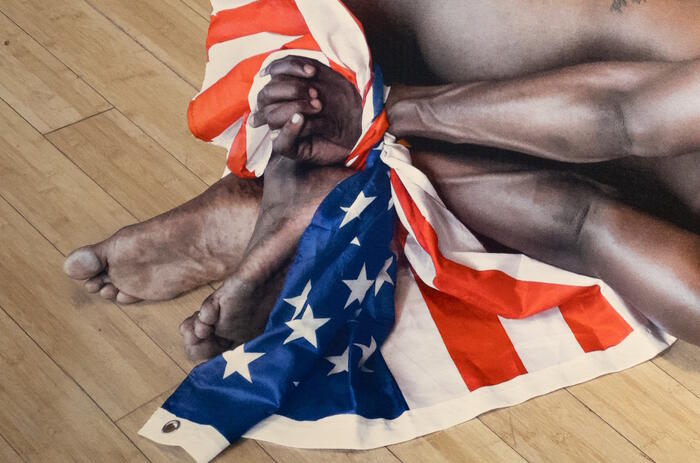
The Valencian Centre del Carme presents South Body, a broad selection of recent performance documentation by Carlos Martiel (Havana, Cuba, 1989). Through photographs and videos, the exhibition explores the relationship between racism and xenophobia and the way the body becomes the materialization of exclusion. This corporeal object, or objectified body, is employed by the artist as a medium to express cries of resistance and to propose critical reflections on power structures and their influence on the construction of contemporary society.