
By
María Galarza
After its acclaimed presentation at the 60th Venice Biennale, the Disobedience Archive lands at PROA21 with a new configuration. What in Italy took the form of an animated pre-cinematic machine —The Zoetrope— that drew the viewer into a visual experience, now adopts in Buenos Aires a more intimate and austere format.
To insist, to question, to multiply, to adapt, to remake.
Curated by Marco Scotini since 2005, the Disobedience Archive is an audiovisual project in constant transformation that explores the intersection between art and politics. Its logic is rhizomatic: it grows, adapts, and resignifies itself in every new territory it enters.
Challenging the idea of the archive as a closed, definitive collection, the Disobedience Archive proposes an unstable, contradictory architecture — one in constant dispute. A space where memories cross and contradict. At the Venice Biennale, the archive adopted a kinetic character, with a curatorial vision that emphasized rhythm, multiplicity, and expanded montage.
Its arrival in Buenos Aires brings with it another temporality: more fragmented, closer to the street than to the museum, more tied to movement than to monumentality, more performative in its dialogue with the local present. The visitor is not guided but thrown into an open, uncomfortable structure where they must dig, search and activate. The experience is neither easy nor seductive: it is political. Stripped of the scenographic apparatus that framed its Venetian version, the Disobedience Archive here operates with fewer resources and, perhaps, more proximity.
Among the works on display, those by the Etcétera / International Errorist Movement collective and the Grupo de Arte Callejero emerge from and speak directly to Argentina. Militant art: a visual practice that is playful and fearless. A disobedience that is not imported, but a habit carried out through error and subversion.
Macri, Feinmann, TN, journalists, the importance of March 24th in Argentina, mass mobilizations, C5N, panel shows, Intratables, Santiago del Moro — all fragments from the media storm generated by the International Errorist Movement’s activation. In FAKE NEWS – El club del helicóptero (2017), a life-sized cardboard helicopter appeared during the March 24 commemorative march. A "fake news" incident that sparked editorials, debates, media coverage, and conspiracy theories, as the image evoked the 2001 crisis in which then-president Fernando de la Rúa fled the presidential palace by helicopter. It is not merely a protest image: it is a visual device that parodies the language of the state, turning the act of marching into a scene of poetic dissent.
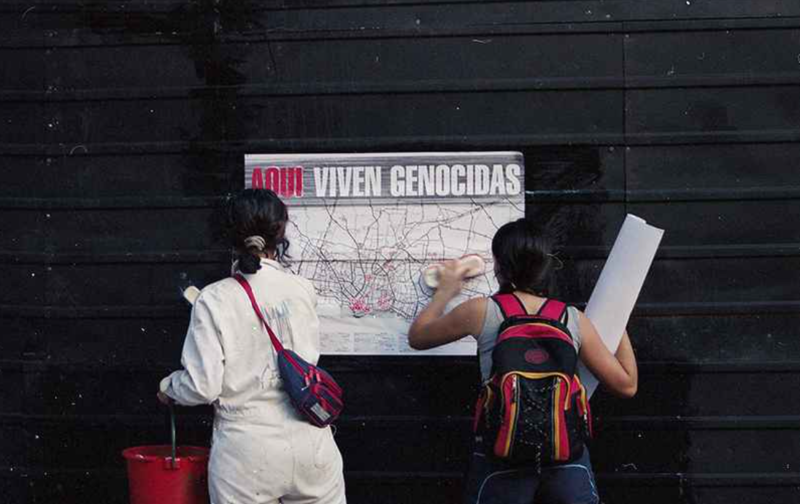
Since 1997, the Grupo de Arte Callejero (GAC) has intervened in public space to subvert transit codes, posters, and urban signage, denouncing institutional violence, repression, and exclusionary policies. Aquí Viven Genocidas (2001) is a poster-guide listing the addresses and phone numbers of still-unpunished repressors. Invasión (2001) involved the release of ten thousand miniature paratroopers from a downtown building in Buenos Aires, coinciding with the social uprising of December that year. Poema visual para escaleras (2002) transformed the Lanús train station into an ascending topography of violence, with repressive phrases read step by step. A winding path of activations, marked by sharp, direct critique, employing the power of shock and humble materials to achieve unwavering symbolic force.
*Cover image: Street Art Group. Aquí Viven Genocidas. Poster nº2. March 24, 2002. Photographic record of actions and interventions. Courtesy GAC.

The gallery welcomes a key figure in Argentine and Latin American art since the 1960s. Her practice has unfolded between Buenos Aires, New York, and Paris, spanning painting, design, performance, and fashion, with a radical approach to the body, desire, and a bold, romantic vision of the female condition.

The artist and the gallerist were drinking mate on Fleming Avenue in Martínez, in front of the gallery, trying to hold onto the warmth of a cool autumn sun. That simple, everyday, and sincere image foreshadowed the exhibition at Departamento 112.

The Cordoban artist and architect Teresa Maluf presents Cuando el encierro es la salida (When Confinement Becomes the Way Out), a site-specific installation located in the chapel of Paseo del Buen Pastor in Córdoba, Argentina. With this work, Maluf pays tribute to all the women who, over nearly one hundred years, passed through this building—many of them deprived of their freedom.

Proa Foundation celebrates the reopening of its renovated spaces with an exhibition organized in collaboration with the Vitra Design Museum: Here We Are! Women in Design 1900–Today, a journey through 120 years of female creativity, innovation, and talent in design.
BIENALSUR Week 2025 opened with a diverse and expansive program at key venues in the city of Buenos Aires. It will continue throughout July and run until December at various venues.