
By
Álvaro De Benito
The Museo Reina Sofía in Madrid reviews over half a century of the Colombian artist’s career with an exhibition that transforms the night and autobiographical experience into key elements for addressing identity, violence, and social and political conflicts through a consolidated formal language.
The Night (La noche), the title of the exhibition dedicated to the work of Miguel Ángel Rojas (Bogotá, Colombia, 1946) by the Reina Sofía in Madrid, reveals almost everything. That darkness, understood from all its semiotic angles, conceptually frames the proposal developed over more than half a century by what is probably one of the most widely recognized figures in the renewal of Colombian artistic language. And it is so because it stems from the meaning of the secret, the discreet, the furtive—in general, of that which remains in a darkness that can be interpreted as a vital and conceptual existence.
Both the artist and the curator of the exhibition, María Wills Londoño, have coincided in this articulation for a show that is not arranged chronologically and that even reverses the spatial order to achieve a comprehensive review of Rojas’s practice and ideas. Above all, a central issue prevails that emphasizes the relevance of the idea over the process, whereby the final result must be contemplated as a whole without an end. Or, at least, without having to reach a specific objective.
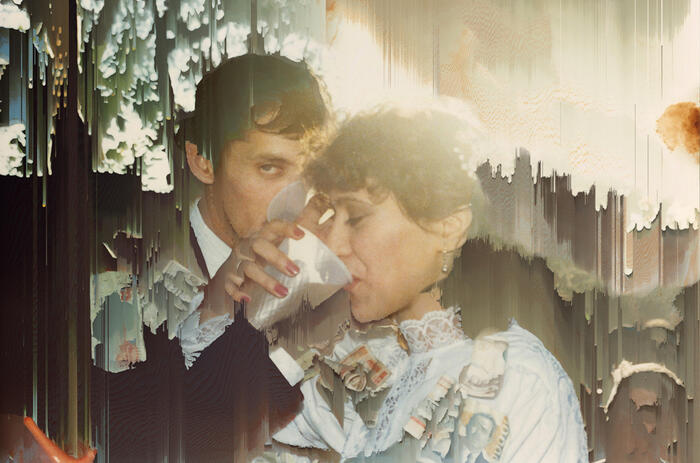
Through The Night parade questions of an autobiographical nature that mark the clandestinity of space as a site of resistance and freedom—places that determine a symbolic and political character. His series of snapshots, such as El Freddy and, above all, Cinemas. Mogador: Tardes tensas IV (1976)—the latter presented for the first time in its entirety—embody an instrumental curiosity of the photographic to satisfy a personal impulse, but also as a record of the marginal.
Precisely, it is these peripheral histories of a certain social violence that constitute a narrative of what is exhibited. And they are so through their narrative capacity to unify the multiple facets and personalities through which the artist has traversed. The assumption of his origin as a foundational element finds a direct allusion in Grano (1981). Rojas travels through family memory, mestizaje, and his roots to construct a foundation that will expand through the gaze of one who inhabits a politically and socially hostile environment.
Although raising certain questions of experimentation, the Colombian prefers to delve into the lived experience. Pelito (1974) and Virosis (1986) exemplify the desire for survival or the vulnerability endured, which are interwoven into a tangle of violence, drug trafficking, and continuous warfare that produces solvent discursive lines. Everything might seem like a graphic interpretation of the history of Colombia, but a vital residue always underlies the critique.
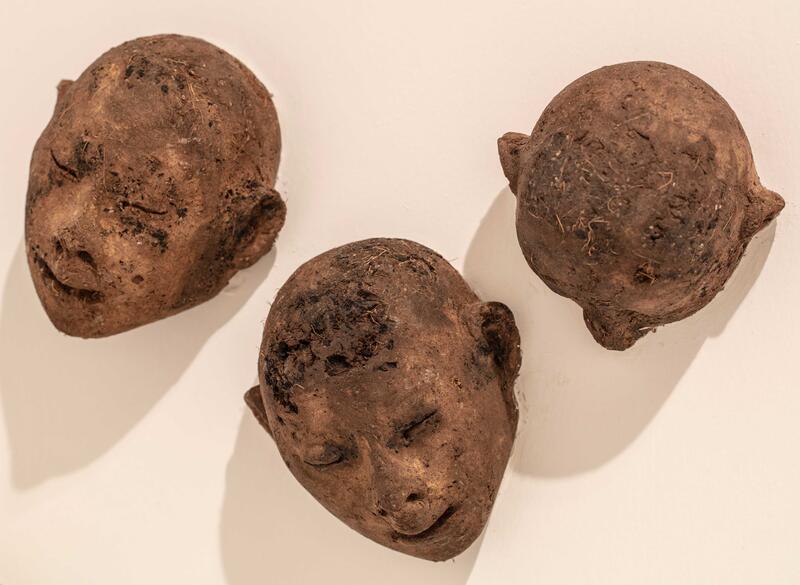
The heads of La cosecha (2012) could allude, almost by way of self-portrait, to that "living Tumaco" with which Rojas identifies, allowing him to unite, in a singular and forceful language, the anthropology of Indigenous identity and ancestral knowledge. All of this is combined with an incisive critique of the impact of extractivism, environmental devastation, or the exploitation of resources upon which he prompts reflection. In El nuevo Dorado (2012/2019) or Dark Amazonas (2006), there lies a total declaration in the recognition that greed and avarice are forces superior to any ideology.
Technically, the use of organic and symbolic materials such as soil, gold, coca, or other plant elements transforms and materializes ideas with an inexorable connection to the territory. In that regard, as in David (2004), the body is also employed as a surface for critique and the recording of memory, or as a foundational element to address political and economic conflicts without leaving behind strong formal innovation.
The Night thus becomes more than a formal survey, positioning itself as a space and state closer to lived experience and to a certain progression of events that have forged Rojas’s career. In that patina of the personal, it obviously touches upon the local, historical, and geographical specificity in which the artist has been both object and subject. His own instrumentalization proves coherent and consistent in a complex exhibition where the narrative is underscored by the idea of sharing with the viewer an experience of idea rather than outcome, even though the latter enjoys enviable aesthetic health.
Miguel Ángel Rojas. The Night can be seen until March 15, 2027, at the Museo Reina Sofía, Santa Isabel, 52, Madrid (Spain).

An exhibition in the Spanish capital gathers nearly one hundred photographs by the Brazilian artist, centering on the landscape aesthetics of water and advocating for the urgent need for its protection.