
By
Manuel Vásquez Ortega
On a wall in downtown Buenos Aires, a tiny message from a fortune cookie tells the viewer: “Today is a good day to fall in love; look carefully around you.” Beneath the text sits an egg wearing a magician’s hat, next to a lit mosquito coil. Above it all, a single word: Yo (I).
The work described here is part of Querida emanación mía, yo te protegeré (My Dear Emanation, I Will Protect You), a series by Argentine artist Cervio Martini presented in the exhibition El triunfo de un corazón que lo da todo (The Triumph of a Heart That Gives Everything), at La Mala Galería between August and October 2026. The series takes the form of a soliloquy of overflowing feelings materialized in small installation-like scenes. A shared sculptural format—a wooden assemblage of objects covered by a small, illuminated canopy—unifies the works, in which hat-wearing eggs take center stage in scenes introduced by aphorisms that are as poetic as they are absurdly funny.
Through these phrases, the artist lays bare the innermost workings of his feelings in each of these altars. The eggs hold, contained and deposited within them, the liquid traces of his own desire: the material emanation of a consummated passion. Yet the title that reveals the autobiographical and self-referential nature of the work is only one part of a larger constellation of misfortunes and defeats. It is the testimony of someone willing to give himself over to another in a city where feelings are not necessarily the most valuable thing one can offer, within a context in which systems of power, both local and global, persist in restricting and eradicating the possibilities of free love. Scenes of tenderness, fetishism, and sadness thus sketch the emotional landscapes of a romantic artist, driven by the impulses of a contemporary subject who remains conscious of the darkness of his own time.
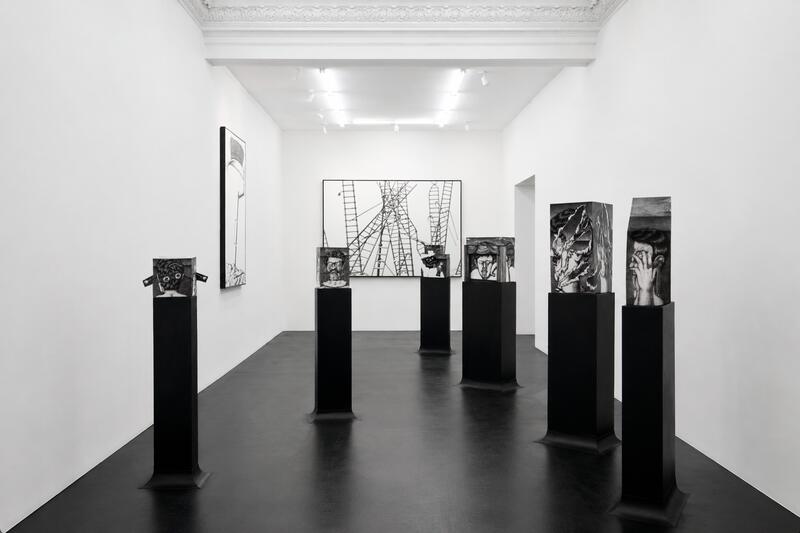
In a possible correspondence, separated by a slight temporal shift and only a few kilometers, another Argentine artist exposes the visceral nature of his thoughts through three-dimensional drawing and self-representation. At Constitución Galería, Nicolás Said presents ÉL (HE): a journey into the psyche of a creator and his fixation on the artistic medium, which he approaches both as a professional practice and as a method of personal inquiry. The exhibition’s title is no accident: it separates the artist from his representation. He is an él, not a yo; an other, rather than a self.
In his effort to find external perspectives from which to observe himself, Nicolás’s graphite drawings acquire corporeality through planes that define precise, almost architectural volumes. The interwoven structures and scaffolding of thought take shape as mimetic, though caricatured, representations of the artist’s existence. This process allows him to access profiles and views that the traditional two-dimensional surface would not afford him: the top of his head, the left side of his face, or the back of his head. Then the pencil appears: both the essential tool and material of his practice, and a central symbol that, in most cases, pierces, penetrates, and flanks his self-portrayed body.
Drawing on these elements, Said constructs a personal imaginary in which each symbol acquires a particular meaning. His visual vocabulary is organized through repetitions and recurring appearances that, alongside the pencil and the portrait, compose fantastical, surreal scenes populated by eggs, birds, houses, capes, and faces. These images sketch—and here I find myself asking again: do they sculpt?—the emotional and inner landscapes of the artist, as well as his concerns and frustrations, both in his artistic practice and in his experience of an increasingly oppressive context. Pain, strangeness, and pleasure intersect in a universe of sharp-edged, ornamental imagery whose structures seem to reproduce the workings of a mind attempting to decipher or, at the very least, represent its own mechanisms. This is a complex, hyper-detailed construction in which psychoanalysis and sexuality intertwine to explore the desires, pleasures, fears, and terrors that run through the artist’s experience.
In both exhibitions, at Constitución and La Mala, we encounter works that seem to condense the experiences of those who give them form: exercises in self-reflection assembled from feelings, hungers, needs, and tensions. These are two artists who are romantic yet realistic, erotic yet raw, complex yet direct, transforming their lived experiences into material for artistic exploration. Their works privilege interiority, imagination, and subjective experience, while making visible the tension between the individual and the world in which life unfolds.
But how does one represent oneself when desire, the body, and one’s relationship to otherness exceed the image one can construct of oneself? Beyond the obvious differences between the two artists, it is more compelling to consider what brings them together: the possibilities for correspondence between Nicolás Said’s objectified ÉL and Cervio Martini’s subjective YO.
While one of Martini’s works declares, “Me toco el culo, me huelo la mano, sos vos” (“I touch my ass, smell my hand, it’s you”)—absolute poetry in an age of fleeting reactions and fire emojis—in Said’s Reloj (Clock), the protagonist’s hand covers his face and touches his nose. Around him, twelve positions, like a personal Kama Sutra, form the circle that measures time. Pencils and eggs, limbs and containers, anxieties and sadness: the drawing acquires a body, and the assemblage becomes a form of autobiographical writing. Are we not witnessing an accidental correspondence between two sensitive testimonies, two experiences of relating to others that are as romantic as they are masochistic, shaped by the weight of time on the body and by existential finitude? (Ahre). Do these artists not share fixations, motifs and symbols, mediums and positions that allow us to think of them as Buenos Aires’s last romantics? Yet, among all the possible similarities, I am even more interested in asking what the object-like images or imaginal objects of Nicolás Said and Cervio Martini seek to uncover.
For the philosopher Pascal Quignard, “there is no image that affects us that does not recall the gestures that brought us into being”; in other words, the images that affect us remind us of our origins. And yet that precise scene—the moment of our conception—does not exist within us, and probably does not exist within anyone. For Quignard, the human being is the animal that lacks an image. Could this absence fuel the obsessions and frustrations of so many artists who search for an original image? Could it explain their exploration of scenes of love and sex in an attempt to find answers to questions never asked, to inherited doubts, and to restrictive structures and dynamics?
We know that, according to Freudian theory, sexuality does not begin with the encounter between two bodies: its roots extend into childhood and participate in the formation of psychic life. Desire, far from being a transparent will available to the subject, is organized through drives, fantasies, and unconscious conflicts that shape both the image we construct of ourselves and the ways in which we relate to others. Sexuality permeates us, from our most intimate spaces to our most public social relations. This dimension shapes our gaze—that of us as viewers and, in this case, that of the two artists as well—leading us to recognize metaphors in a pencil that is a working tool but also a longed-for phallus, or in a hen that evokes both the food that satisfies hunger and the testicles from which we seek to extract their contents, taste them, and swallow them.
Beyond these associations, however, a deeply human and distinctly contemporary desire emerges in the works of Said and Martini: the need for protection. The need to shield oneself from the hostility of a world turning to the right, from the absence of emotional responsibility, from the fear of growing old alone, of failing to succeed, or of never finding love. In the face of all this, it would be irresponsible to claim that today is a good day to fall in love. But, ultimately, nothing ventured, nothing gained.
In sixteenth-century Florence, Duke Cosimo de’ Medici and the painter Giorgio Vasari founded the Accademia del Disegno, one of the first institutions to offer artists a space devoted to perfecting their craft, free from commercial pressures. In 1863, in Paris, by order of Napoleon III, an exhibition was held for a number of artists whose works had been rejected by the jury of an official Salon. It was given the name Salon des Refusés (Salon of the Rejected).
The stand of the feminist civil society organization presents works by Nicola Costantino, Florencia Breccia, Guido Yannitto, Marina Daiez, and weaving collectives.
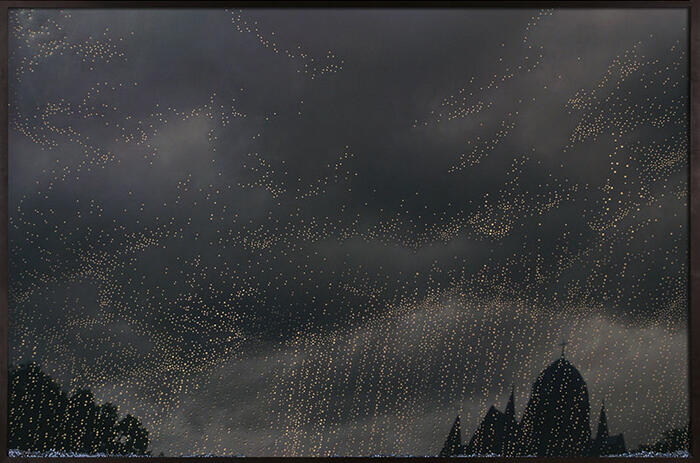
The Berlin-based Argentine artist was selected at Pinta BAphoto with a micro-perforated photograph.
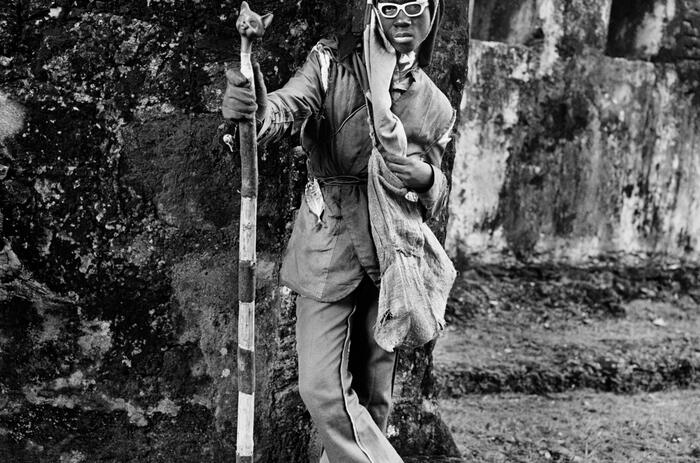
At the 22nd edition of Pinta BAphoto, the honored artist was Sandra Eleta, one of Latin America’s foundational photographers