
By
Alvaro Javier Marrocco
CERVIO MARTINI. THE SALON OF THE REJECTED
In sixteenth-century Florence, Duke Cosimo de’ Medici and the painter Giorgio Vasari founded the Accademia del Disegno, one of the first institutions to offer artists a space devoted to perfecting their craft, free from commercial pressures. In 1863, in Paris, by order of Napoleon III, an exhibition was held for a number of artists whose works had been rejected by the jury of an official Salon. It was given the name Salon des Refusés (Salon of the Rejected).
October 30, 2026
8 min.
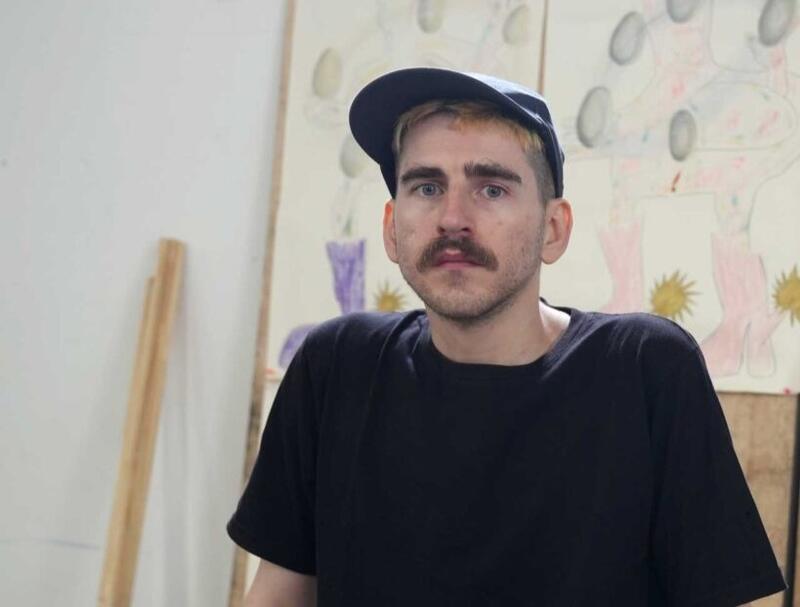
Cervio Martini
In their early days (before 1900 and into the early twentieth century), artist residencies and programs were usually initiatives driven by wealthy benefactors or patrons who housed creators in isolation. Today they are institutionalized or self-managed programs, or open calls organized around thematic axes such as technology, memory, gender, or territorial activism.
Artist residencies and programs are nothing new; they go back centuries. These programs offered not only material support but also fostered intercultural exchange, allowing artists to draw inspiration from one another. Today they remain active, though they have taken on diverse forms and disciplines. We spoke with visual artist Cervio Martini (1985) about his experience with residencies and programs for artists.
The sadness of the countryside at dusk with a radio playing in the background
Cervio Martini was born in a small town in the province of Córdoba called Huinca Renancó. “Being born there is pure magic. My head would explode whenever there was fog so thick I could only see my hands, crossing the square in my shirtsleeves on the way to school on cool mornings, my older brother’s electronic records, the Romani people sleeping and snoring on rugs, my first half-drunk nights, the smell of chlorine in summer, the sadness of the countryside at dusk with a radio playing in the background, I could go on and on… Every step I took there is still the most important thing that has happened to me.” Speaking of his move from his hometown to Buenos Aires, Cervio says: “I came to this city many years ago (15!). Nobody helped me, I think, but I do remember that when I took a workshop back around 2014, the prominent Argentine visual artist and graphic designer Andrés Sobrino told me I had to learn to call myself ‘artist,’ a word I still avoided.”
Enlarge image
-
Cervio Martini Instituto Tele Arte
Meeting people and talking
Around 2015 he took part in the Artists Program at Instituto Di Tella in Buenos Aires. Cervio recalls: “What I generally value about those processes is meeting people and talking; I don’t think there’s such a thing as teaching in art. What I remember most is a workshop I took with the versatile performance artist Eduardo Navarro (Buenos Aires, 1979) around 2017, where over the course of the classes we had to create our own avatar, a kind of costume of what we want to be.”
4 hours of natural light a day
In 2019 he completed the NES Artists Residency (Skagaströnd, Iceland). Skagaströnd is a small fishing village in northern Iceland, with stark landscapes, an extreme climate, and severe geographic isolation. For an artist whose aesthetic skirts the limits of the forbidden, the Icelandic residency radicalized his fixation with the male member; in fact, before traveling to northern Europe, he had opened solo shows with titles as suggestive and direct as Dicktionary (2014) at La Fábrica. “I was doing the residency in a town of 400 people, nothing to do, about 4 hours of natural light a day… I was editing video animation, but after a few hours my eyes were fried, and at the same time it was my first time having a studio, so I wanted to make the most of the hours there (since there was nothing to do), and I stole a pencil (which I’m still drawing with) and some A4 sheets. The first thing I did was copy latex gloves I found on the internet.” The work Cervio Martini conceived from his experience in Iceland was presented under the overall title Opið Hús (an Icelandic term meaning “Open House”). It is a piece with the texture and color of human skin that combines explicit anatomical forms: a glans that opens to reveal lips with teeth inside.
In 2019 he received the Yungas grant, a federal program of training, work analysis, and support for visual artists, coordinated in different regions of Argentina and aimed at training young artists from across the country. It operates as a space for production and reflection on Argentine art through an annual grant program in different cities. Its goal is to encourage not only artists in training but also the spaces and collecting circles of the various host cities where its meetings take place.
In 2020, Argentine visual artist Cervio Martini received the Oxenford Extraordinary Grant. The grant was an initiative of the Colección Oxenford, adapted as emergency financial aid during the COVID-19 pandemic and intended to ease artists’ economic hardship rather than fund a specific project or work.
Enlarge image
-
El triunfo de un corazón que lo da todo de Cervio Martini
In October 2023, the contemporary art exhibition No soy de aquí, ni soy de allá was held at the Instituto Tele Arte in Santiago, Chile, featuring Argentine visual artist Cervio Martini. The group show brought together ten artists to reflect on identity, migration, and displacement. Martini presented a series of drawings that work much like film frames or the pages of a storyboard, in which silhouettes in vibrant red and black footwear dance or perform acrobatics; they are suspended body parts, from nowhere, like the show itself: they are not from here, nor from there.
“I feel more places like these are needed”
In 2025, Martini took part, along with other artists, in a residency at Hito Cultural, a research, production, and networking platform for contemporary artists. Of his stay he said: “There were about 12 of us artists sharing a studio. At Hito we had visits from curators and collectors, and also 3 or 4 occasions when lots of people were invited to see a show of all the artists’ work. I feel more places like these are needed, a kind of exchange, a place to work toward one piece a year.” In the latest edition of the Federico Jorge Klemm Visual Arts Award 2025, Cervio Martini received a special mention from the jury.
La Mala Galería
This year, 2026, Cervio Martini presented his solo show last August, titled El triunfo de un corazón que lo da todo, a kind of carousel of experiences in which each work (all wall sculptures) represents some experience from his love life. “It’s not as literal as it sounds, but walking in, it feels like an open private diary. Simple as they are, each work has countless nuances, but of course that happens when you stay looking at them. As for the assembly process, since it’s a series, I first gave them a structure both physical and contextual: they all have a wooden floor and wall, a paper awning, and a small lightbulb, and each one also has a representative title. After that, I knew they would all have an egg representing me and different objects around it representing a situation.”
Enlarge image
-
Cervio Martini en PIEDRAS
In several of your works/drawings you deal with aspects related to sex, the forbidden, the body. What do you find in these themes?
—I’m barely interested in sex, but situations of the body are what drive me most. I feel the first thing I did was work with MY body because it’s what I have closest at hand. Over time I understood that biology can’t be disconnected from thought, something humans want to do at all costs. My work is there, in that ecotone where nothing is forbidden.
Which contemporary artists do you like and follow (life and work)?
—Diego Bianchi, Santiago de Paoli, Nicanor Aráoz, Martin Farnholc Halley, Jimena Croceri, Eduardo Navarro, Paula Castro, Björk, Toto Dirty, Roque Larraquy, Aki Kaurismäki, Mica Levi…
What plans do you have for 2027?
—Not much: keep applying to things, and maybe the odd group show. Fingers crossed. Honestly, for now I have no plans for 2027. 2026 was a year in which I did a group show, a solo show, a play, and two fairs; I think people deserve a rest from me.
Bio
Cervio Martini (Huinca Renancó, Córdoba, 1985) graduated from the technical degree program in Audiovisual Media Production at the Universidad Nacional de Córdoba in 2011. In 2009 he began developing his artistic work, publishing in independent art magazines and taking part in solo and group exhibitions. Between 2017 and 2018 he took part in the Artists Program at Universidad Torcuato Di Tella. Throughout his career he has taken workshops and work clinics with artists such as Eduardo Navarro, Miguel Mitlag, Diego Bianchi, Flavia da Rin, and Nicanor Aráoz, among others. In recent years he has exhibited, individually and collectively, at venues such as Galería Sendrós, Galería Piedras, Museo de Arte Moderno de Buenos Aires, La Fábrica, BA Photo, Roseti 202, UV Estudios, and Proa 21. In 2019 he completed the NES Artists Residency (Skagaströnd, Iceland) and received the Yungas (Buenos Aires) and Oxenford grants; in 2020 he received the Oxenford Extraordinary Grant.
Related Topics
May interest you
Interviews
SEBA CALFUQUEO: "I AM INTERESTED IN BLOWING UP PRE-ESTABLISHED IDEAS ABOUT THE INDIGENOUS"
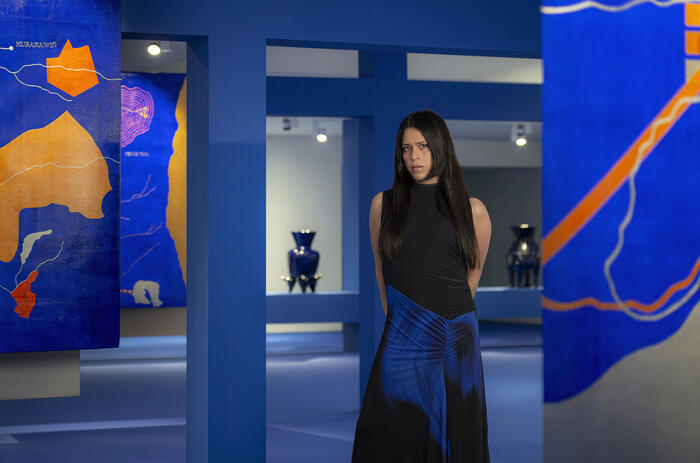
We spoke with Seba Calfuqueo on the occasion of her first institutional exhibition in Europe, at the Museo Thyssen-Bornemisza in Madrid, an exhibition that delves into the relationship with territory through history and identity from a heterogeneous, contemporary perspective.

Interviews
LA CHOLA POBLETE: "THEY EXPECT A VICTIM, I GIVE THEM A DIVA"
An Interview with La Chola Poblete
Interviews
EMILIA DE LAS CARRERAS, THE ARTIST WHO PRACTICES FICTIONAL TAXIDERMY
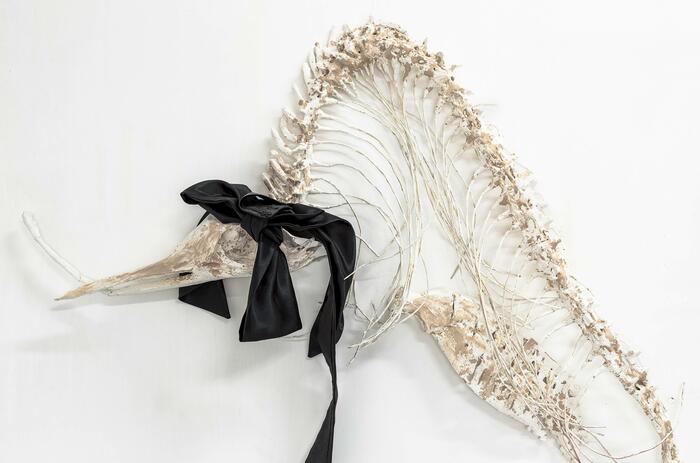
Just as Emilia de las Carreras (Buenos Aires, 1989) looks at the hermit crab and understands that leaving a mark means that life leaves marks on you too, engaging with her artistic practice inevitably means that little crusts of her narrative stick to us: the methodology she works with, her intuition as a collector, her thinking of the body as geology, her obsessions, her skeletal and exoskeletal sculptures. The artist's work explores bodies and their remains through a visual and sensory operation crossed with scientific research and self-knowledge, giving shape to pieces that evoke an intersection of the archaeological, the clinical, and the speculative. Her approach to art could easily fill dozens of pages; this is only one chapter.