
By
Álvaro De Benito
The reconstruction of Minujín and Santantonín’s iconic work at the Reina Sofía revives its transgressive spirit, nuances its ephemeral dimension, and confronts the temporal contradictions of an image-dominated contemporary society.
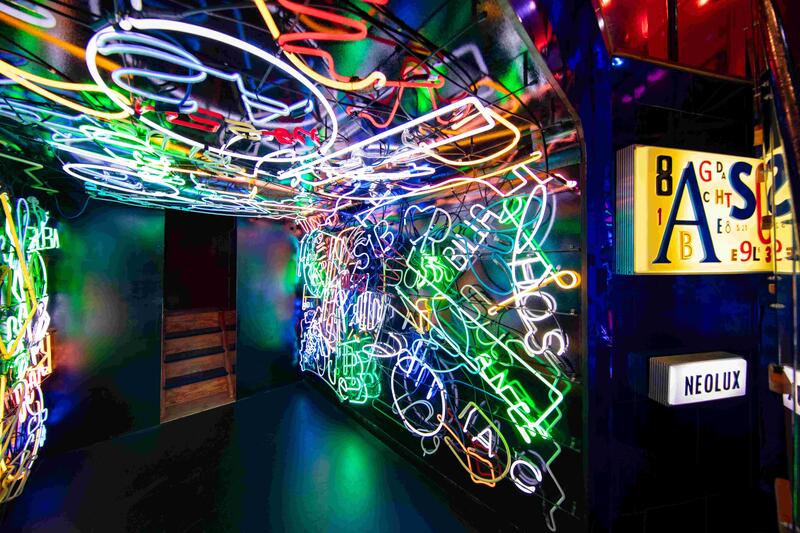
The rethinking of La Menesunda (1965) as a recurring event seems, in itself, destined to become yet another extension of the idea conceived by Marta Minujín (Buenos Aires, Argentina, 1943) and Rubén Santantonín (Villa Ballester, Argentina, 1919–Buenos Aires, Argentina, 1969) more than sixty years ago. Unfortunately, Santantonín is no longer with us, which means that Minujín’s memory and documentation are the only viable means of bringing it back to life with any degree of reliability. This is why La Menesunda According to Marta Minujín is such an apt title for the way the Museo Reina Sofía once again frames a new incarnation of the work—this title has been used since its first reconstruction in 2015—of one of the actions that most profoundly shook (and upended) the art world of the 1960s.
Starting from this essential fact, the questions raised by this new reconstruction in Madrid revolve around its exhibitionary and experiential dimensions, as well as the uncertainties surrounding its temporal and spatial decontextualization. No two iterations of the piece are alike, not only because of their structural differences but also because of the reasons underlying each revival. Here, La Menesunda emerges as the exhibition’s central focus, but also as though it were an excuse to revisit some of the indisputable milestones in the Argentine artist’s career.
Although it functions as a hive orbited by archival imagery and didactic panels emblematic of the Argentine artist’s practice and career—elements that effectively operate as a retrospective—, this curatorial effort ultimately becomes overshadowed by the magnetism of La Menesunda itself, whose physical presence asserts its dominance. The reconstruction, shaped by memory and executed with remarkable attention to detail, has been only minimally affected by European bureaucratic requirements concerning the materials. This is a minor obstacle compared with the enormous undertaking involved in bringing the exhibition to fruition over the past three years, a process that helps explain the immediate absorption experienced by anyone who enters the installation.
That spatial delirium, a layout not suited to every perceptual disposition, draws visitors into a time that is not their own. One might say that this initial sense of disorientation is less a form of madness than an estrangement induced by the dreamlike quality of the curiously mundane. There is something about the unfolding of the journey, the uncertainty of its trajectories and possible exits, that prompts a state of alertness, even as part of the mind drifts, guided by external factors, elements, and actors that shape the experience.
Assessing the ephemeral and fleeting nature of the current La Menesunda may lead to a certain contradiction. If the participatory dimension of happenings allowed anyone to become part of the artwork, their perception and experience also became part of the action itself. Hence, the reconstruction of the space, always according to Marta Minujín, cannot restore the original work’s momentary character, but it does underscore that the visitor’s experience remains personal and ephemeral—and in this respect, nothing has changed.
A conceptual clash might therefore emerge around the notion of intimacy, which one enters from within a society where the absurdity of extimité prevails. Visitors are invited to embark on an intestinal journey, to engage in passive voyeurism before reproduced scenes of everyday life, or to encounter the surreal uncanninessthat converges in every corridor. At the same time, however, a temporal divergence takes place, whereby the space simultaneously becomes the subject and object of visual consumption, as well as an ideal setting for an aesthetic beholden to the like.
Amid these temporal discrepancies, which are almost exogenous in nature, La Menesunda remains aseptic as an element out of its time, but never anachronistic. It has not merely survived the accelerated pace of contemporary life; it also stands proudly as a living testament to a period vastly different from the present in both social and technological terms. If it was once disruptive and avant-garde, its function now endures through the transformation of a society that seems to need stimuli in order to move forward, regardless of whether that medicine is, curiously enough, being revived from a past that, according to Minujín, was no better.
La Menesunda According to Marta Minujín is on view through March 8, 2027, at the Museo Reina Sofía, Santa Isabel, 52, Madrid, Spain.
The Museo Reina Sofía in Madrid reviews over half a century of the Colombian artist’s career with an exhibition that transforms the night and autobiographical experience into key elements for addressing identity, violence, and social and political conflicts through a consolidated formal language.

An exhibition in the Spanish capital gathers nearly one hundred photographs by the Brazilian artist, centering on the landscape aesthetics of water and advocating for the urgent need for its protection.