
By
Adriana Herrera
THE LEGACY OF EVELYN W. POLITZER (1961–2026) IN MIAMI'S ARTISTIC COMMUNITY
May 22, 2026
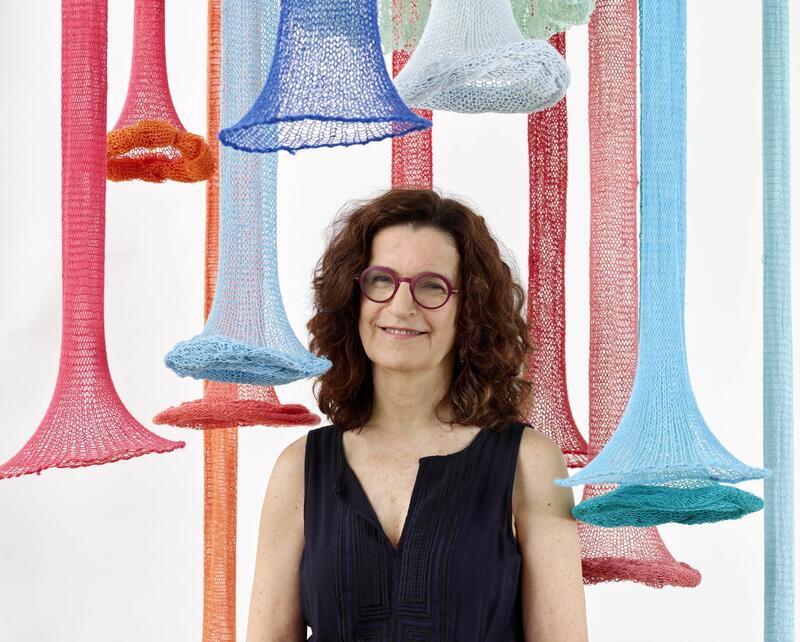
Evelyn Politzer ©2023 Daniel Portnoy (Edited)
In the week that followed the passing of Evelyn W. Politzer (1961–2026), a pivotal figure in the city's textile art scene, countless expressions of affection emerged alongside a mobilization of cultural initiatives that revealed how, in a time when the sense of community seems to have vanished, art in a city like Miami has been capable of building a social fabric able to bind itself to the meaning of creation even beyond death.
In tribute to Politzer's work — which united a sense of play and creative freedom with the need to "make us aware of the fragility of Mother Nature and convey her call to interconnection through wools, thread, and fabric" — her family asked that, instead of flowers at her farewell ceremony, donations be made to the Jewish National Fund for water solutions or to plant trees, as well as to the Fiber Artists Miami Association (FAMA), which she co-founded with Aurora Molina and Alina Rodríguez Rojo one afternoon during the pandemic year, and which today counts 350 members.
Enlarge image
-
Evelyn W. Politzer. Free Form Weaving On Cloud Nine, 2026
In a work from that same year, Nature's Map (2020), this artist — born in Uruguay, who left law to study at the Parsons School of Design in New York and was then working on her thesis for an MFA in Visual Arts — created an imaginary cartography of a nonexistent place using hand-dyed sheep's wool: multiple open paths departed from or arrived at a place where colors meet. It was the beginning of her poetic maps for returning, gently, to the elements of the Earth, also connected to her idea of weaving together communities bound by a love of tactile fiber and visions of reconnection.
Molina highlights that the generosity of Evelyn's husband, Gabriel Politzer, was a constant throughout FAMA's growth, and that today, with the funds received through numerous donations, the association will award a scholarship for students wishing to undertake a project with textile fibers — a scholarship that will bear her name. Likewise, at the Textile Art Triennial that FAMA will inaugurate next June at the Miami International Fine Arts venue (MIFA), the Evelyn Politzer Prize has been established. Both initiatives extend the legacy of Evelyn, who created her work with the conviction that it was both possible and necessary to recreate — through touch and color, through abstract forms or ones as archetypal as nests — the beauty and fragility of the planet, in order to cry out for its protection. She demonstrated this through solo and two-person exhibitions at Florida Atlantic University, at the Fort Lauderdale and Miami airports, in the gardens of the Miami Beach Botanical Garden and Pinecrest Gardens with the Harvest Project, and at the Miami Beach Botanical Garden. At the time of her passing, she was simultaneously showing work at the Deering Estate and the Aluna Art Foundation in Miami, as well as at the Florida Craft Art Gallery in St. Petersburg, among other venues. She also devoted herself to ensuring that FAMA elevated the value of textile art within the community through education and initiatives that connected the individual to a collective made up primarily of women — though today Marco Caridad, artistic director of MIFA, stands as one of its pillars.
Her work radiated, as her two-person exhibition Woven Waters (2022) announced, "a sensitive and sensitizing poetics, connected not only to water but to our own steps, as a species, upon the earth." Born in Uruguay — a country where there were more sheep than people — Politzer grew up perceiving hanks of hand-dyed wool drying in the sun as part of the landscape. For her, it was therefore natural to forge an alliance between the thousand greens and ochres of the earth and the intense reds, yellows, and blues of uncarted wool, or of fibers resistant to sun and rain, designed to hang from trees, as seen in her Nidos series (2016–2021), currently on display in the interior garden of the Tower Hotel in Little Havana, as part of Aluna Art Foundation's Endangered and Unseen exhibition. A testament to the consistency of her love for other kingdoms and her character — as open to the playful as to deep commitment — is the fact that, upon discovering that a stray cat nicknamed Botero by the artists of Tower Studios Miami (for his beauty and dimensions) had taken possession of one of her red nests hanging from a tree, where he sunbathed and slept, she declared him the only cat in the world to own a work of art.
Enlarge image
-
Evelyn W. Politzer, Red Nest
It was in the mid-nineties that, upon entering a Manhattan shop and touching wool from her homeland, its rough texture carried her back to her origins and unleashed the beginning of her artistic career. "As soon as I touched the wool and saw the colors, I reactivated the thread of connection with my land." The knitting women of her country and of her family returned to her memory, and she healed the pain of the early loss of her mother to an undetected cancer by crocheting breasts of all sizes and colors, and nipples that formed enormous installations, interwoven with a mode of bodily awareness that exorcised the fear of illness — without lacking, in the ensemble, humor as a shield, as an exercise in lightness.
Conjuring aesthetic forms to invoke protection, she created Every Drop Counts (2018–2023). Each drop, knitted on two needles in monochromatic or combined tones, is different from the next, hanging or falling in ways that accentuate the weight, the very existence of this element akin to a teardrop. Politzer embroidered some of its surfaces with red or orange threads tracing vein-like forms, endowing water with an organic quality connected to human beings. The pieces in the Overflowing Dreams series (2022) arose from flood dreams she experienced after moving to Miami in 2015. But rather than depicting destruction, she created works that, while abstract, evoke aerial perspectives of the waters of the Blue Planet washing over the gaze.
Evelyn W. Politzer always believed that the experience of beauty calls us to care. In her earlier works devoted to the language of water, the restraint of her undulating textile furrows — moving between blues, greens, and ochre — echoed the restriction that the course of human beings now requires. In one of her final creations, made for FAMA's current collective exhibition River of Grass at the Art and Culture Center of Hollywood, she wove red wools into a textile full of force, and rather than evoking the tones of water and grass, she recreated the red aura of light on the horizon. A monochromatic work invoking life — not only for a threatened place like the Everglades, but for all spaces on Earth. Something that, she knew, can only be achieved by bringing visions together. For this reason, Amy Gelb — one of the first artists to rally behind FAMA and who gave Evelyn the recent joy of acquiring two of her nests for her personal collection this month — affirms that the tapestry of Evelyn Politzer's life, which wove together so many threads of care within the community, will continue to be extended and honored.
May interest you
News
MARGARET WHYTE TURNS FRAGILITY INTO LANGUAGE AT THE 2026 VENICE BIENNALE
The Uruguayan Pavilion in Venice will present Whyte’s work, which combines textiles, obsolete machines, and scraps of waste to demonstrate that disorder does not destroy.

Architecture
CRISTO OBRERO: BRICK, GRAVITY, AND FAITH
By
Isaac Khafif
Tucked between Punta del Este and Montevideo in the unassuming coastal town of Atlántida, Uruguay, lies one of the most powerful and tenacious examples of twentieth-century architecture in the world: La Iglesia Cristo Obrero.
Reviews
WIFREDO LAM: “WHEN I DON’T SLEEP, I DREAM” - RETROSPECTIVE AT MoMA
By
Julia P. Herzberg
April 27, 2026