
By
Isaac Khafif
CRISTO OBRERO: BRICK, GRAVITY, AND FAITH
Tucked between Punta del Este and Montevideo in the unassuming coastal town of Atlántida, Uruguay, lies one of the most powerful and tenacious examples of twentieth-century architecture in the world: La Iglesia Cristo Obrero.
March 31, 2026
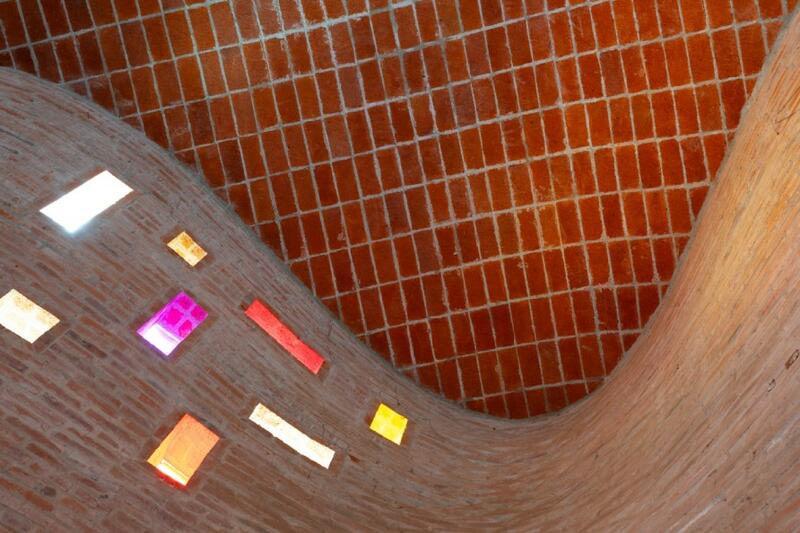
Iglesia Cristo Obrero, 2026 © Isaac Khafif
Unlike most Catholic churches, Cristo Obrero rejects symbolism, authority, ornamentality, and excess of any kind. To worship here is to choose red bricks over painted saints, intentional mathematical design over stained glass mosaics. In a sense, it is a church that values logic over belief.
Completed between 1958-60, Cristo Obrero was intended to revolutionize religion. From the outside, the building rejects the traditional hierarchy of the church. There is no dominant façade nor axial entrance, nor does it tower towards the heavens, promising to raise a visitor up above their earthly station. Instead, its brick walls unfold laterally into the landscape. Rising and falling with the quiet, rhythmic discipline of sandstone. Its presence is neither commanding nor picturesque. It is deliberate, measured, and restrained.
Inside, that restraint intensifies. The pews are puritan, the walls unembellished. There is no religious imagery of any kind, instead, geometry, load, and worship collapse into a single architectural dance. The brick ceiling ripples as though inhaling above you, and soft sunlight beams in through defined apertures.
Here, religion is not about tracking the journey of saints or martyrs, but of tracking the journey of the sun across the sky. Light becomes a secondary material, as calibrated as the brickwork it interrupts.
The photographs accompanying this essay engage with Iglesia Cristo Obrero on its own terms. Close-ups emphasize the masonry’s precision and discipline; wider shots reveal the continuity of the structural waves and the absence of hierarchy. The near absence of people is intentional. The architecture is allowed to perform on its own. Neither orthodox modernism nor regional expressionism, the church remains as quietly revolutionary today as it was fifty years ago. It demonstrates how radical innovation can emerge from constraint, and how humble materials—brick and human thought—can produce a space of profound intensity. This church does not tell you how to worship God, it instead invites you to feel Him.
This Church became a UNESCO World Heritage Site in 2021.
Related Topics
May interest you
Closed
Open Calls
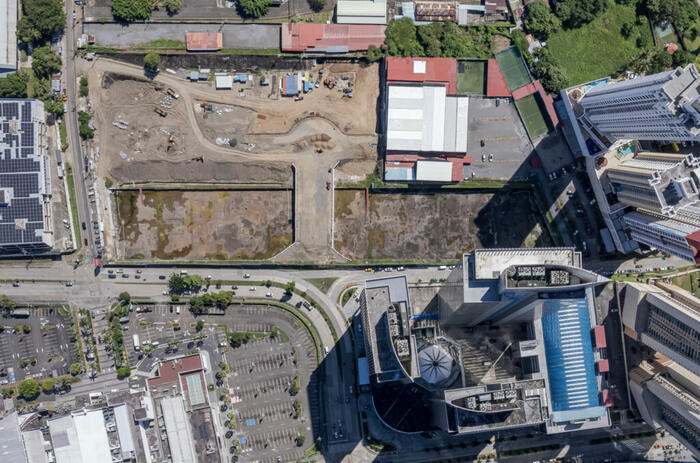
MAC PANAMÁ LAUNCHES AN INTERNATIONAL ARCHITECTURE COMPETITION
The museum seeks to reaffirm its leadership as a cultural institution and its commitment to a more sustainable, inclusive, and creative future for the country and the region. Application deadline: March 29, 2026.
News
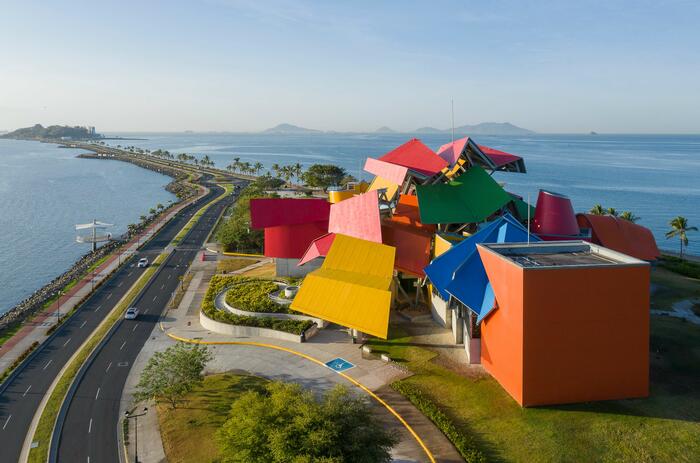
THE BIOMUSEO, SCIENCE AND ARCHITECTURE OF THE FIRST LEVEL
By
Esther María Arjona
On the Amador Causeway, right at the entrance to the Panama Canal of the Pacific Ocean, the Museum of Biodiversity takes place, with a structure that does not go unnoticed both for its shapes and for its color. It is an avant-garde building that coexists with the natural environment.

Reviews
THE LEGACY OF EVELYN W. POLITZER (1961–2026) IN MIAMI'S ARTISTIC COMMUNITY
By
Adriana Herrera
In the week that followed the passing of Evelyn W. Politzer (1961–2026), a pivotal figure in the city's textile art scene, countless expressions of affection emerged alongside a mobilization of cultural initiatives that revealed how, in a time when the sense of community seems to have vanished, art in a city like Miami has been capable of building a social fabric able to bind itself to the meaning of creation even beyond death.
May 22, 2026

