CLOSE ENCOUNTERS: ART AS A SOCIAL EXPERIMENT - BEATRIZ CHACHAMOVITS IN ART AND CULTURE CENTER, HOLLYWOOD, FLORIDA
Review about the exhibition Into the Great Dying: (The Steps We Take), on view until June 2022
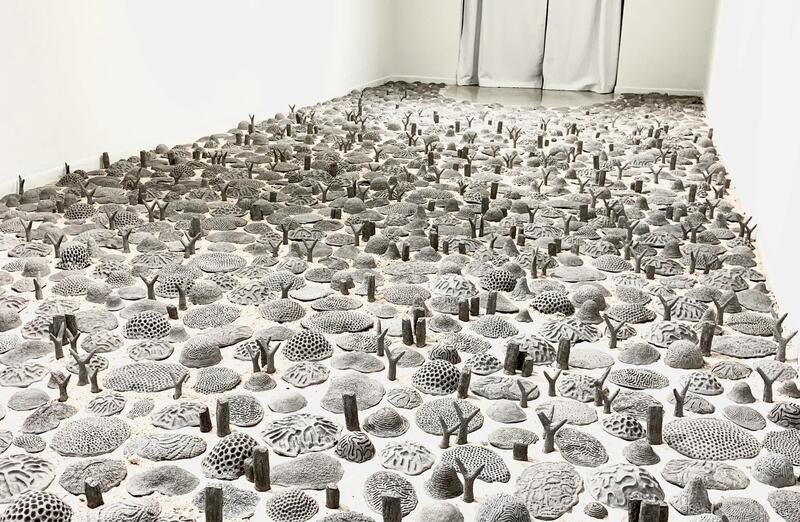
A room filled with more than 2,000 clay coral sculptures was conceived as a visual and sociological experiment that reflects upon the dire situation of most coral reefs in the world, an important concern in Beatriz Chachamovits’ body of work. Only 40 minutes after the show’s opening, there was nothing left on the ground but an unrecognizable layer of crushed clay and sand. For Into the Great Dying: (The Steps We Take) Chachamovits made 50 different molds inspired by real and imagined coral shapes in order to produce the pieces occupying the 30 x 11 feet project room at the Art and Culture Center in Hollywood, Florida for C(h)oral Stories and Collective Actions exhibition, curated by Ombretta Agro. This relevant work is the artist’s first large-scale installation, and it continues the research-based social and educational art process Chachamovits has been inclined to since her early beginnings as an artist who raises awareness towards the preservation of coral ecosystems.
Upon entering, a label announces that the public is invited to walk through the installation, with the artist’s intention of generating a thought-provoking action while walking on top of a fragile ecosystem of clay corals, an action which draws parallels between processes of construction and destruction in both art and nature. The artist´s expectation was that the public would walk carefully through the ‘reef’, considering the fragility of the pieces and making one or two paths. Instead, as a result of the invitation to walk through, the experiment ended up being destructive, as the public purposely aimed to destroy every existing clay figure. We cannot but understand this action as a violent representation of the worldwide state of coral reefs. Since the 1950s, the earth has lost more than half of the existing reefs, and in the next 20 years 90% more will probably be gone. The causes for this always point towards human activity: fishing, coral mining, contamination, and of course, human induced climate change. Coral reef destruction is currently one of the gravest consequences of global warming. How we understand the world and make it a better place is one of the important premises that art making has for Chachamovits.
-
Beatriz Chachamovits, Installation View (Before) at Art and Culture Center Hollywood - Into the Great Dying (The Steps We Take), 2022 - Photo courtesy of the artist.
-
Beatriz Chachamovits, Installation View (Before) at Art and Culture Center Hollywood - Into the Great Dying (The Steps We Take), 2022 - Photo courtesy of the artist.
Some interesting facts that need to be pointed out in the context of the installation are that the intention of the artist did not produce the desired outcome, as Chachamovits underestimated the savage interpretation made by the public. She initially thought that every literal step taken by the public would metaphorically imply the steps to learning about the fragility of the reefs, just as the action acknowledges the value of the hand-made work of an artist, which ultimately ended up being destroyed with ease. The vandalism that devastated her installation was heartbreaking, as they clearly invoked what real reefs suffer in the long term. We can re-think the paradoxes and parameters of our participation in both art and nature; understanding that the process of art as a social or educational tool needs only to be made clearer, as an invitation to participate can be easily misinterpreted.
Chachamovits recently inaugurated the Faena Art Project Room, for which she produced a second large scale immersive site-specific installation Into the Great Dying: Waters We Share, showcasing clusters of diverse coral systems that have been carefully placed on blue circumference platforms, slightly elevated from the floor, so the public can look and meander throughout, but is not welcome to walk over. Though her practice, Chachamovits hopes that the instinctive inclination of humans to destroy can be reoriented towards caring behavior in response to clearly defined stimulus, much in the way we should walk through art or the natural world.
-
Beatriz Chachamovits, Installation View at Faena Art Forum Project Room - Into the Great Dying (Waters We Share), 2022 - Photo courtesy of the artist
Beatriz Chachamovits (b. São Paulo, 1986) is an environmental artist and educator living and working in Miami since 2018. Her work renders tangible the decline of the coral reef ecosystems, and the role played by humans in it. Her intention is to share the majestic beauty of at-risk marine ecologies as well as the appalling rate of their destruction. She works with monochromatic ceramic sculptures and drawings to highlight the unique shape, form and texture that exists in the underwater world. She is the author and illustrator of the highly prized book The little handbook of marine fishes and other aquatic marvels (2018), published by Companhia das Letrinhas. Selected solo shows include Into the Great Dying: Waters We Share, Faena Project Room, Miami, FL (2022); Can you sea change?, Soho Beach House, Miami FL (2021); The Oceans Within, Coral Contemporary Gallery, Miami, FL (2020), White Sea at Galeria Tato, São Paulo, Brazil (2017). Selected group shows include C[h]oral Stories and Collective Actions, Art and Cultural Center, Hollywood, FL (2022); Transitional Nature, The Phillip and Patricia Frost Science Museum, Miami FL (2020); Coral Expedition: 1865 - 2018, National Museum of Rio de Janeiro, Brazil (2018).
Chachamovits' work has recently been featured in Vogue Magazine's Earth and Us section and in the National Geographic Education platform, part of an AAAS grant to teach fifth graders about women in marine science. She has received The Village of Pinecrest Artist Grant and is currently a resident artist at The Bakehouse Art Complex, Miami.
Related Topics
May interest you
ART, A HARD BONE TO CHEW
Regarding Artist in Residence, an exhibition by Fernando “Coco” Bedoya (Borja, 1952), at the Instituto Cultural Peruano Norteamericano (ICPNA) in Miraflores, Lima, Peru. Curated by Max Hernández Calvo, the exhibition is open until June 4, 2022.
FROM PARTICIPATION TO IMMERSION
A few decades ago, the art utopia consisted of incorporating the viewer into the work, either physically or sensorially. Frank Popper called these practices with the term "participation art".
THE BEAUTY OF DANGER AS STIMULUS – NAN GONZÁLEZ IN PINTA CONCEPT
With the curatorship of Félix Suazo, Pinta Miami 2021 becomes a scenario for immersive and thought provoking installations. The aim of Pinta’s section Special Projects is to accentuate the individuality and artistry of contemporary artists who, through their works and installations, bring to life the concerns and possibilities of the near future.
PLASTIC PRINTS IN ‘OCÉANOS’ – PENUMBRA FOUNDATION
The New York based photography foundation Penumbra exhibits OCÉANOS by Roberto Huarcaya (Lima, Perú, 1959) until July 22nd. The show presents the first-ever exhibition of this Peruvian artist’ large-scale photograms of the Pacific Ocean. In what could be described as a "photogrammatic performance," Huarcaya immerses himself into the waters of the sea to record its virulent nature and traces of contamination.
RAFAEL LOZANO-HEMMER: "PULSE TOPOLOGY" AT DESIGN MIAMI/BASEL
Presented by Superblue and BMW i, this art installation uses new technology to create an immersive chorus of 6,000 heartbeats. "Pulse Topology" will be presented in the foyer of Design Miami/ Basel from June 14 to 19.
'INHOTIM IS ABSOLUTELY UNIQUE,' SAYS JULIETA GONZÁLEZ
An institution that is more attentive and permeable to public debate, that has its own collection as a living witness to the changes. This could be one of the guiding axes of the work of the Venezuelan Julieta González at the head of the artistic direction of Inhotim, one of the main centers of contemporary art in Brazil and one of the most inspiring open-air museums in the world.