

By
Jorge Luna Ortuño
Part 2
Painting a Single Tree: Method, Patience, Relation
The series Cartografía sensible de un árbol (2021–2024) is central to understanding Kate Araoz’s painterly thinking. At its core is the pistachio tree in the Jardin des Plantes in Paris, a living being the artist has returned to for four years, repainting it in monumental oils (200 × 160 cm) as well as in small formats.
Around this concrete relationship with the Jardin des Plantes pistachio tree, Araoz’s search takes shape. She chose to connect it to her first creative impulse: her migratory experience between two worlds. Here lies a pivotal point in her work, for painting a single tree over years inscribes itself within a tradition of slow attention— inspired by the botanist Francis Hallé—where drawing becomes a form of thought.
“A plant is like meeting someone with whom we do not share a common language. That is why we must spend a long time observing.”(Hallé, quoted by Araoz)1
This is not merely a matter of technical skill but of entering a state. As method, it requires synchronizing with a nonhuman temporality. Trees grow outside social time, without haste or workdays; drawing them becomes an act of desynchronization from contemporary speed. Here one hears an echo of the philosopher Boris Groys, who argues that certain artistic projects generate an “other time,” suspended from daily flow, compelling the artist to experience periods of desynchronization from social time2.
Araoz’s paintings unfold within that suspended time, where reconciliation becomes possible. The four large oils titled El verano, El invierno, La primavera, and El otoño establish a direct parallel between the cycle of the seasons and the artist’s emotional cycle in an adopted country. The pistachio tree thus becomes an affective substitute for Illimani— a silent interlocutor and emotional center of gravity.
The Tree as a Subject of Relation
The point of departure is an encounter, not a concept. In the introduction to her master’s thesis Un geste infini. Les arbres, l’esprit, la peinture (2022)3, Araoz states that her research stems from a sensitive and affective relationship with a single tree: the 300-year-old pistachio. This marks a crucial difference. She does not begin with theory; first comes an intuitive, bodily bond with the tree, from which philosophical, ecological, and painterly questions later emerge.
This order is key: the tree is neither metaphor nor symbol nor naturalistic motif; it is a subject of relation. This constitutes her shift from the landscape tradition, in which nature has been represented as scenery, identity, or territory. Instead, Araoz proposes a relational epistemology grounded in attention and slowness.
The Tree as Identity Double
In her thesis, the artist recounts discovering in the tree a kind of self-reflection (“était comme moi, un étranger”), recognizing in it a foreigner that has taken root far from its place of origin—since the pistachio tree originates in Asia Minor and Western Asia. In this way, what began as a theme of uprootedness and life between two places finds resolution. The pistachio enables her to articulate a personal mythology in which the tree is neither “Parisian” nor “Andean,” but beyond the local. The project transcends debates of origin and nationality.
Thinking Like a Mountain
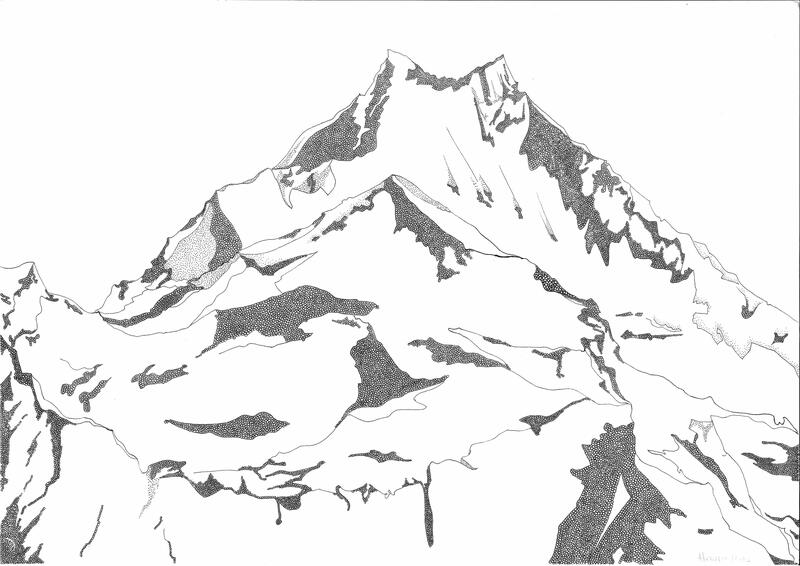
Araoz’s other series, Pensar como una montaña (Thinking Like a Mountain), engages the Andean cordillera: Illampu, Ancohuma, Sajama, Parinacota. Yet again, she does not approach them through descriptive landscape or identity-based claims. She approaches the mountain as an animate entity, as a content of consciousness rather than a physical form.
The result is a body of remarkably delicate ink drawings, where the mountain appears almost stripped of matter, as if emerging from introspection. As the artist explains: “I try to understand ideas that belong to my native land, Bolivia, stemming from ancestral knowledge, as well as the theories of thinkers from different parts of the world.” (Araoz, 2025)
Pulso Mágico: Minimal Rituals for a Living World
All these elements were suggested in the exhibition Pulso Mágico (Fundación Patiño, 2025), in which Araoz expanded her pictorial research into installation, incorporating eucalyptus leaves gathered in La Paz and inviting visitors to write wishes on them—perhaps echoing the Andean k’intu ritual.
What Araoz activates is an affective ecology, where humans and plants exchange symbolic energy. This minimal gesture resonates with the invisible threads of the poet Jaime Sáenz and with the ethic of “mutual care” articulated by the artist-researcher Elvira Espejo. The exhibition space becomes an intimate landscape: a place where nature is not a theme, but co-author.
Toward a Painting of Encounter
Katé Araoz’s work has the potential to establish itself as a singular contribution to contemporary Latin American painting. Rather than representing nature, she proposes thinking with it. Her method entails a radical decentering of the self: not looking at the tree, but allowing the tree to transform the gaze.
In an era saturated with rapid images, her practice defends slowness, patient gesture, sustained relation. Her painting belongs neither to Bolivia nor to France— and precisely for that reason, it expands the emotional geography of landscape.
Araoz reminds us that inhabiting a living world requires attention.
And that attention—this primary form of care—is also painting.
1 Araoz, K. Participation in the panel “Amazonian curatorial shift: perspectives from creation” (2021), organized by the Cultural Centers of Spain in Lima and La Paz. Available: https://www.youtube.com/watch?v=WiCqPxhEwFE
2 Groys, B. Going Public: The Loneliness of the Project. Black Box, Buenos Aires, 2020.
3 Katherine Araoz, Un geste infini. Les arbres, l´espirit, la peinture (2022), master's thesis presented at the School of Arts at the Sorbonne, (pp. 6–10).e dos aquí
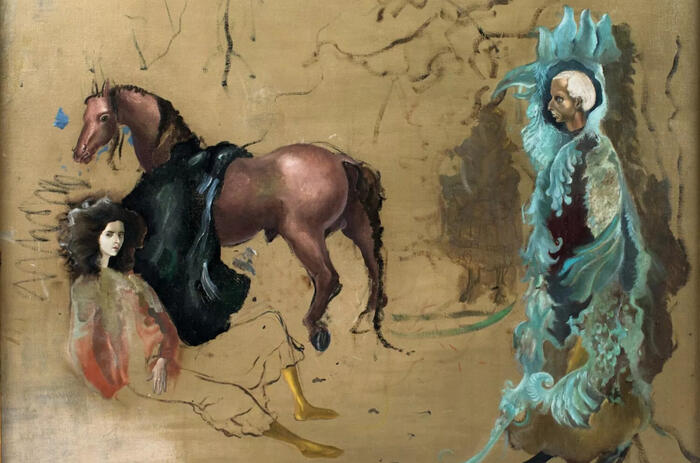
The museum presents the work of the Mexican artist through a journey that articulates her main interests, combining chronological and thematic perspectives.
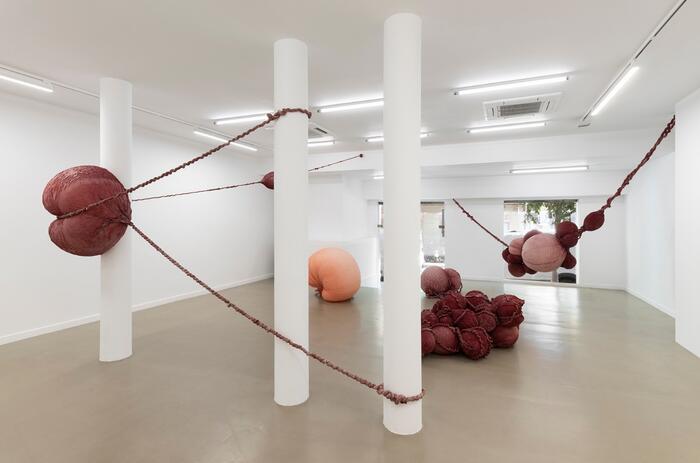
Spanish art galleries are protesting with a temporary closure against a tax policy that places them at a competitive disadvantage compared to their European counterparts. The sector is calling for the application of a reduced VAT rate to ensure commercial competitiveness and to continue strengthening and reinvesting in the cultural ecosystem.

By Mónica Sotos
What are the successive diasporas of Latin American artists to Spain about, from the final years prior to the turn of the twenty-first century to the present? Article 2 of a series of 3.
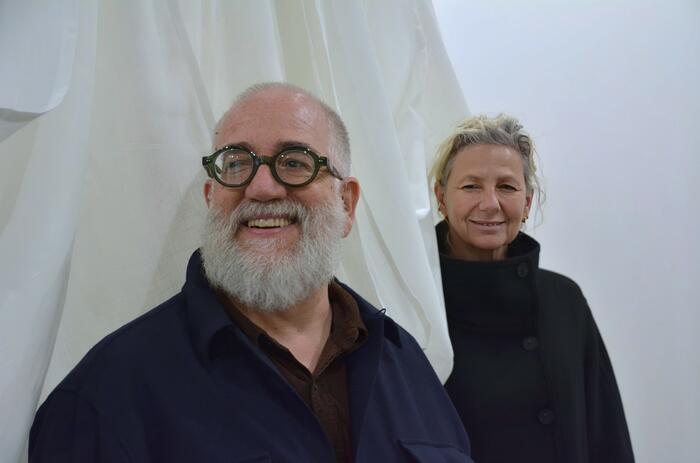
The curators present in their program at ARCOmadrid 2026 the exploration of the future as an open question. From theatrical play, where the dialogue between works and artists raises doubt and critique without certainties, the curators invite to “keep the eyes open” regarding what is to come.
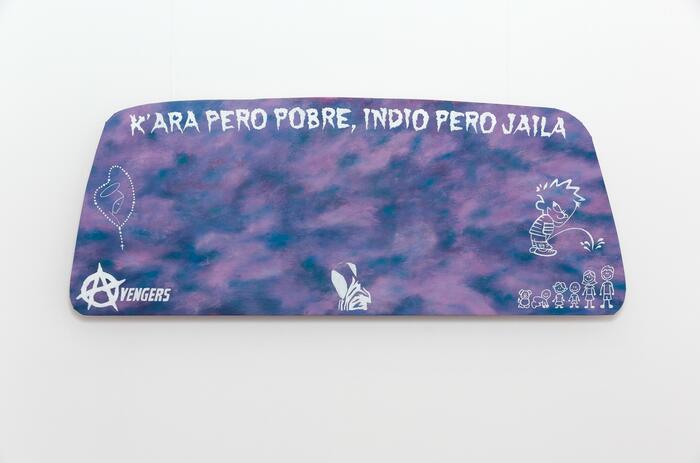
“From a distance (while living in Europe), I saw another Bolivia through the ways it was (self-)represented on social media and in the press, and I consumed images produced in the country that did not fall within the sphere of ‘culture,’ yet in my view revealed a much richer complexity. The Cedición projects emerged from these collections of images, or from texts and representations that were not official, so to speak.” (Coloma, 2025).
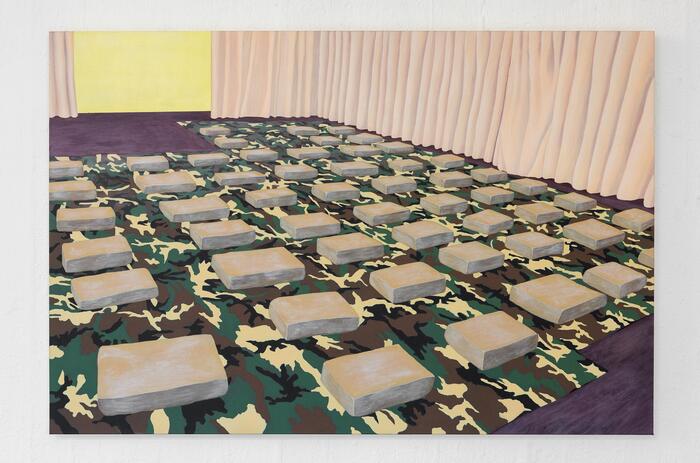
“From a distance (while living in Europe), I saw another Bolivia through the ways it was (self-)represented on social media and in the press, and I consumed images produced in the country that did not fall within the sphere of ‘culture,’ yet in my view revealed a much richer complexity. The Cedición projects emerged from these collections of images, or from texts and representations that were not official, so to speak.” (Coloma, 2025).