
By
Álvaro De Benito
The Santander-based institution proposes a curatorial reading of Marisol through a major retrospective of her drawing practice, understood as a fundamental axis of her work and as a means of articulating the knowledge acquired through her vital displacements.
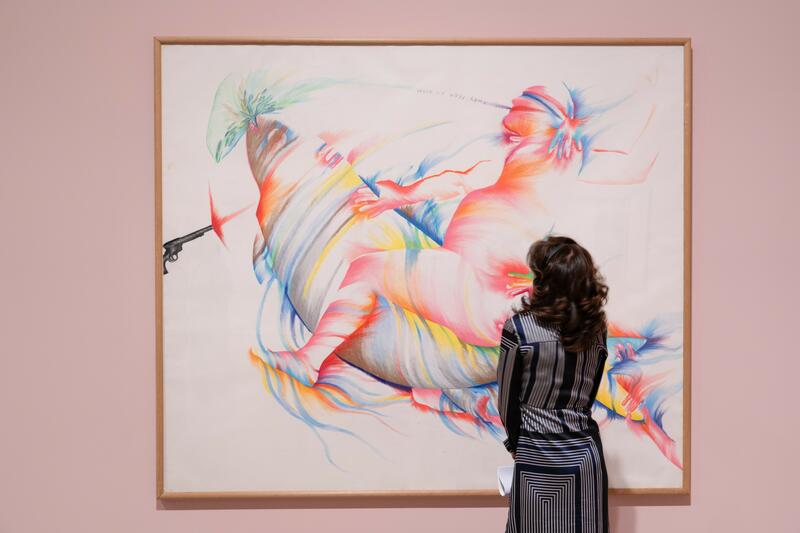
The Centro Botín in Santander presents When Things Are Just Beginning, the first major retrospective devoted to Marisol’s drawings and works on paper (María Sol Escobar, Paris, France, 1930–New York, USA, 2016). The curatorial framing, led by Laura Vallés Vílchez, offers a significant opportunity to reassess the artist’s practice beyond her most widely recognized sculptural production, expanding the scope of her extensive artistic output.
Starting from the conceptual framework embedded in the exhibition’s title, the show is structured around cyclical and existential concerns through which the Venezuelan-born artist repeatedly distances herself from the art world in order to renew her practice following periods of reflection, intellectual engagement, and critical inquiry. This premise, essential to both the spatial organization and curatorial logic of the exhibition, raises a central question: the need to withdraw from a media-driven, market-oriented, and socially saturated environment that may otherwise distort one of the most enigmatic—though not unknown—figures of the vibrant New York art scene of the 1960s and 1970s.
When Things Are Just Beginning also articulates a significant technical axis. While drawing and works on paper constitute the primary focus, the exhibition resists a strictly disciplinary delimitation. The gradual inclusion of her well-known sculptural works and pieces in other media suggests a sustained interrelation that extends beyond the notion of drawing as preparatory stage, instead foregrounding a practice that has often been constrained by art-historical categorizations and that is here reasserted as part of a broader and partially fragmented whole.
The intensity of the 1950s New York art scene is identified as the first major catalyst for these displacements. At the height of her early recognition as an artist, Marisol leaves a promising environment, deliberately distancing herself from a hierarchical structure that may not have aligned with her own creative imperatives. The exhibition thus engages with the limitations of an academic—or academicist—training that soon proves insufficient.
The period of observation and formation in Europe introduces a mode of social analysis and a subtle irony that persists sine die as part of her conception of the body as a communicative medium. Within this context, drawing emerges as a space for the preservation of intimacy, set against the increasing public exposure accompanying her growing fame.
A second withdrawal is situated within the historical context of the Vietnam War and the broader political and cultural conflicts of the 1960s and 1970s. Rather than explicitly representing wartime violence—an approach adopted more directly by other contemporary artists—Marisol investigates how portraiture can function as an archive, as well as a site for corporeality, gesture, and language.
Through the incorporation of molds of her own face, recurrent references to Native American imagery, bodily expression via sculptural hands, and collaborations with dance, the artist expands her practice through a sustained interplay of techniques. In this process, individual identity gives way to the public sphere and to forms of appropriation articulated in works such as Indian (1969) or the anthropological framing of Woman with Child and Two Lambs (1995), both of which structure key sections of the exhibition and interrogate the relationship between selfhood and alterity.
Particularly significant is the articulation of a third existential departure linked to her travels across Southeast Asia and Polynesia. This experience becomes an internal conceptual shift, opening her practice to more fluid and experimental morphologies and consolidating the hybridization already present in earlier works, as evidenced in Triggerfish I (1970).
The exhibition successfully conveys this expansion of drawing beyond the confines of paper, establishing it as a structuring principle of Marisol’s oeuvre. The sensorial quality of her audiovisual works, particularly her underwater films, resonates with the drawing practice’s aspiration to transcend the limits of two-dimensionality. The difficulty of consolidating the exhibition’s temporal strands and the historiographical debates it may generate is ultimately resolved through a central proposition: Marisol’s “withdrawals” should be understood not as retreats, but as alternative modes of perception, enabling different ways of apprehending the world from its margins.
In conclusion, the exhibition engages with the concision of a linear timeline that inevitably leads to the onset of Alzheimer’s disease—a condition that may have affected memory, language articulation, and identity recognition. This process, which challenges the notion of the mask as face, introduces a more fragile and quotidian dimension to her production. Ultimately, the exhibition allows for an understanding that moves beyond linear narrative, in which drawing persists as the record of a vital displacement that traverses her entire practice.
Marisol: When Things Are Just Beginning is on view until 25 October 2026 at the Centro Botín, Plaza Emilio Botín, s/n (Jardines de Pereda), Santander, Spain.
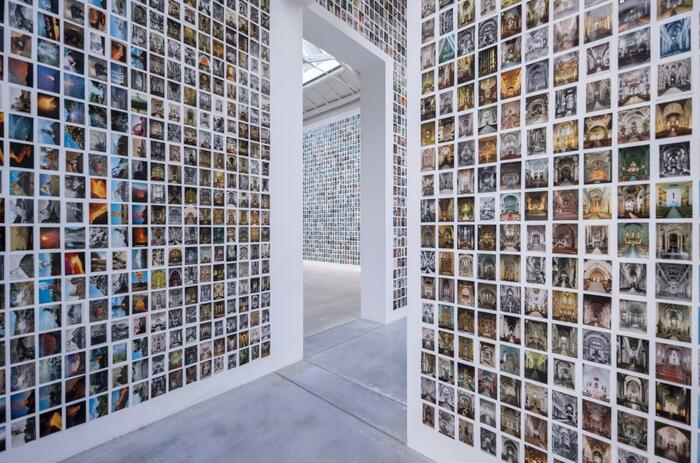
The Spanish Pavilion at the Biennale is transformed into an anti-museum led by the Catalan artist, grounded in the accumulation of postcards, memory, and a critique of the archive.
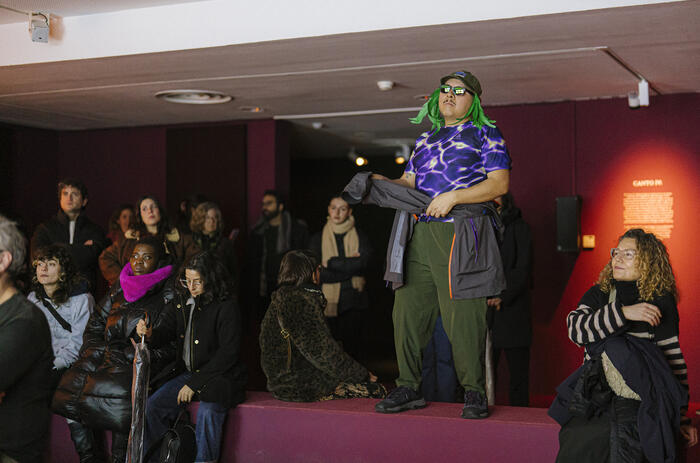
The call for submissions, open until May 31, is aimed at creators residing in Spain and invites them to design performative tours and workshops in dialogue with “Cautín,” the exhibition by the Mapuche trans artist.
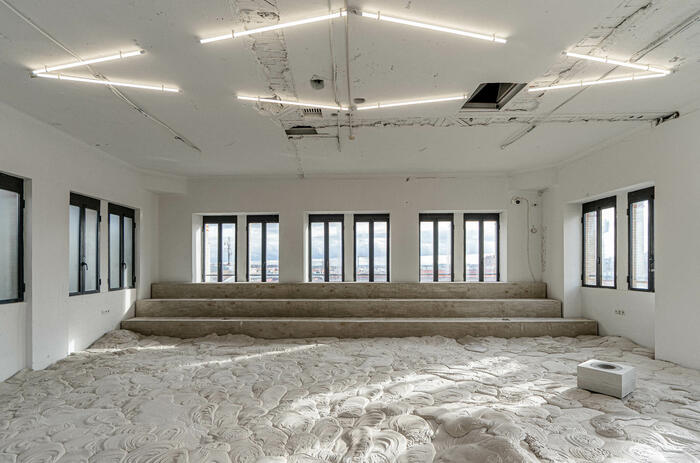
Fundación, by Marlon de Azambuja, transforms one of La Casa Encendida’s towers into a walk-through sculptural installation. Aiming to reflect on the act of founding and the search for what underpins knowledge, the work questions the divisions between reason and sensation and proposes the exhibition space as an experiential environment.
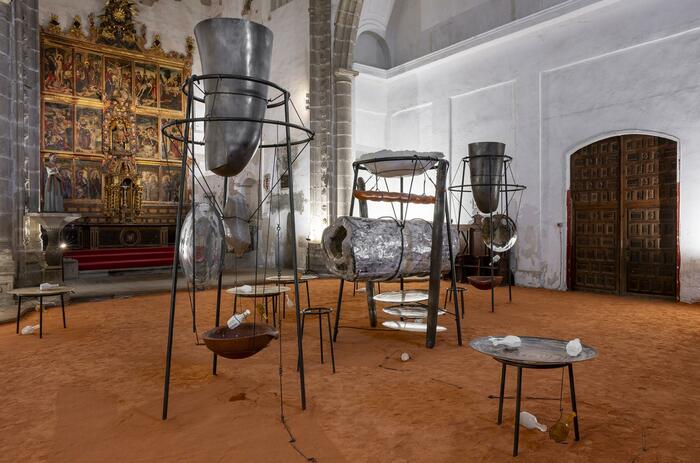
Supported by Collegium, the acclaimed installation by the Brazilian artist arrives in Spain with a sensorial and contemplative proposal in dialogue with the Church of San Miguel in Arévalo.
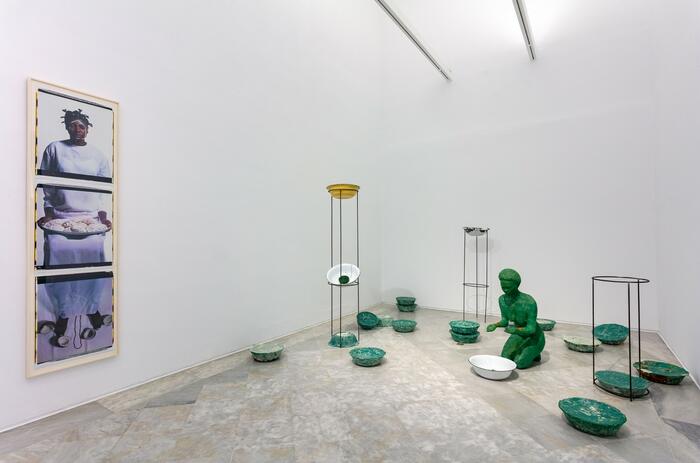
Inspired by Lélia Gonzalez’s concept of “amefricanity,” Seville once again engages with the Jorge M. Pérez collection, bringing together American and African artists and proposals to question the historical, symbolic, and aesthetic links across both sides of the Atlantic.