

By
María Sancho-Arroyo
The Twelve Paintings
Following the first two parts of this series, which explored the history of the Blaquier-Arrieta collection, the family’s approach to collecting and the circumstances surrounding the sale, this third instalment focuses on the twelve paintings being offered at Sotheby’s on 18 November.
The works are presented in the same order as they appear in Sotheby’s auction catalogue, to make it easier to follow the selection. Below is a summary of some of the key points relating to each painting, including its history and artistic significance. All twelve works are recorded in the respective artists’ catalogues raisonnés, providing an important reference for their authenticity and scholarly recognition. The fourth and final instalment will be published after the auction, once the results are known. It will review the outcome of the sale, looking at the prices achieved and what they reveal about the market’s response to the Blaquier-Arrieta collection.
1. Maurice de Vlaminck
Nature morte à la cruche bleue
Date: 1906
Estimate: $2,000,000–3,000,000
Key points
• A work from Vlaminck’s Fauve period, when he and other artists were exploring a more expressive use of colour and brushwork.
• The painting’s subject is a still life, but the handling of colour and paint gives the composition its energy.
• The work was acquired by the Blaquiers from Lefevre Gallery in 1988. Its earlier provenance includes the Paris dealer Etienne Bignou and the New York Perls Gallery.
2. André Derain
Bateaux au port de Collioure
Date: 1905
Estimate: $8,000,000–12,000,000
Key points
• Painted in Collioure in the summer of 1905, during Derain’s important period of collaboration with Henri Matisse.
• The works made in Collioure were central to the development of Fauvism, with their intense, non-naturalistic color and freely applied brushwork.
• Sotheby’s describes it as one of the strongest examples of Derain’s Fauve production remaining in private hands.
• It is being offered at auction for the first time in almost thirty years.
3. Paul Gauguin
Fleurs dans une coupe
Date: c. 1899–1901
Estimate: $10,000,000–15,000,000
Key points
• Part of a small group of still lifes Gauguin painted during his final years in Tahiti.
• Gauguin described these works as products of his “crazy imagination”; they reflect his continuing experiments with colour, form and the arrangement of objects.
• The composition brings together flowers, fruit and drapery in a design that echoes the reclining figure in some of his other works.
• The painting also reflects Gauguin’s admiration for Cézanne, whose still life Compotier, verre et pommes he had owned since the 1870s.
• The painting was exhibited in Brussels in 1904 at La Libre Esthétique, an important early presentation of Gauguin’s work.
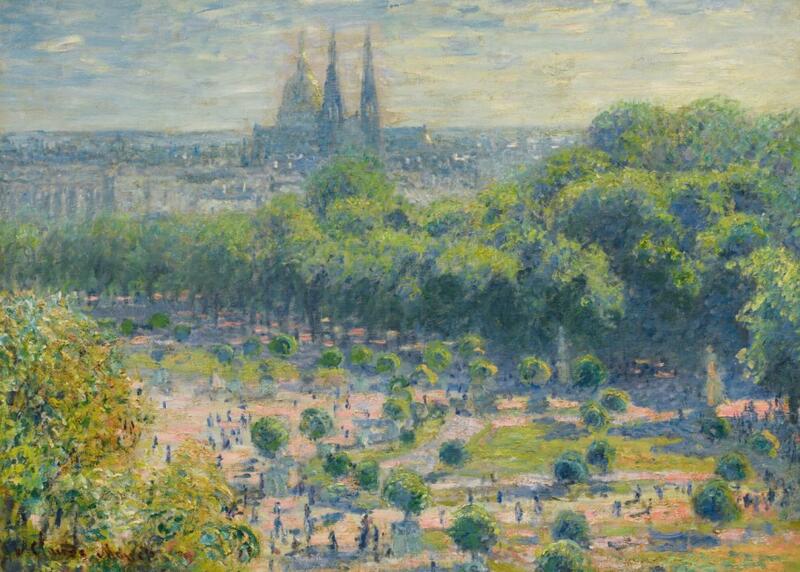
4. Claude Monet
Le Jardin des Tuileries
Date: 1876
Estimate: $15,000,000–20,000,000
Key points
• One of four views of the Tuileries gardens that Monet painted in 1876 from an apartment on the rue de Rivoli, lent to him by the collector Victor Chocquet.
• The painting reflects Monet’s growing interest in modern Paris and its public spaces, rather than the rural landscapes that had occupied him earlier.
• It was exhibited at the Third Impressionist Exhibition in 1877.
• Of the four views, only two remain in private hands; the others are in the Musée d’Orsay and the Musée Marmottan Monet in Paris.
• The catalogue records that the painting was acquired directly from Monet by Ernest May in 1878, just one year after its first exhibition.
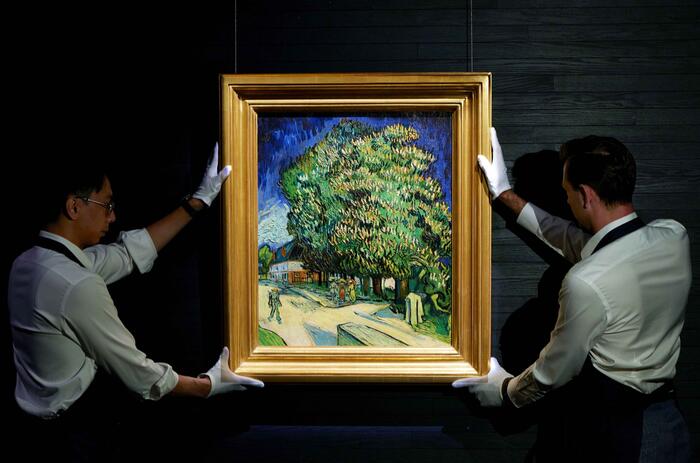
5. Vincent van Gogh
Châtaigniers en fleurs
Date: c. 24 May 1890
Estimate: Estimate Upon Request (in the region of $180 million)
Key points
• Painted in Auvers-sur-Oise shortly after Van Gogh left the asylum at Saint-Rémy; it belongs to the intense final period of his career.
• The flowering chestnut tree dominates the composition, its canopy rendered in richly worked, gestural brushstrokes that connect the painting directly to some of Van Gogh’s most celebrated works of the period, including The Starry Night.
• It is the only known version of Van Gogh’s flowering chestnut-tree motif to include figures: three women and a man who may be a self-portrait.
• Only eight of the approximately fifty landscapes Van Gogh painted in Auvers remain in private hands; Sotheby’s identifies this as one of the largest and finest.
• A building visible at the left of the painting still stands in Auvers and operates as the bar-tabac Le Balto. Van Gogh referred to completing a study of chestnut trees in a letter to Theo dated 25 May 1890. (as per Martin Bailey in The Art Newspaper)
• The painting was last exhibited publicly in 1964, at the Solomon R. Guggenheim Museum in New York. The Blaquiers acquired it from Wildenstein in 1975.
• On 12 November 2026, the heirs of German Jewish publisher Samuel Fischer formally raised a restitution claim, arguing that the painting had been sold in 1936 under financial pressure resulting from Nazi persecution. The Blaquiers acquired the painting from Wildenstein in 1975, after it had passed through several hands. However, the passage of time and the succession of owners do not necessarily extinguish a restitution claim. At the time of writing, Sotheby’s stated that, although its research had not established that the painting was sold under duress, it was in dialogue with the Fischer heirs and committed to working towards a mutually satisfactory resolution.
6. Alfred Sisley
La Seine à Port-Marly
Date: 1873
Estimate: $800,000–1,200,000
Key points
• An early Impressionist landscape, dating from 1873.
• Sisley was among the Impressionists most devoted to landscape painting, focusing here on the quieter riverside setting of Port-Marly, west of Paris.
• His use of closely juxtaposed brushstrokes and pure colours captures the changing effects of light and atmosphere. The cropped trees also reflect the influence of Japanese prints.
• The painting demonstrates Sisley’s ability to convey movement through subtle variations of tone and perspective, while preserving the tranquillity of the scene.
7. Edgar Degas
Avant la course
Date: c. 1893
Estimate: $20,000,000–30,000,000
Key points
• One of the largest fully worked pastels of horseracing by Degas remaining in private hands.
• Degas was fascinated by horse racing and regularly attended races at Longchamp and other racecourses around Paris. He made numerous studies of horses and jockeys, observing their movements and the moments of anticipation before the start.
• The scene captures the tense stillness before a race, with the horses arranged as if seen in a fleeting glance.
• Degas builds the pastel in successive layers, using the medium to convey the sheen of the horses’ coats, the jockeys’ colours, light and atmosphere.
• The work was acquired as early as 1895 by American collector Harris Whittemore and later belonged to Sidney and Frances Lasker Brody, major Los Angeles collectors associated with the founding of LACMA.
• It has not been publicly exhibited since 1968 and has never before appeared at auction.
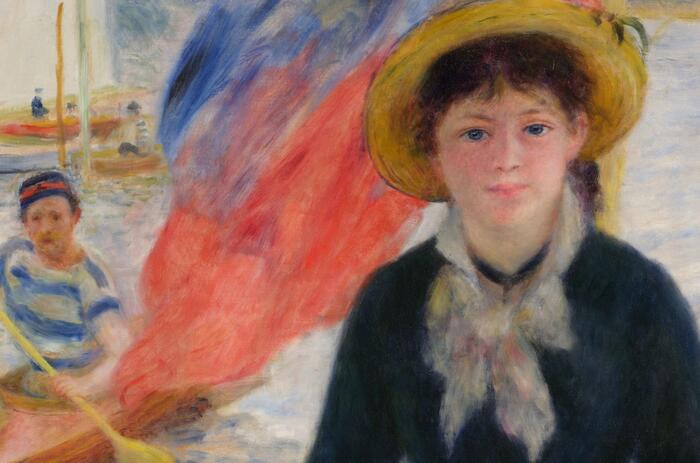
8. Pierre-Auguste Renoir
En Canot (Jeune fille à la barque)
Date: 1877
Estimate: $25,000,000–35,000,000
Key points
• Painted in 1877, the year of the Third Impressionist Exhibition, when the artists formally adopted the name Impressionists.
• It belongs to Renoir’s celebrated boating scenes of the 1870s and shares the sunlit atmosphere of his best-known works of this period, including Bal du moulin de la Galette.
• The painting also reflects the growing importance of leisure in nineteenth-century France, as the expanding middle classes increasingly embraced outings and recreational activities on Sundays and holidays.
• The composition contrasts the young woman’s still, almost self-contained presence with the movement of the water and the activity around her, combining portraiture with the changing effects of light characteristic of Impressionism.
• The sitter is believed to be Marguerite “Margot” Legrand, who appears in several important Renoir paintings.
• The painting was acquired directly from Renoir by Charles Haviland, the Limoges porcelain manufacturer and a friend of the artist.
• It has never before been offered at auction and is one of the few boating scenes from this period still in private hands.
9. Paul Cézanne
Arlequin
Date: 1888–1890
Estimate: Estimate Upon Request (in the region of $120million)
Key points
• Part of a rare sequence of four Harlequin paintings Cézanne made between 1888 and 1890. The model was his son Paul, then a teenager.
• Drawing on the Commedia dell’Arte, Cézanne portrays Harlequin in his traditional costume but moves away from the comedy and action associated with the character. Instead, he emphasises the figure’s stillness, monumental presence and almost mask-like expression.
• The painting marks an important stage in Cézanne’s development, connecting his study of the human figure with his exploration of colour, brushwork, space and structure. These concerns would become fundamental to later Modern art.
• It is the only painting from this series remaining in private hands and has not been seen publicly since 1975.
• Its distinguished provenance includes Ambroise Vollard, Durand-Ruel, Paul Rosenberg and the Lefevre Gallery. It subsequently belonged to Lord Victor Rothschild and hung at Merton Hall, his Cambridge residence, from 1936. The Blaquiers acquired it from the Lefevre Gallery in 1975.
• The painting was exhibited internationally during the first half of the twentieth century, including at the Museum of Modern Art in New York in 1929. It was also on extended loan to the Courtauld Institute in London from 1962.
10. Camille Pissarro
La Place du Théâtre-Français et l’avenue de l’Opéra, soleil d’après-midi en hiver
Date: 1898
Estimate: $30,000,000–40,000,000
Key points
• Part of Pissarro’s celebrated series of Paris cityscapes, made during the final decade of his career and considered among his major contributions to Impressionism.
• Pissarro painted from an elevated position at the Grand Hôtel du Louvre, observing the changing light and movement along the grand boulevards of Haussmann’s Paris.
• The work is among the finest examples of the series remaining in private hands and was executed in the largest format Pissarro used for these Paris views.
• Its provenance includes the collections of Leigh B. and Mary Lasker Block and the collector and museum founder Norton Simon.
• It has not been seen publicly since 1958 and has never before been offered at auction.
11. Henri de Toulouse-Lautrec
Femme assise de profil vers la gauche
Date: 1890
Estimate: $3,000,000–5,000,000
Key points
• An early work from Toulouse-Lautrec’s career, painted in 1890, before his best-known images of Parisian nightlife and entertainment.
• In contrast to his lively scenes of Montmartre, this painting presents a woman in a quiet, introspective moment. Her composed posture and clasped hands convey a sense of stillness, while her expression remains difficult to read.
• The vivid red blouse contrasts with the dark skirt, while the emphasis on contour and the simplified background draws attention to the figure.
• The painting reveals Toulouse-Lautrec’s interest in the psychological dimension of portraiture and in moments of solitude and reflection.
• Its provenance includes the collections of Otto Gerstenberg and Albert D. and Mary Lasker. It was shown in major exhibitions devoted to the artist, including at the Philadelphia Museum of Art and the Art Institute of Chicago in 1955–56, and at MoMA in 1956. It has also been requested for the 2027–28 exhibition Toulouse-Lautrec: Obsessions at the de Young Museum and the Guggenheim Museum.
12. Camille Pissarro
Maison de Piette à Montfoucault, effet de neige, avec un homme portant un fagot
Date: 1875
Estimate: $700,000–900,000
Key points
• An early landscape by Pissarro, painted in 1875 during the period when he was developing his Impressionist approach to rural subjects.
• The snowy setting and the figure carrying a bundle of firewood give the scene a quiet, everyday character.
• The work’s provenance includes the galleries Bernheim-Jeune and Paul Cassirer.
• It was included in the 1962 exhibition El Impresionismo francés en las colecciones argentinas at the Museo Nacional de Bellas Artes in Buenos Aires.
For full descriptions, provenance, exhibition history and bibliography, please refer to the individual entries in Sotheby’s catalogue.
This is the second article in a four-part series exploring the Blaquier-Arrieta collection. In Part One, The Art of Collecting, I looked at how Nelly Arrieta de Blaquier and her husband built the collection, the role of London dealer Martin Summers, and the very different art market in which many of the paintings were acquired.
This article is the first of a four-part series exploring how the collection was built, its journey towards the international market, the twelve paintings now coming to auction and, finally, what the sale results reveal about the market for major Impressionist and Post-Impressionist works.
The first major institutional Baldessari survey in South Florida brings together nearly 40 works spanning five decades, drawn from the Craig Robins Collection.
The reconstruction of Minujín and Santantonín’s iconic work at the Reina Sofía revives its transgressive spirit, nuances its ephemeral dimension, and confronts the temporal contradictions of an image-dominated contemporary society.
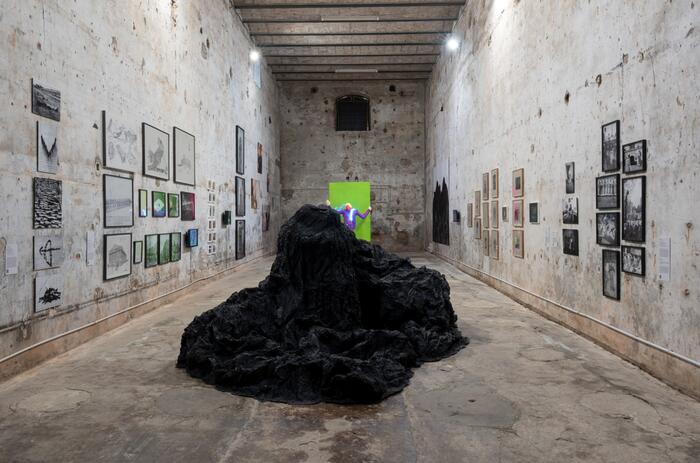
A tour of the Argentine pavilion at the 61st Venice Biennale, with Matías Duville’s proposal Monitor Ying-Yang, curated by Josefina Barcia, in dialogue with the Argentine group exhibition Oscuridad visible: La larga sombra de la dictadura (Darkness Visible: The Long Shadow of Dictatorship), in collaboration with Museo de Arte Moderno de Buenos Aires at Spazio Punch.