
WHO WAS MIGUEL FERRANDO, THE DOMINICAN PAINTER OF NEW YORK'S QUEER DOWNTOWN SCENE?
Off the Shelf, on view at Nina Johnson in Miami through November 14, will bring together two decades of the artist’s work.
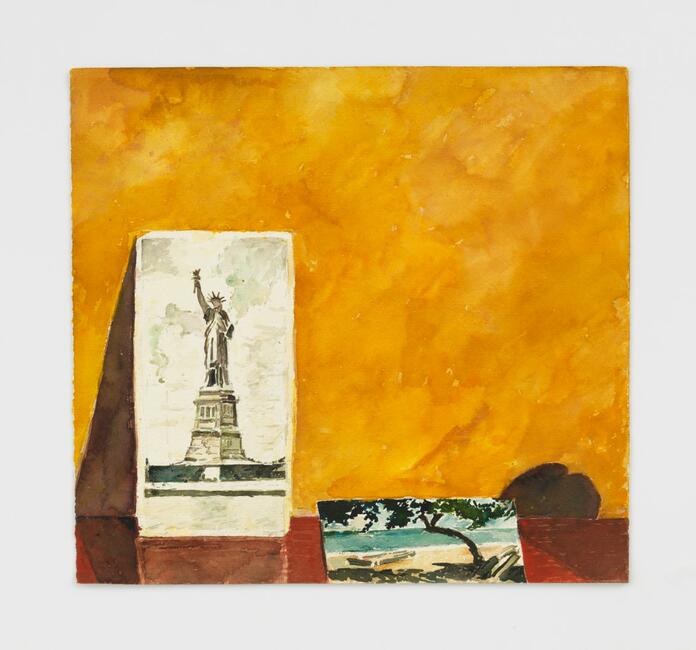
Nina Johnson presents Off the Shelf on September 10, an exhibition of Miguel Ferrando's (Santo Domingo, Dominican Republic, 1957–New York, United States, 1996) work. More than thirty pieces created over two decades will be on display, highlighting his experimental and imaginative approach to landscape, portraiture, and still life, while creating a visual language that reflects both sides of the Atlantic and his role as interpreter of multilingual, pluralistic societies full of juxtapositions, namely New York City and Santo Domingo, Dominican Republic.
Ferrando migrated to New York City in 1962, at the age of five, but returned frequently to the Dominican Republic, where the city of Santo Domingo and smaller towns like Las Terrenas were integral to his practice. His body of work reveals a fluid sensibility that oscillates between oceans and languages, anchored by a rigorous citation practice invested in marking the stylistically innovative techniques born of Caribbean modernism.
-
Miguel Ferrando. Untitled, 1980-85. Courtesy of Nina Johnson
He admired and often referenced canonical European artists ranging from Caravaggio to Velázquez to El Greco. Yet, like the late-nineteenth-century Puerto Rican maestro Francisco Oller, Ferrando refused to adhere to any single European style and instead synthesized realism, impressionism, naturalism, and neo-impressionism into a distinctly Caribbean visual language.
Having trained at the Escuela de Bellas Artes with Guillo Pérez, Ferrando represents a transitional link between different generations of Dominican artists. He carries the legacy of the generation working during Rafael Trujillo's dictatorship (1930–1961). That generation often resorted to visual strategies like abstraction, symbolism, and tenebrism, since they were often unable to openly critique the socio-economic and political conditions of the island. In New York, Ferrando found his place within the queer downtown art scene. He lived on the Lower East Side and performed drag at the Pyramid Club. He belonged to a tight-knit circle of artist friends including Darrel Ellis, Richard Brintzenhofe, Allen Frame, Malcolm Morley, and Ann Wilson.
-
Miguel Ferrando. Untitled, 1980-85. Courtesy of Nina Johnson
Although Ferrando's life was cut short at thirty-eight by AIDS-related causes, his intervention in the field of contemporary Dominican art and its diaspora is significant. His work has nonetheless been largely absent from those discussions. Yet, he shares with artists like Tony Capellán, Raúl Recio, and Freddy Rodríguez a set of recurring themes: the natural environment, Christian iconography and its relationship to political power structures, and Dominican and U.S. vernacular culture. His visual lexicon was informed by the culture, sound, and landscape of the Caribbean and the kaleidoscopic environment of Manhattan.
“Ferrando's compositions destabilize tropical fantasies and insist on the in-between. He conjures the distance itself, embracing a geographic-temporal flux and claiming it as not only habitable but a place of rich possibility,” said Naiomy Guerrero, art historian and curator.
Miguel Ferrando: Off the Shelf is on view through November 14, 2026, at Nina Johnson, 6315 NW 2nd Ave, Miami, Florida 33150, United States.
Related Topics
May interest you
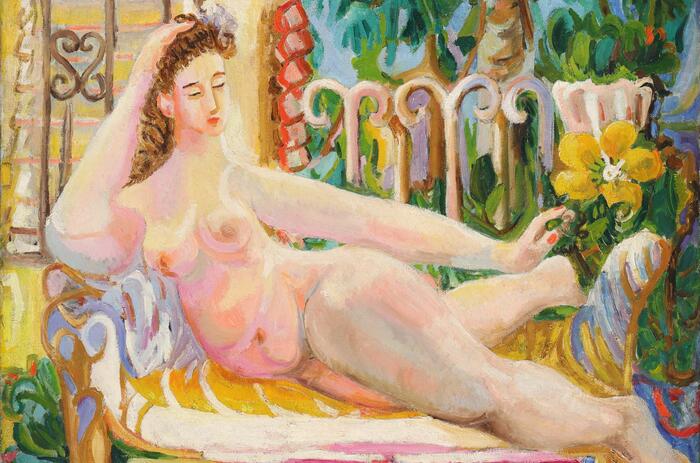
MIAMI REVISITS MOMA'S HISTORIC 1944 EXHIBITION OF CUBAN PAINTERS
The exhibition brings together works by Wifredo Lam, Amelia Peláez, and Mario Carreño, preserved by private collectors for more than 80 years.
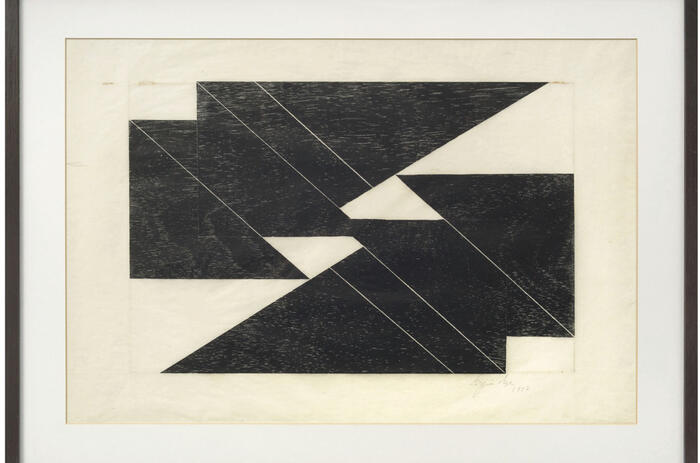
THE JUAN CARLOS MALDONADO COLLECTION ANNOUNCES A NEW CHAPTER: IT IS CLOSING ITS SPACE IN MIAMI
After a decade in the Miami Design District, the institution shifts its focus toward collaborations with museums, universities, and cultural organizations worldwide.
FROM THE SUBTERRANEAN TO THE COSMIC: TERESITA FERNÁNDEZ REAWAKENS A DORMANT HOUSTON LANDMARK
After nearly a decade closed, The Menil Collection's Fresco Building reopens with a meditation on spirituality and matter.
MODELS OF GALLERY COLLABORATION MARC STRAUS AND NUEVEOCHENTA: AN ALLIANCE BETWEEN COLOMBIA AND NEW YORK
By Maria Paula Suarez and Montserrat Miranda Ayejes
THE BAHAMIAN HERITAGE THAT ANINA MAJOR SCULPTS AT PAMM
The Bahamian artist’s most significant institutional presentation in the United States to date transforms the museum’s waterfront gallery into a protective landscape of woven clay, bottle trees, and shells.
PAMM INVESTIGATES CARIBBEAN PERFORMANCE ART PRACTICES AND THEIR DIASPORAS IN “BEYOND REPRESENTATION”
The ongoing project, curated by Iberia Pérez González and presented by the museum's Caribbean Cultural Institute, combines live art events with a digital video-performance platform.
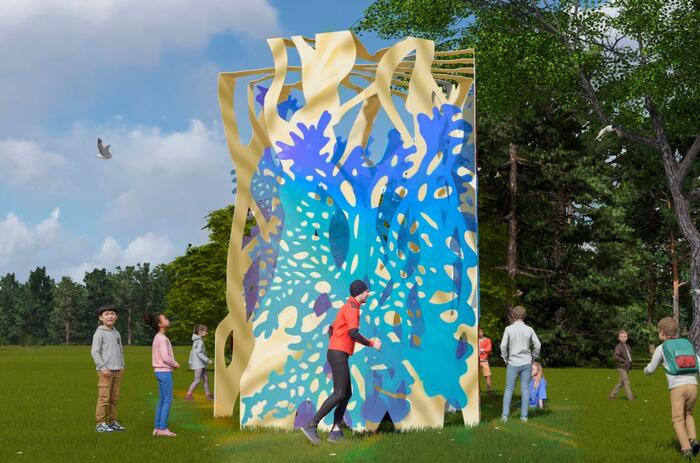
THE MORTON ARBORETUM ANNOUNCES "TREE DIMENSIONS," AN IMMERSIVE ART EXHIBITION IN ILLINOIS
Rommy González presents five large-scale sculptures that invite visitors to enter, explore, and experience trees in unique ways.
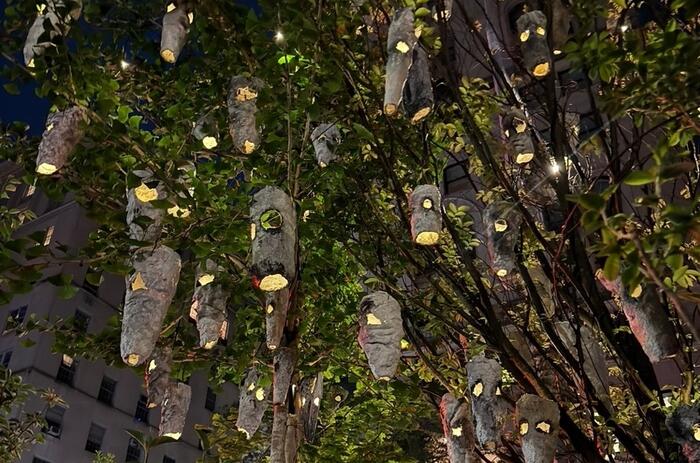
A CONVERSATION BETWEEN MICHELE OKA DONER AND JULIA P. HERZBERG – TALISMAN, A SACRED GROVE
Talisman, A Sacred Grove is a natural grove featuring twenty-one different species of trees that support approximately two hundred hand-formed heads, known as Talisman. The grove is installed on Park Avenue mall near the corner of East 66th Street in front of The Park Avenue Armory.