
AMERICAN FRAMING – UNITED STATES PAVILION AT THE VENICE ARCHITECTURE BIENNALE
To the question proposed by Hashim Sarkis (curator of the 17th International Architecture Exhibition) How will we live together?, the United States project team alludes to the democratic nature of wood framing.
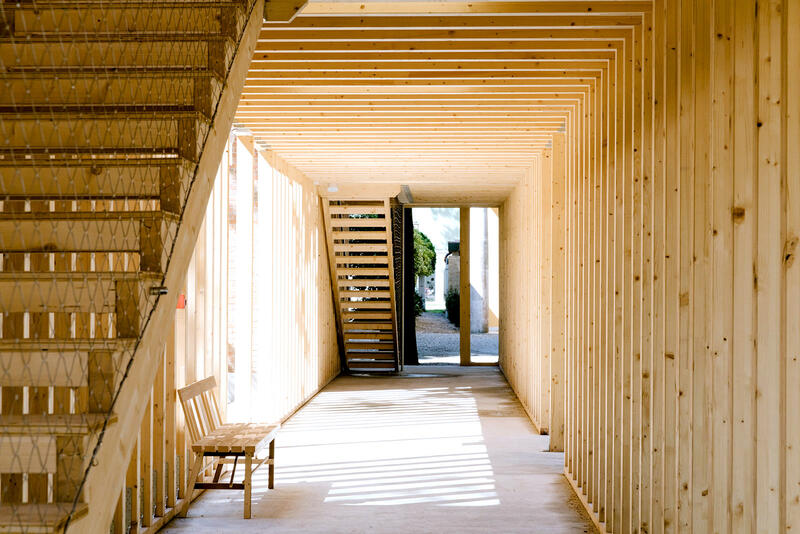
Originating in the early 19th century, softwood construction was a pragmatic solution to a need for an accessible building system among settlers with limited wealth, technical skills, and building traditions. Wood framing has been the dominant construction system ever since—more than 90% of new homes in the U.S. today are wood-framed. The accessibility that shaped its early development continues to influence contemporary life and reflect democratic ideals in subtle, but powerful ways. For instance, softwood construction is exceptionally egalitarian. No amount of money can buy you a better 2x4 than the 2x4s in the poorest neighborhood in town. This fundamental sameness paradoxically underlies the American culture of individuality, unifying all superficial differences. Buildings of every size and style are made of wood framing.
Despite its ubiquity, wood framing is perhaps the country’s most overlooked contribution to architecture. A variety of prejudices and habits explain its absence from intellectual discourse, which tends to zero in on the exotic while ignoring the ordinary. In the case of wood framing, a lack of disciplinary prestige stems from the same characteristics that make it so prevalent—it’s easy, thin, and inexpensive. These qualities introduce a flexibility for form, labor, composition, class, sensibility, access, and style that open up wild possibilities for architecture. Wood framing is inherently redundant and transient, which allows for improvisation in design and construction, rough detailing, and ongoing renovation.
-
Images courtesy of the United States Pavilion at the Venice Biennale
-
Images courtesy of the United States Pavilion at the Venice Biennale
-
Images courtesy of the United States Pavilion at the Venice Biennale
-
Images courtesy of the United States Pavilion at the Venice Biennale
-
Images courtesy of the United States Pavilion at the Venice Biennale
The exhibition presents the subject of wood framing in a collection of works throughout the galleries and grounds of the U.S. Pavilion at the 17th International Venice Architecture Biennale. A four-story installation forms a new façade for the historic pavilion—a half-section of a wood-framed house through which visitors enter the exhibition. This open-air wood structure encloses the courtyard to provide space for reflection and conversation. It also introduces the world of wood framing as directly as possible by allowing people to experience its spaces, forms, and techniques firsthand. The full-scale work expresses the sublime and profound aesthetic power of a structural method that underlies most buildings in the United States.
Two types of works are exhibited within the galleries. Newly commissioned photographs from Daniel Shea and Chris Strong address the labor, culture, and materials of softwood construction. A collection of scale models, researched and designed by students at the University of Illinois at Chicago School of Architecture, presents the history of wood framing. Two sets of furniture by Ania Jaworska and Norman Kelley are installed outside in the courtyard and full-scale wood structure, both reviving historic pieces and producing them out of common dimensional lumber.
The 17th International Venice Architecture Biennale comes at a time when national cultural practices are struggling with their histories. How do we come to terms with our past choices? What kinds of futures can we create? American Framing examines the improbably overlooked and familiar architecture of the country’s most common construction system and argues that a profound and powerful future for design can be conceived out of an ordinary past. The works within the exhibition tell the story of an American architectural project that is bored with tradition, eager to choose economy over technical skill, and accepting of a relaxed idea of craft in the pursuit of something useful and new.
American Framing
Paul Andersen and Paul Preissner/Ania Jaworska, Norman Kelley, Daniel Shea, Chris Strong, with University of Illinois Chicago School of Architecture
Until November 21st, 2021
United States Pavilion at the Venice Architecture Biennale
Giardini, Venice, Italy
Related Topics
May interest you

BIENALSUR INAUGURATES ITS CARTOGRAPHY OF EXPANDED ACTIVITIES
The third edition of the Bienal Internacional de Arte Contemporáneo del Sur (BIENALSUR) organized by the National University of Tres de Febrero (UNTREF), an Argentine public university, will take place until December 2021 in more than 120 venues in 50 cities in 23 countries and the Vatican, with the participation of around 400 artists of various nationalities and different backgrounds.
DOCUMENTA FIFTEEN AND IT’S COMMITMENT TO SUSTAINABILITY
documenta fifteen becomes part of the network for sustainable material circulation. On July 23 and 24, 2021, documenta fifteen hosted a symposium on material circulation within the arts and cultural sector. The temporary nature of art exhibitions results in the short-term implementation of resources, which is why documenta fifteen has become involved in the subject of sustainable material distribution.
DAVID E. LITTLE APPOINTED AS NEW EXECUTIVE DIRECTOR OF THE INTERNATIONAL CENTER OF PHOTOGRAPHY
The Board of Trustees of the International Center of Photography (ICP) in New York announced today the selection of David E. Little as its new executive director, following an international search. Little will join ICP in mid-September 2021, after six years as director and chief curator of the Mead Art Museum at Amherst College, and will succeed Mark Lubell, who announced his decision to depart ICP in March 2021.
TO THE BIENNALE’S QUESTION “HOW WILL WE LIVE TOGETHER?” THE DANISH ANSWER WITH “CONNECTEDNESS”
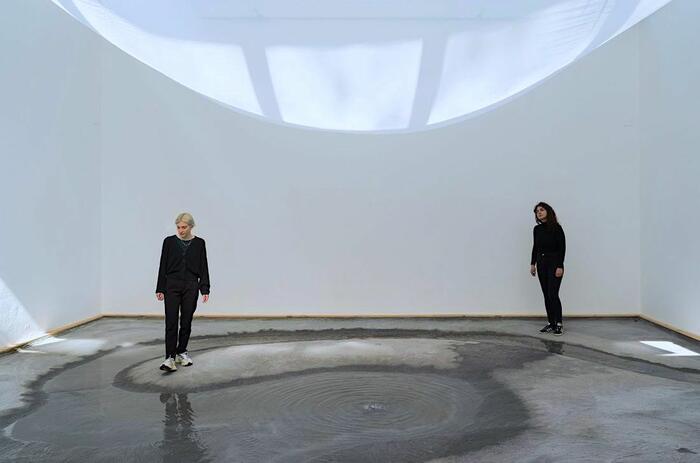
Con-nect-ed-ness: The Danish Pavilion at the 17th International Venice Architecture Biennale focuses on people’s connection with each other and with nature, in a total installation consisting of a giant cyclic system of water collected locally in Venice.

MAGDALENA FERNÁNDEZ WINS INTERNATIONAL CODAawards
When artists, designers, industry resources, and clients work together, common places are transformed into spectacular spaces. CODAworx, the hub of the commissioned art economy, has announced the winners of the ninth annual international CODAawards: Collaboration of Design + Art. The CODAawards recognize collaborations that result in outstanding projects which successfully integrate commissioned art into interior, architectural, or public spaces.

LATIN AMERICAN ARTISTS IN NEW YORK – AMERICAS SOCIETY’S EXHIBITION
This Must Be the Place: Latin American Artists in New York, 1965–1975 is a group exhibition that explores the artworks, performances, and experimental practices of this generation of artists, as well as their involvement in the local art scene. Diversifying the city’s artistic life, these artists helped shape New York into the global art center it is today. The artworks presented in this exhibition are central to understanding the social and political landscape in the Americas and the tensions and bridges between north and south, exploring issues of migration, identity, politics, exile, and nostalgia.
CARLO SCARPA, VENICE, THE ENIGMA IN THE POETIC
"Venice, nenuphar city" ... says the poet Paul Morand in his magnificent book Venises, plural. Venice, in addition to being host of the most famous biennials, today on its seventeenth edition in architecture, is in its plurality the land of one of the great masters of 20th century architecture, Carlo Scarpa.
LESLEY LOKKO APPOINTED CURATOR OF THE VENICE ARCHITECTURE BIENNALE 2023
The Board of the Venice Biennale, upon the recommendation of President Roberto Cicutto, appointed Lesley Lokko as Director of the Architecture Sector, with the specific task of curating the 18th International Architecture Exhibition to be held in 2023. The Exhibition will be held from Saturday, May 20 to Sunday, November 26, 2023.