By
María Galarza
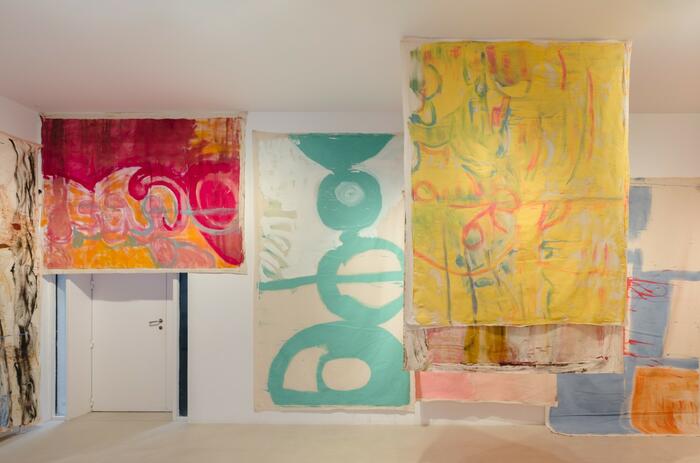
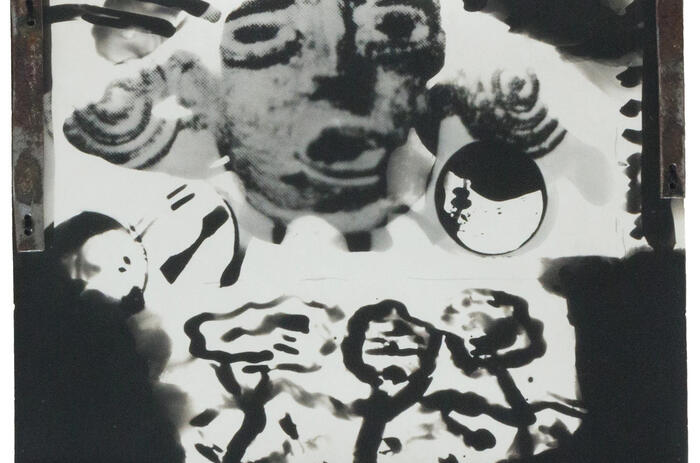
With a characteristic exercise of Ruth Benzacar's exhibition program, intergenerational dialogue is established between Roberto Aizenberg's works in "La flor de la distancia" (The flower of distance) and Andrés Piña's "El alma volvió preñada de materia" (The soul returned pregnant with matter).
There are two meanings of the word dream. On the one hand, is a physiological state of rest. A process demanded by the body. On the other, it is the self-promise of a desire to pursue, or the place where our hopes, images, or memories roam freely according to another logic.
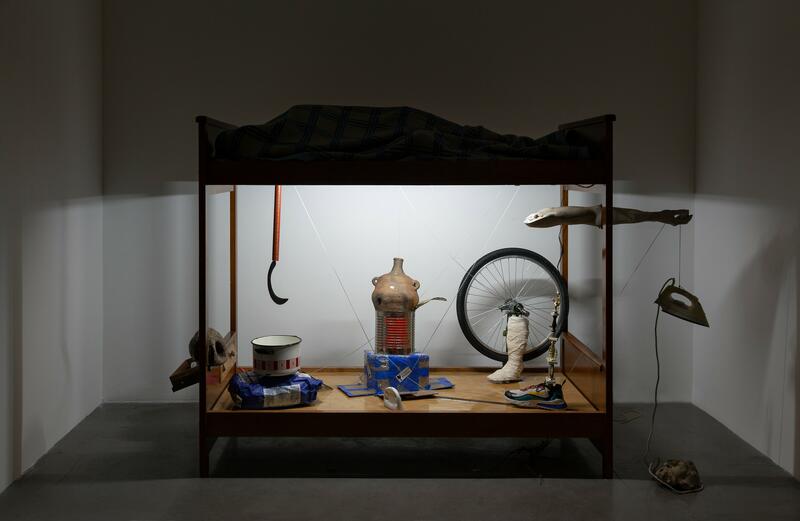
In Andrés Piña’s exhibition “El alma volvió preñada de materia,” there is a bed with sculptures made of sweaters, trophies from amateur competitions, bedside lamps, and soccer balls. But there is also a bed with smoke and water, without a mattress. And another with someone sleeping, camouflaged within the bedroom scene and lying in a sleeping position. Different sleep routines with elements the artist uses to play between objects and bodies, the living and what remains still. The moment of sleep opens a threshold where these boundaries blur, disrupting binary distinctions and revealing the artifice of the categories we insist upon to keep ourselves ordered.
“What aspects of our current sleep will be seen as ridiculous several centuries from now? Will they laugh at our chairs, always occupied by piles of clothes, or at the bedside table that never gets cleared?” writes Martín Felipe Castagnet in the curatorial text. The act remains the same: closing our eyes, finding a comfortable position, and waiting for the trance state. But the way we invoke sleep has changed throughout history. The exhibition estranges our contemporary sleep routines, making visible the scenes that unfold in our bedrooms, the silence (or lack thereof) before we try to sleep. And it raises the question: what traces remain from that rest we have grown accustomed to and, at the same time, what kinds of dreams does it make possible to construct?
In Roberto Aizenberg’s exhibition, a certain quality of “the dreamlike,” can be located through subtler guidelines. As Juan Cruz Pedroni writes in the curatorial text: “Aizenberg introduces small somatic deviations into systems that might appear ideal, and small regularities into patterns that might appear automatic. This is where his relationship with a Surrealist legacy, which he is willing to cool down, takes shape. The epic of automatism—that energy that exhausts itself—is tempered by a discipline of notation that does not prevent the accident, but forces it to account for itself.”
In his paintings, he constructs an architecture that moves away from free association. It is more like a sharpened tool that refines the energy of the dream, channeling it into images of robust, contemplative figures. Perhaps, instead, a state of stillness or poise. Pedroni uses the word “reposo” (at rest).
Whether as a practice of the body or of the mind, dreaming is a vital process. While Piña turns it into a scene in order to estrange our bodies, objects, and routines, Aizenberg turns it into a language through which to intertwine deviations with structure, automatism with control, and the possibility of an image departing from reality without losing its logic.

Suave es la noche, by Silvana Muscio, and Trago Amargo, by Claudia Coca and Claudia Casarino, propose two distinct ways of inhabiting memory from Buenos Aires: one sensory and oneiric, the other historical and colonial.

The museum welcomes Juan Del Prete and, for the first time, Líbero Badíi, along with donated pieces by Jorge Pineda, Mario Testino, and Margarita Paksa.
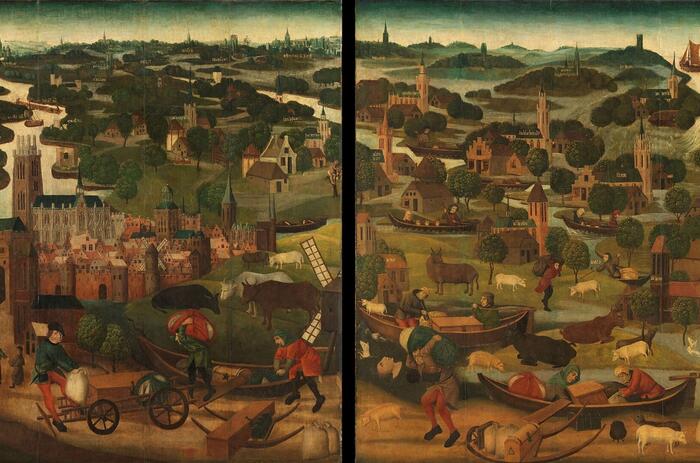
Paraná Delta and the Rhine-Meuse-Scheldt, between domination and resistance
The institution is reinforcing its commitment to Latin American art with three exhibitions that, like the thematic lines underpinning this season, will explore the body, memory, and participation.