TATIANA BLASS: HALF UNDERGROUND TORNADO
By Marina Baltazar*, cultural critic, writer, and researcher
Tatiana Blass is a Brazilian artist known by burying a car in the parking lot in front of a gallery, or putting a big loom, with red threads, in a chapel. Despite these large installations, their meanings always work in the underground of language. The first one, Vaga (2012), starts on the polysemy of this title, vague, which may vary from something empty, general, drifting past the waves’ movement, until reaching the parking space nomenclature. The fact that the car, a Mazda, is just partially buried, suggests that things can only ever be seen relatively, with parts always out of sight, buried underground, embedded in concrete, within language – which can be key to reading the rest of Blass’ work.
The second mentioned work, Penélope (2011), firstly installed in Morumbi Chapel, also in São Paulo, uses a red wool flowing inside and outside the chapel architecture, through the holes in the wall. When reinstalled (2019) in Belo Horizonte, where Blass now lives, received a new name, quite consonant with the work’s proposition of doing, undoing and redoing the Greek myth’s work, also blurring whether the thread in being sewn or unraveled, converging architecture, landscape and wave.
But the look here is from inside a tornado: her latest works were exhibited in the first floor of Albuquerque Contemporânea, at Belo Horizonte, from June 24th to August 30th 2025, featuring both new pieces and others previously shown in different cities. Tornado Subterrâneo, or Underground Tornado, is the exhibition title and the subtitle of a series: Teatro de Arena [Arena Theatre], divided into seven pieces, in oil and wax on cast bronze. The three-dimensionality of the scenes suggests, on the one hand, the ancient structure of the arena theatre, its centre, acoustically favourable, once held tragedies and comedies audible from any seat in the half-moon-shaped stands. On the other hand, it suggests a moving scene in which the characters erode alongside the landscape. At the centre of this whirlwind, or in the subterranean realm of this tornado, where everything ultimately dissolves, there is a subtle and yet persistent critique of mining: layers of earth are removed, destroying the environment in an already devastated land, forming desert-like landscapes. This long-term process is shown on video, situating the effects of temporality on raw material, and its implications for light and the surroundings of this series.
-
Tatiana Blass. Teatro de Arena_Tornado Subterrâneo #5, 2025. Encaustic on resin with iron powder, 27 x 37 x 7 cm. Courtesy of Albuquerque Contemporânea
-
Tatiana Blass. Teatro de Arena_Tornado Subterrâneo #6, 2025. Encaustic on resin with iron powder, 28 x 36 x 5cm. Courtesy of Albuquerque Contemporânea
-
Tatiana Blass. Teatro de Arena_Tornado Subterrâneo #7, 2025. Encaustic on resin with iron powder, 22 x 30 x 3cm. Courtesy of Albuquerque Contemporânea
Beyond working with heterogeneous supports and practices, dimensioning different notions of time and space, of the world and subjectivities in constant abyss and transformation, Tatiana Blass operates ambiguity in a meticulous way. In the series of eight large-scale paintings, Meia Luz [Half-Light], the use of oil paint is diluted across the surface in layers, no longer digging into the centre of the earth to mine precious metals, but superimposing coatings of subjective skin, furniture and the people portrayed. Yet these are undefined scenes, narratives bordering on suggestion, bodies that float, move and shatter all expectations. Despite the large dimensions and saturated colours, everything is seen in Gaslight, like George Cukor’s 1944 thriller.
Another series that erases language, and exposes incommunicability, both in its name and in its proposition of incompleteness, is Metade da fala no chão [Half of the speech on the ground]. In the muffled silence, piccolo and resin with iron powder, the sound prevented, muted from coming out, the instrument displaced, as are the drums, flooded with microcrystalline wax and black pigment. Fifteen years ago, it had already been made, but with white pigment, which may demonstrate a certain continuity in the fissure of language and edification of the melting of the work, but also the need to occupy the gallery in the context of contemporary art, nonspecific and in a quite literal expanded field. Yet here, speech could have been left out entirely, as the paintings already expand and scream silence, in the noise of an approaching tornado, interior, subjective, like the first words of Guimarães Rosa’s novel The Devil to Pay in the Backlands: “Nought. Shots you heard weren’t a shootout, God be [...] The devil is in the street, in the middle of the whirlwind”.
Furthermore, these mismatches and translational fragilities can be seen in a small, hidden room, where the sound is almost inaudible. Older videoperformances tracked by the artist are shown there, along with her multiple intertwined musical, film and theatrical references. There is a common thread that connects them all, and it is the disconnection. Two people on an escalator cannot go in the same direction, or the other two agree with a word. They can be read as a foreshadowing image of the Tightrope painted, in Portuguese Corda Bamba #1, whose numbering announces that it will become a series, suggesting that there is more to come.
-
Tatiana Blass. Corda Bamba/Tightrope #1 (30x40cm), 2024. Oil on canvas. Courtesy of Albuquerque Contemporânea
Longilonge is a series of four works painted in synthetic enamel on glass, once again showing Blass’ skills in working on various pictorial surfaces. The warm colours, contrasting with the cold ones, in a simple and alternating way, expands the landscape of the mismatch: empty, deserted, away, lonely. Nonetheless it is on the back that the overlapping of the layer of paint gains more contrast, where only the tiny and fragile human figures’ shadows can be seen more clearly, while the space, so preeminent in front, loses focus.
-
Tatiana Blass. Reverse side of Longilonge #4 (80x100cm), 2025. Synthetic enamel on glass. Courtesy of Albuquerque Contemporânea
This same technique is used in the Brasilia series, in paintings of slightly smaller dimensions, alluding to Brazil’s capital, a planned city where everything feels exceedingly far, inaccessible and somewhat ghostly. The vacance is also represented by the set of empty chairs, ochre or greenish, painted and covered, flooding the frames since the series title: Inundado [Flooded]. The chair, symbolising emptiness or waiting, is a recurring motif in Blass’ work, marked by overlapping paint and reapetition through difference.
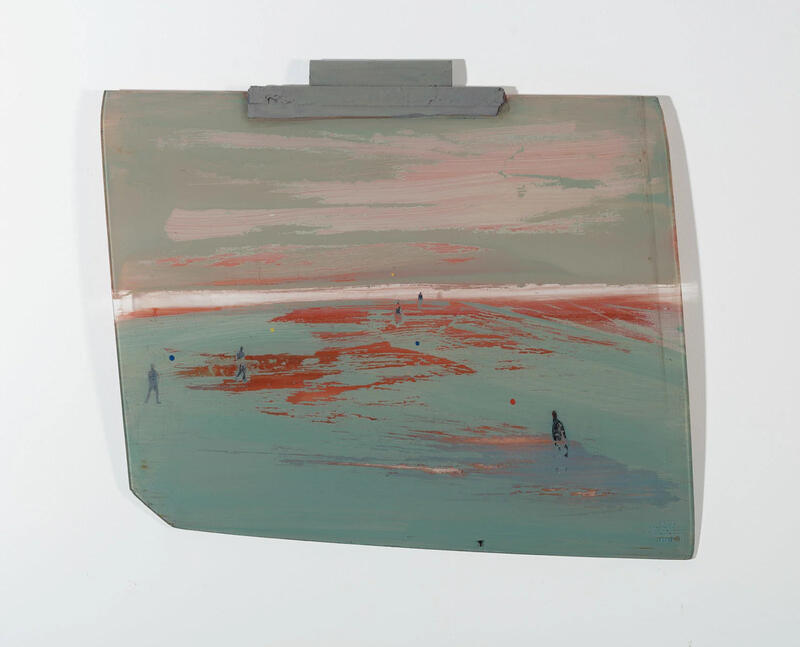
Finally, it’s possible to see Through the side window, in the translation of Pela janela lateral: three side windows cars painted. The inside and the outside, the interior and exterior landscape, the destination and the arrival, but above all the path, the journey, the crossing that Tatiana Blass’ pieces invite anyone who passes by to enjoy, since the unspoken word, the empty and lonely way, until a Brazilian music, Paisagem da Janela [Window Landscape] – which I reference here as an interreferential soundtrack, though is not part of the exhibition itself –, making departure in a half underground tornado.
To a certain extent, half underground tornado can become a metaphor for Blass’ current production: fractured, elusive, and in continuous transit. Her work burrows beneath the visible, unearthing the impermanence of forms, the instability of language, and the erosion of time itself. From buried cars to flooded chairs, from gaslit figures to silenced instruments, Blass insists on an art that exists in the in-between: between performance and object, voice and void, surface and depth. Through the side window: the artist’s trajectory is one of looking out while moving forward, an interior landscape glimpsed from the road. We are invited to travel with her, not toward clarity, but into the eye of the storm, into the half-light, the half-speech, the half-submerged poetry of a world undone and remade in art.
-
Tatiana Blass. Pela janela lateral/ Through the side window #2 (55x90cm), 2025. Synthetic enamel on glass. Courtesy of Albuquerque Contemporânea
-
Tatiana Blass. Pela janela lateral/ Through the side window #1 (50x58cm), 2025. Synthetic enamel on glass. Courtesy of Albuquerque Contemporânea
*Cultural critic, writer, and researcher based in Belo Horizonte, Brazil. Her work focuses on contemporary art, poetry, language, psychoanalysis, and ecology. She holds a Master's degree in Modern and Contemporary Literatures from UFMG and is currently completing a PhD titled The Thread and the End: Fictions, Apocalypses, Embroideries, and the Problem of Literature. Her writing has appeared in journals such as Revista Interfaces and eLyra, and she is the author of the book Escrever Leonilson: expansão da poesia (Relicário, 2022). Her research explores artistic practices that navigate the thresholds of expansion, fragmentation, and narrative.
Related Topics
May interest you

A HISTORIC LYGIA CLARK RETROSPECTIVE ARRIVES IN ZURICH
Kunsthaus Zürich brings together more than 120 historical works and 50 participatory pieces that reveal the Brazilian artist’s profound transformation of modern art.
MARCELLE, BASUALDO, AND PRIETO INCLUDED IN CONCEPTUAL EXHIBITION AT COLLEGIUM
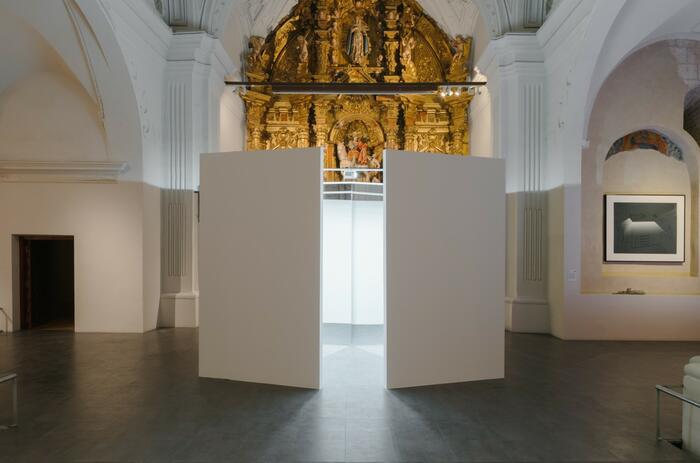
Collegium is hosting at its headquarters in the Castilian town of Arévalo the exhibition Jaque. Poder, tiempo e imagen en estado de juego (Check. Power, Time, and Image in a State of Play), a conceptual show that stems from the relationship between chess and the Torre de los Ajedreces, part of the Romanesque-Mudejar style Church of San Martín, which currently serves as the institution’s main headquarters. The building, dating from the 11th and 12th centuries, features an unusual brick frieze in a checkerboard pattern that evokes the chessboard and the strategic dimension of the game.

GDA – GALERIA DE ARTISTAS LANDS AT ZIELINSKY BARCELONA WITH THE GROUP SHOW PERQUIRERE

MASP INAUGURATES AN EXHIBITION BY MINERVA CUEVAS ON SOCIAL ECOLOGY
The multidisciplinary exhibition by the Mexican artist, featuring installation, sculpture, painting, posters, and video, closes the Histories of Ecology cycle and highlights the environmental crisis as a social issue.