A HISTORIC LYGIA CLARK RETROSPECTIVE ARRIVES IN ZURICH
Kunsthaus Zürich brings together more than 120 historical works and 50 participatory pieces that reveal the Brazilian artist’s profound transformation of modern art.
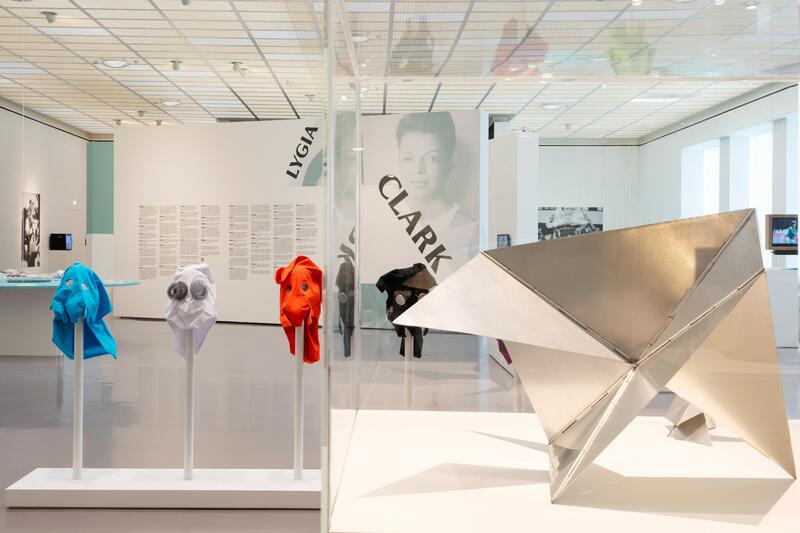
Until 8 March 2026, Kunsthaus Zurich (Switzerland) stages a major retrospective devoted to Lygia Clark, one of the most influential voices of the Latin American avant-garde. Developed in cooperation with the Neue Nationalgalerie Berlin, it is the first large-scale exhibition of Clark in a German-speaking country and the most comprehensive worldwide since MoMA New York’s 2014 presentation.
The exhibition opens with lyrics written in 1971 by Caetano Veloso, who dedicated the song to Clark. They evoke the intimate dialogue between music, life, and art—an entry point to understanding the radical way in which Clark redefined artistic experience by involving the body, the senses, and the active presence of the viewer.
-
Lygia Clark. Cabeca Coletiva. Courtesy of Kunsthaus Zürich
Lygia Clark (1920 Belo Horizonte – 1988 Rio de Janeiro) reshaped art history by dissolving the boundaries between artist, artwork, and viewer. Abandoning conventional forms of painting and sculpture, she developed process-oriented works completed only through participation. Her practice questioned the museum as an institution and the very notion of art as a finished object. For Clark, art was a holistic experience grounded in human perception and transformation.
As a leading representative of Neoconcretismo, founded in Rio de Janeiro in 1959, Clark pursued a body-centred experience of art from the 1960s onwards. While the movement drew on modular and constructive principles propagated by Theo van Doesburg and Max Bill, it simultaneously broke from them by elevating intuition over mathematically driven structures.
In Brazil, Concrete Art had been embraced as a democratic principle, where every visual element holds equal value. Clark pushed these ideas further, opening them toward participation, perception, and embodied experience.
Throughout the 1960s and 1970s, Clark expanded the image into space, then into physical interaction, ultimately abandoning the object entirely. In this period she developed her influential propositions—instructions for participatory actions activated through masks, garments, or sensory devices designed to offer new ways of seeing the world and oneself. Clark emphasized their healing potential, aligning with Kunsthaus Zurich’s long-standing engagement with this theme.
-
Lygia Clark. Courtesy of Kunsthaus Zürich
The exhibition features around 120 original works from major public and private collections in Brazil, the United States, and Europe—many shown publicly for the first time—alongside 50 participatory replicas produced by the Associação Cultural O Mundo de Lygia Clark. Key groups include the celebrated Bichos, movable metal sculptures whose form emerges only through interaction, and Caminhando (1963), a series of actions based on the Möbius strip in which the act itself becomes the work.
Organized with the Neue Nationalgalerie Berlin, and developed in close collaboration with the Associação Cultural O Mundo de Lygia Clark, the exhibition offers an unprecedented exploration of the artist’s innovative practice. An accompanying presentation at Haus Konstruktiv highlights the Swiss-Brazilian connection and the influence of Swiss Concrete artist Max Bill.
Related Topics
May interest you

A SENSORIAL ENCOUNTER IN BERLIN: LYGIA CLARK AND HER LIVING UNIVERSE
Neue Nationalgalerie presents the first major retrospective in Germany of Brazilian pioneer Lygia Clark, with over 120 works and an interactive approach that expands the boundaries of the museum experience.
TATIANA BLASS: HALF UNDERGROUND TORNADO
By Marina Baltazar, cultural critic, writer, and researcher

MALBA PRESENTS POP BRAZIL, THE RADICAL PULSE OF THE 60s–70s
Over 120 groundbreaking works arrive in Argentina in the most extensive exhibition to date on this defining artistic era.