ARTBO 2025: CARTOGRAPHIES OF MARKET, IDENTITY, AND NATURE
By Candelaria Penido
ARTBO, Bogotá’s international art fair held from September 25 to 28, once again reaffirmed its position as one of Latin America’s most relevant platforms. It brought together 46 galleries and more than 180 artists across the five floors of Ágora Convention Center. With a program intertwining market and thought, this year’s edition emphasized diversity in formats, trajectories, and geographies, offering a multifaceted map of contemporary regional production.
Escalators with illuminated messages, the aroma of coffee, and a hum blending with Bogotá’s traffic set the fair’s atmosphere. Upon entering, visitors were greeted by a vast empty hall. A single work, Estamos acá (We Are Here) by Colectivo Mangle, welcomed them with 40,000 compressed earth spheres. The piece not only revives an ancestral technique —rammed earth— but also invites viewers to rethink their relationship with the environment. This work served as a threshold to the key themes of the fair: identity as a contested territory, nature as a space of resistance, and violence as a wound that still pulses across the continent.
As visitors ascended, they encountered a range of projects, exhibitions, gallery and publishing stands, and rooms devoted to talks and institutions. In his series Palabras Invisibles (Invisible Words), Santiago Castro Pulido inscribes “Esto (no) es un voto” (This Is (Not) a Vote) beneath a machine gun —a critical dialogue with Magritte and Colombia’s political history. “The project addresses the relationship between reality, representation, and language, taking as its starting point objects whose meaning is constantly redefined through daily use,” explained representatives from Vertigo Contemporary gallery. Cartagena-born Fidel Álvarez, meanwhile, juxtaposes economy and natural fragility: flowers pierced by coins, oceans reduced to drops of glass, a tree assembled with minimum-wage bills. Through humor and irony, he exposes tensions we tend to normalize.
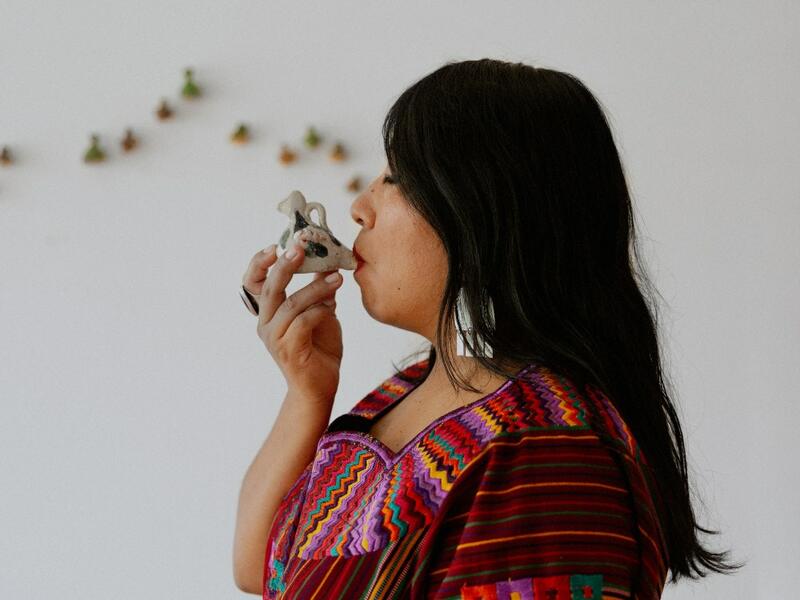
Beyond the big names, ARTBO enables diverse perspectives on Latin American art, featuring proposals that challenge hegemonic centers of artistic production and open unexpected dialogues. From Costa Rica, Satisfactory Casa de Arte presented a solo show by Marilyn Boror Bor: ceramic bird sculptures formed a musical staff across yellow walls —the only colored booth—; clay faces threatened by cement; and corn husk leaves expelled by urbanization. “A lineage turned into visual survival,” said Andrés Juan, who oversaw the stand. Puerto Rican artist Sofía del Mar Collins explored the metamorphosis of insects through painting and embroidery, incorporating fibers such as wool, linen, and cotton into works that speak of desire, fragility, and persistence.
Del Mar Collins was among the artists featured in the Projects section, curated by Carla Acevedo-Yates, which placed textile art at the center as both an aesthetic and political language. “Many contemporary artists are reclaiming ancestral techniques,” noted the curator. There, Guatemalan artist Andrea Monroy Palacios transformed traditional textile processes into sensitive records of material heritage, evoking cycles of the earth and inherited gestures. From Colombia’s Misak community, Julieth Morales combined performance, video, and ritual to explore her cultural roots and heal historical wounds in dialogue with her community.
Special sections also shaped the rhythm of the fair. Trayectoria, dedicated this year to Beatriz González, revisited the work of a key figure in Colombian art. Her practice—steeped in memory and vindication—reminds us of art’s power to open questions about conflict, mourning, and collective identity. In Artecámara, curated by Carolina Cerón, the journey was both intense and diverse: 21 emerging artists expanded the boundaries of Latin American identity through works requiring the viewer’s activation—from Andrés Felipe Castaño’s Coreografías de la imposibilidad, which demanded that visitors walk, touch, and leap through the installation to exit the room, to uncovering hidden messages in old computers in Federico Reyes Mesa’s perdón por tanto y gracias por tan poco (sorry for so much and thanks for so little), or witnessing the giant pendulum by Eder Mauricio Gallego.
Beyond the circulation of artworks and collections, this edition of ARTBO confirmed its role as a stage for cultural reflection—where intersections of memory, belonging, and nature resonate with a present shaped by social and political tensions. A cultural platform that unfolds the map and questions the centrality of dominant narratives, the fair functions not merely as a commercial showcase but as a laboratory of aesthetics and discourse, revealing how Latin American art continues to test forms of persistence, care, and renewal.
*Cover image: Marilyn Boror Bor. “Ancestral Call,” 2020–2025.
May interest you
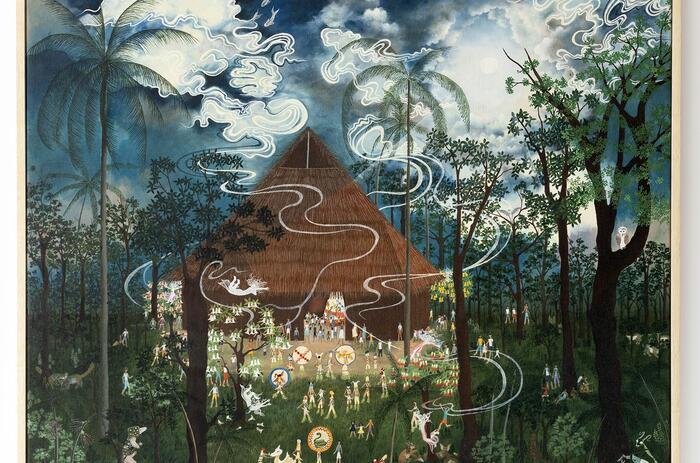
ARTBO ART FAIR OPENS IN BOGOTÁ
The cultural event celebrates its 21st anniversary with 46 international galleries, four curatorial sections, and a program that reaffirms its role as a key platform for contemporary art in Latin America.
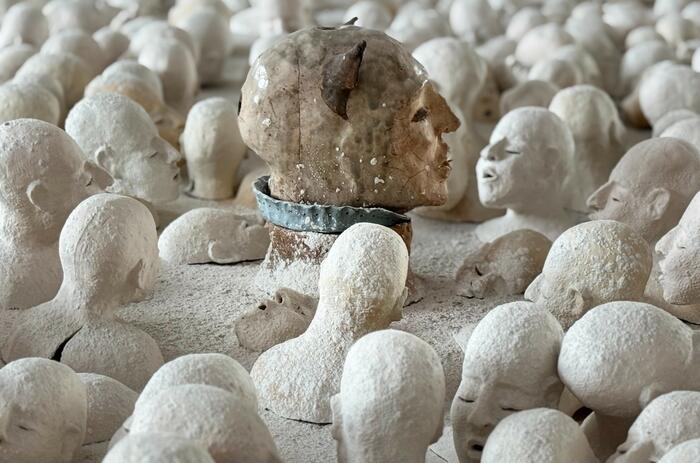
ANTIOQUIA BECOMES A GLOBAL HUB FOR CONTEMPORARY ART WITH BIAM 2025
The International Art Biennial returns after 44 years, bringing together over 120 artists from 25 countries, 300 artworks, and a free program spanning 15 municipalities.

LIMITS AND METAMORPHOSES OF THE HUMAN EXPERIENCE AT MAMBO
Ambra Castagnetti: Ephemeral Panic explores the mutability of the body and its link to the political and the poetic through sculpture, video, and performance.

RE-FILMING HISTORY: SU HUI-YU BETWEEN COLOMBIA AND TAIWAN
The Museum of Modern Art of Bogotá presents A Total Story, an exhibition that reinterprets historical archives and collective fictions to intertwine the memories of both territories.
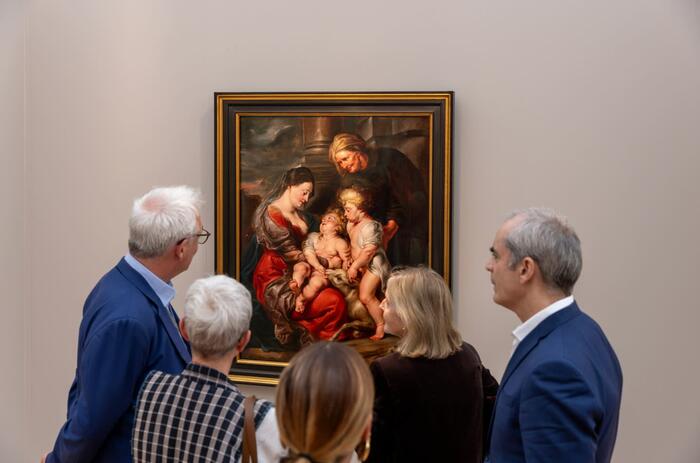
IN UNCERTAIN TIMES, COLLECTORS TURN BACK TO THE CLASSICS
Signs of caution in a market seeking stability.
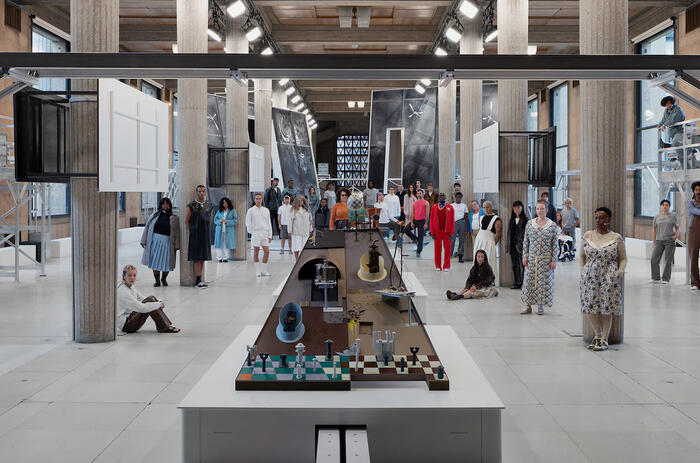
PARIS, CAPITAL OF ART AND FASHION: MIU MIU AND HELEN MARTEN’S 30 BLIZZARDS AT ART BASEL
In a city where art and fashion have long shared the same stage, one of the most talked-about encounters during Art Basel Paris week was 30 Blizzards, a performative project by British artist Helen Marten, presented by Miu Miu at the Palais d’Iéna. The preview gathered an international mix of collectors, curators, and fashion figures, confirming how naturally these worlds now intersect.

REFORESTING MEMORY: YUNUEN DÍAZ AT THE BOGOTÁ BIENNIAL
Bogotá and Mexico City are among the cities with the greatest bird diversity in the world: Bogotá is home to 550 species, while Mexico City has 365. Inspired by this observation, Mexican artist, poet, and educator Yunuen Díaz presented a series of ten habitable nests at the International Biennial of Art and the City, BOG25—a collaborative creation with basket weavers from Apulo, Colombia, installed in the plaza of the Gabriel García Márquez Cultural Center of the Fondo de Cultura Económica.