By
Manuel Vásquez Ortega
Bogotá and Mexico City are among the cities with the greatest bird diversity in the world: Bogotá is home to 550 species, while Mexico City has 365. Inspired by this observation, Mexican artist, poet, and educator Yunuen Díaz presented a series of ten habitable nests at the International Biennial of Art and the City, BOG25—a collaborative creation with basket weavers from Apulo, Colombia, installed in the plaza of the Gabriel García Márquez Cultural Center of the Fondo de Cultura Económica.
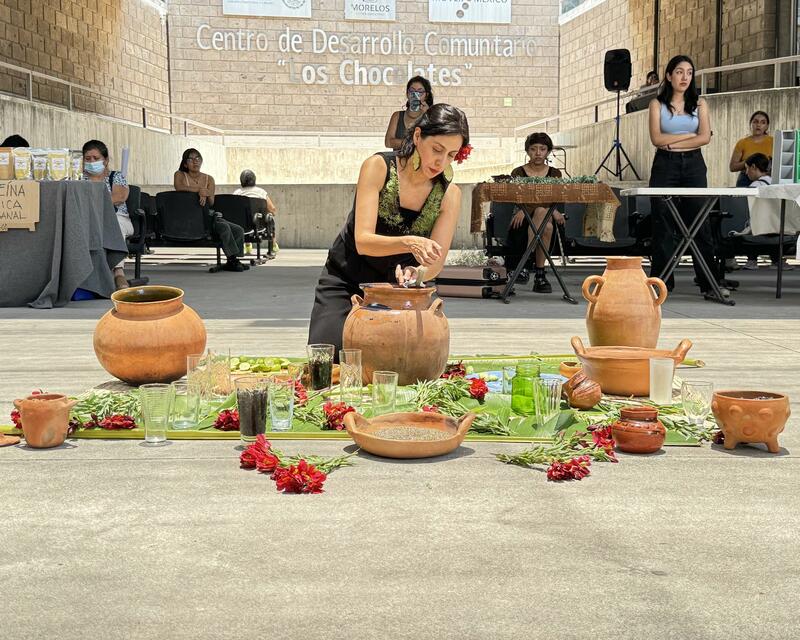
Selected to represent Mexico City—guest of honor at this edition of the Biennial—Díaz proposes a public art installation where weaving, poetry, and birdsong coexist to offer a space for contemplation, rest, and delight. Visitors who enter the nests hear the songs of birds and the voices of poets from Mexico City and Bogotá.
Titled Tapazolli-Uze—with tapazolli meaning “nest” in Nahuatl and uze the same in the Muysca language—the installation sensibly reflects on more-than-human symbiotic relations, sound as an interspecies language, and the fragility of natural and cultural ecosystems.
In this conversation with curator Manuel Vásquez Ortega, the artist reflects on ecology, care, collaboration, and interspecies relations throughout her artistic practice.
MVO: I’d like to begin by highlighting the relationship between territory and your work—not only your artistic practice but also your pedagogical and poetic ones. From the sourcing of materials to your interest in food, cultivation, and the stories that ground your research. As an artist, what interests you about “taking” from the land? And I use “taking” in quotes to later address the question of respect, interrelation, and co-authorship. What relationships do you establish with the beings that inhabit it?
YD: I like to think of territory as a web of biocultural relations: the land is plants, animals, people, but also their stories and memories. There’s always a narrative component in my work because I’m interested in the affective relationships that emerge from shared memories. Stories are what give a place its uniqueness—what allow us to look closely and create bonds. I like to think of my work as an exercise in “reforesting memory”: making the many layers of history within a territory resurface.
A text by Lucy Lippard, The Lure of the Local, has deeply influenced me. Lippard describes our disconnection from the environment in contemporary life, encouraged by capitalism, and argues that becoming more conscious inhabitants of a place begins with knowing it—understanding the issues that affect it, the relationships that form within it, and what existed before we arrived.
Likewise, Silvia Rivera Cusicanqui proposes that we commit ourselves to “the here and now of the earth and its landscape.” My work is grounded in this idea: in embodied landscapes. The dichotomies of capitalism—mind/body, body/territory—show us a false world of separation. There is no mind without a body, and no body without a territory. That’s how the threads of my work intertwine: the idea of body-territory, drawn from Latin American and popular feminisms, which I explore through the senses and also through the symbolic—where it meets poetry.
Cusicanqui also points out that historically, the notion of territory has been linked to defensive or competitive behavior, rather than to values like cooperation, respect, and coexistence. Yet in your work, the territory appears as a space for sharing and caring.
Yes, absolutely. The etymology of “ecology” comes from oikos, which means “home.” So ecology is really about learning how to inhabit. Making a house is making a home. That’s why I’m interested in the affective content of territories—we truly inhabit when we care and connect.
The notion of care is increasingly present in contemporary art, not only in human relationships but also in interspecies and contextual ones. This is clearly visible in your work.
Yes, and I think it’s something we must focus on. It’s central to ecofeminist thought, because recognizing the vulnerability of life is essential to learning how to care for it. Care work—food, health, education—has traditionally been assigned to women, and these are often precarious and undervalued forms of labor. They must be made visible and appreciated.
Through art, we can help promote a culture of care. Ecology and biology approach it from a scientific standpoint, but people act not only rationally—we act through emotion and empathy. It’s about being moved by the narratives of life.
There’s a beautiful text by Ursula K. Le Guin, The Carrier Bag Theory of Fiction, in which she, following anthropologist Elizabeth Fisher, proposes that the first human technology was not the weapon, but the basket—the container that allowed us to gather, carry, and share. The idea of technology has long been tied to war and domination, but what truly enabled survival was mutual aid. That idea of the basket is central to my work, and it directly informs the nests in Tapazolli-Uze as well as my projects around food and nourishment.
In your nests for the Biennial, there’s a strong sense of ancestral memory. We hear both the voices of poets and the songs of birds. What kinds of memories are you interested in preserving or reinterpreting?
I’m drawn to recovering those other histories—not the epic, universal ones of war and heroes, but those that place us in a position of respect and care toward the earth. My work with food and seeds is about echoing those stories. Some recent studies suggest that humans developed larger brains because we learned to cook; when we did, our bodies and cognition changed. So our evolution as a species is deeply linked to cooking, food, and care.
In Tapazolli-Uze, poetry plays a crucial role—it gives the work its immersive, almost environmental quality. Could you tell me about how poetry and birdsong became part of the piece?
I’m very interested in fabulation—the creation of stories—and in poetry as a non-utilitarian relationship with language. Poetry isn’t made to tell you something; it’s made to make you feel and to open the imagination. It’s a language set free to play.
Some theories suggest that human language originated from listening to birds or observing bees—their rhythms, movements, and sounds. I love that idea. That’s why I invited poets like Mónica Nepote, Luz Mary Giraldo, and Diana Carolina González, whose work resonates with the natural world and birds. Poetry, like birdsong, invites an expanded listening—an interspecies form of attention. Once there were nests, there had to be birds and poetry, as an invitation to that shared listening.
Collaboration is a constant in your practice, even though the art system often privileges the individual creator. How does collaboration shape your artistic logic?
I love collaboration and the relationships it creates. Capitalism presents us as self-sufficient individuals, but we are actually socially and emotionally interdependent beings. Art, for me, is a way to learn, connect, and live with others.
In Apulo, the process was beautiful. I had made a two-meter basket the previous year with women from the Cuentepec Indigenous community in Mexico, so when I arrived, I showed the artisans photos of that piece, and we began to imagine the nests. We worked outdoors in the workshop of Don Arbey Jiménez, near the Apulo River, under the shade of large trees. It was a challenge—they initially proposed a more linear structure, while I envisioned something round and organic—but together we found a way. Over time, I got to know his family, and learned they are affectionately called “the birds.” It felt poetic that these “birds” helped us build the nests.
What does the material—reed (carrizo)—mean to you?
Carrizo is an ancestral material, used since pre-Hispanic times for weaving baskets and building homes. You can even see it represented in Mexica codices, where one of the calendar years is named “Year of the Reed.” The material itself carries a vegetal and cultural memory. It grows along rivers, is flexible when green, strong when dry, biodegradable—it’s born from the earth and returns to it.
Weaving reed is a bodily dialogue with the land—a gesture that connects cultural history, material history, and embodied memory.
I find it fascinating how you work with a material often considered invasive or undesirable. You manage to sublimate it into an artwork through this sensitive technology of weaving.
Yes, I’m very interested in re-signifying material culture. What’s often dismissed as “weeds” can, as Gilles Clément reminds us, be a thriving ecosystem. Reed was rejected by modernity and replaced by plastic—and now we live with the consequences. It’s vital to change industrial logics and restore the wisdom of local materials.
To end, I’d like to highlight the connection between your work and that of Mónica Mayer, whose piece Soy tan vieja que... shares space with yours at the García Márquez Cultural Center during the Biennial. While your works differ, they both recover intimate and collective stories. How does it feel to be alongside her?
It means a lot to me. Mónica Mayer was my teacher, and she’s a teacher to an entire generation of women. She taught us that making art is a political and ethical position, but also that it’s about solidarity and humility. Mónica didn’t just teach us how to make art—she taught us how to build shared worlds.

The Museum of Modern Art of Bogotá presents A Total Story, an exhibition that reinterprets historical archives and collective fictions to intertwine the memories of both territories.

Ambra Castagnetti: Ephemeral Panic explores the mutability of the body and its link to the political and the poetic through sculpture, video, and performance.
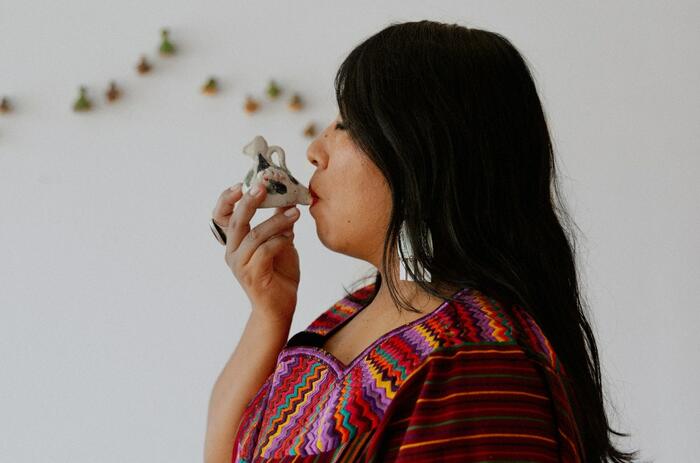
By Candelaria Penido
ARTBO, Bogotá’s international art fair held from September 25 to 28, once again reaffirmed its position as one of Latin America’s most relevant platforms. It brought together 46 galleries and more than 180 artists across the five floors of Ágora Convention Center. With a program intertwining market and thought, this year’s edition emphasized diversity in formats, trajectories, and geographies, offering a multifaceted map of contemporary regional production.
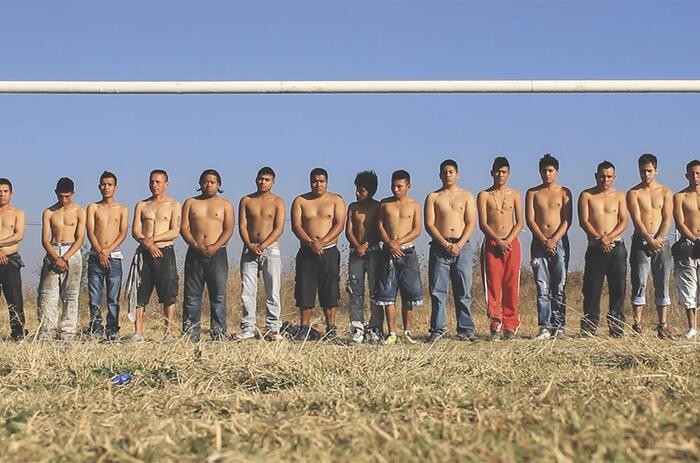
At a moment when the world unites around the ball, Football and Art. That Same Emotion invites us to reflect on the sport’s power to bring communities together, build imaginaries, and transcend borders.