
By
Violeta Méndez
A 10-metre-long sculpture by the acclaimed Venezuelan artist is on view in Kensington Gardens, inviting visitors to experience art both physically and visually.
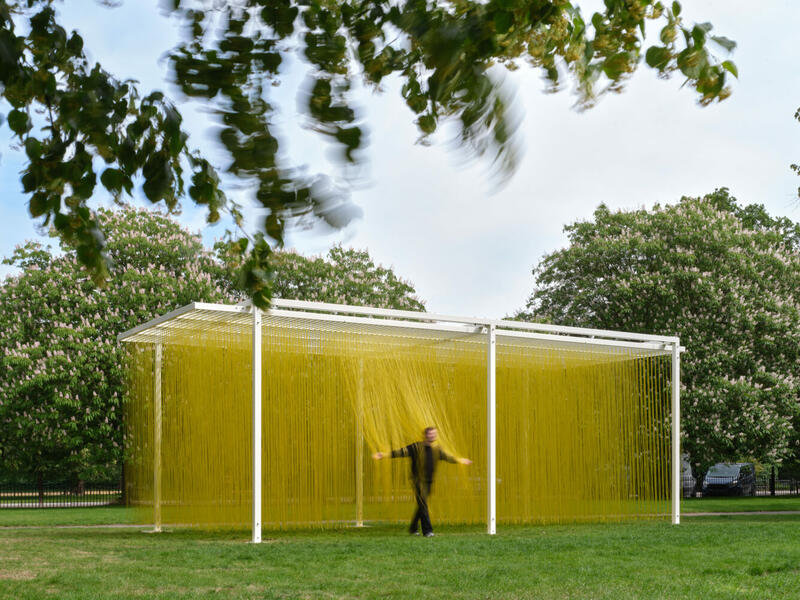
To recall the work of Jesús Rafael Soto (Ciudad Bolívar, Venezuela, 1923-2005) is to once again question what place objects occupy in space; or rather, what place space occupies within objects. Pénétrable BBL Jaune (1999; 2023 edition) is presented by Serpentine South at Kensington Gardens, London, until October: a 10-metre sculpture made up of 4,000 yellow PVC tubes suspended from a steel structure. The work allows for multiple experiences: from afar, the strands appear to shimmer and change; moving through it activates its motion and transforms its surroundings.
Curious about what came after Cubism in art history — a question his professors could not answer, since Europe was at war — Soto travelled to Europe in 1950. Inspired by Mondrian's colourful works, which he believed had truly achieved spirituality, Soto also wanted to generate movement. "I tried to create art that revisited what had fascinated me about Mondrian, but adding an element of dynamism," he said. László Moholy-Nagy (1895–1946), and in particular Naum Gabo (1890–1977), were among his other influences. With these ideas in mind, Soto created his first Pénétrable in 1967, designed by Jean Prouvé (1901–84) (he later produced more than seventy versions in different sizes and colours). The work now on view in the English gardens is based on the original Pénétrable BBL Jaune, made in 1999, which was relaunched by the artist's heirs in 2023 to mark the centenary of his birth.
Through his artistic production, Soto sought to show that space matters more than any object or element within it. "Contrary to what we have always believed, space is not something that is filled with objects. Objects are in fact filled with space. Space flows. Nothing limits it. I'm interested in showing people who are interested in space as a quality or a universal density that in fact it is space that is in control—it defines and sets its own conditions," he explained in a 2004 interview with Hans Ulrich Obrist, republished by Serpentine Galleries.
As Duchamp had also proposed, Soto was convinced that the viewer was the one who had to complete the work. In 1968 he wrote: "The viewer becomes an integral part of the work. Heretofore, the viewer was in the position of an external observer of reality. Today, the notion that there is mankind on one side and the world on the other has been superseded. We are not observers but constituent parts of a reality that we know to be teeming with living forces, many of them invisible. We exist in the world like fish in water: not detached from matter-energy; INSIDE, not IN FRONT OF; no longer viewers, but participants," as republished by Serpentine.
Soto belonged to the generation of artists who explored the possibilities of incorporating movement into art, developing kinetic art. Over the course of his seven-decade career he created an expansive body of work spanning drawings, paintings, sculptures and installations. Even more than 20 years after his death, his works remain vividly alive — so alive that they transform space, and space transforms them in turn.
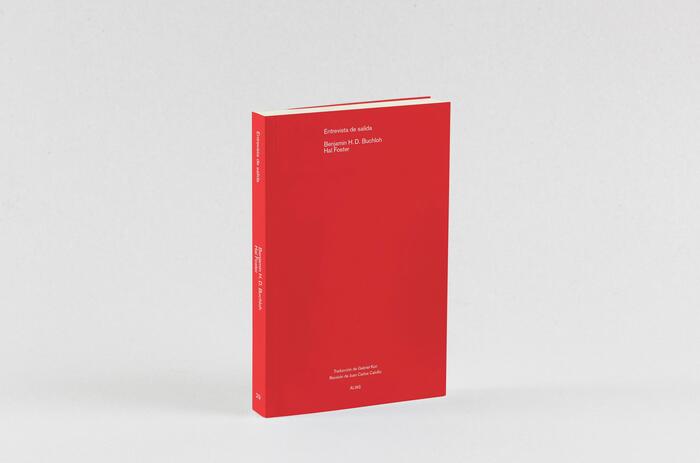
Alias editorial publishes the Spanish translation of the conversation between Benjamin H. D. Buchloh and Hal Foster, conceived as the farewell of one of postwar art criticism's central figures.

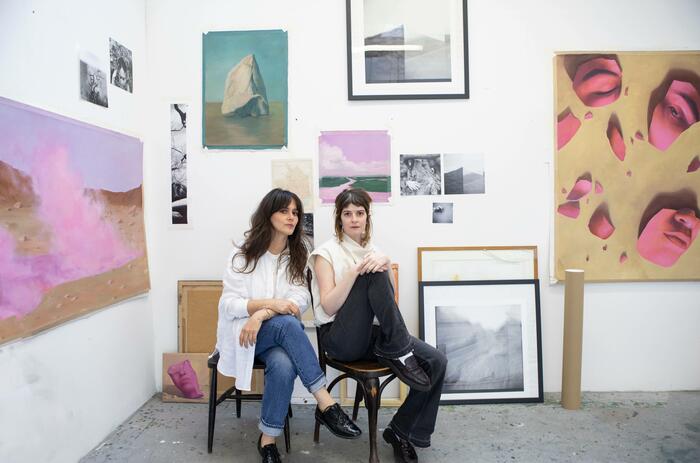
Founded by Brazilian collector Flavia Nespatti, ANTESALA opens its doors on October in Fitzrovia with the inaugural group show Assembly Lines.