
BETWEEN EARTH AND CONCRETE: DELCY MORELOS EXHIBITS IN LONDON
Ancestral knowledge and modern utopias meet at the Barbican Centre; the installation invites to reflect on how we inhabit the world.
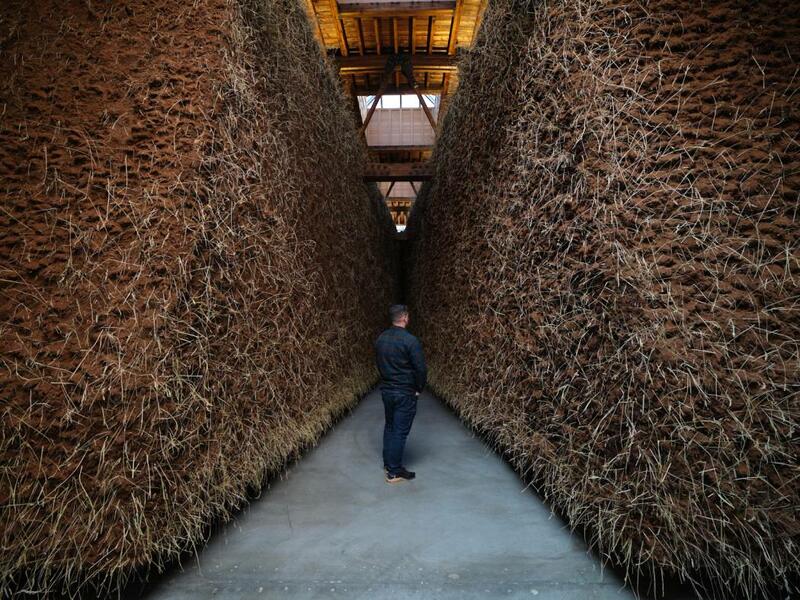
This Wednesday, the Barbican Centre unveiled Origo, the first public artwork in the United Kingdom by Colombian artist Delcy Morelos, on view through July 31. The project engages with the complex’s iconic concrete architecture while extending its visual arts commissioning program beyond traditional gallery spaces.
Morelos’s practice draws on Andean worldviews alongside the aesthetics of Minimalism and Abstraction. Her work reflects on the relationship between bodies and the earth. Born in 1967 in Tierralta, Córdoba—a region deeply affected by armed conflict linked to land dispossession and large-scale mining—she began by creating paintings with red clay pigments, exploring the connections between territory, violence, and the body. Since then, her work has consistently approached the earth not as a resource, but as a living agent with which humans form a symbiotic relationship.
-
Delcy Morelos. Portrait 2025. Photo credit: Inés Magaña Mayorga. Courtesy of the artist and Marian Goodman Gallery
-
Delcy Morelos, El abrazo (The Embrace), 2023. Installation view, Dia Chelsea, New York, 2023. Photo credit: Don Stahl. Courtesy of the artist and Marian Goodman Gallery
-
Delcy Morelos, Iglesia, 2024. Installation view, CAAC Centro Andaluz de Arte. Contemporaneo, Sevilla, Spain. Photo credit: Pepe Morón. Courtesy the artist and Marian Goodman Gallery
Building on her research into soil and plant matter, Morelos developed monumental installations designed to be experienced immersively. Handcrafted from clay, earth, hay, and seeds, these works incorporate spices such as cinnamon and cloves, whose antifungal properties help preserve the material. Combined with the damp scent of soil, these elements create a sensory environment that evokes memory and encourages a more ethical relationship with what the artist calls the “mother of all materials.”
Origo establishes a counterpoint with the Barbican through both form and material. The complex’s concrete surfaces, marked by traces of human labor, evoke both the devastation of the Blitz and the social ideals of the postwar period. Influenced by Le Corbusier, the Barbican was conceived in 1959 by Chamberlin, Powell and Bon as a “city within a city,” integrating housing, culture, and public space.
-
Delcy Morelos. Photo credit: Ernesto Monsalve. Courtesy of the artist and Marian Goodman Gallery
Installed in the Sculpture Court—reactivated for the first time in a decade—the work is Morelos’s most ambitious to date. Rising over three meters high and formed as an oval structure with multiple access points, its porous topography contrasts with the rigidity of its surroundings. Earth-lined tunnels invite visitors to move through the interior and to consider forms of coexistence beyond the human, in relation to the microscopic life within the soil.
The installation encourages visitors to circle, enter, and inhabit this earthen body, where light, scent, and texture shape an immersive experience.
Related Topics
May interest you
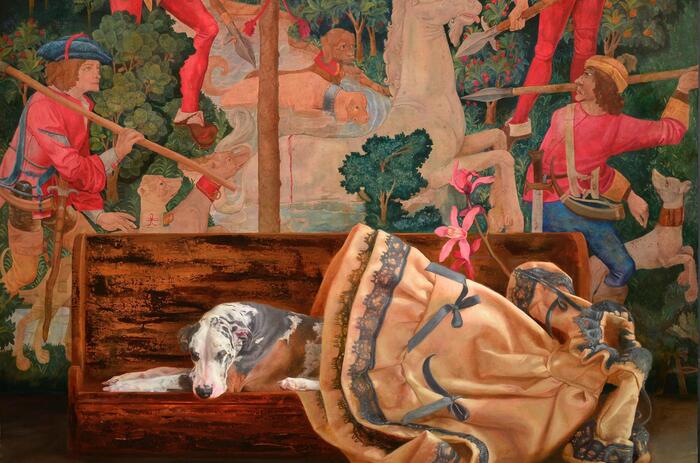
MIGUEL ESCOBAR INAUGURAL RECIPIENT OF THE IAN ROSENFELD FUND
Global selection underscores the Colombian singular pictorial language shaped by tension, staging, and introspective inquiry.
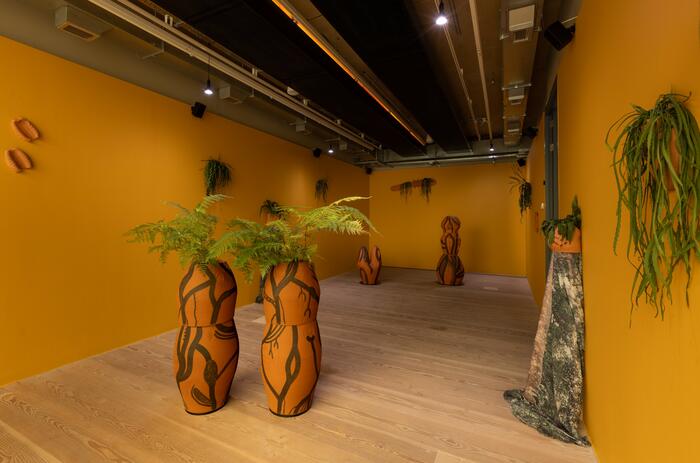
AT THE INTERSECTION OF SCIENCE AND POETICS: LUCÍA PIZZANI IN THE UNITED KINGDOM
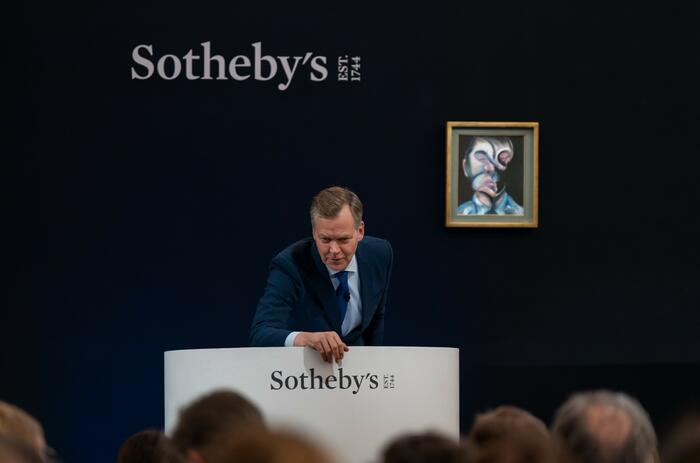
IS THE ART MARKET FINALLY RECOVERING?
The art maket stabilizes, but the recovery remains uneven.
MEXICAN CURATOR ANNOUNCED FOR LIVERPOOL BIENNIAL 2027
Lucía Sanromán and Aimee Harrison to co-curate the 14th edition of the festival, taking place from 5 June 2027 until 12 September 2027.
BEATRIZ GONZÁLEZ IN LONDON: A MONUMENTAL RETROSPECTIVE FOLLOWING HER PASSING
The acclaimed Colombian artist will be honoured at the Barbican Centre with an exhibition bringing together more than 150 works spanning seven decades of production.
WHEN FASHION MEETS ART: QUOTES, BODIES, AND POWER AT THE MET GALA
Between references to art history and spectacular visual statements, the 2026 Met Gala once again pushed the boundaries between aesthetic creation and performance.
GABRIEL CHAILE UNFOLDS HIS ARCHAEOLOGY OF MIGRATION IN LONDON
The Argentine artist connects memory and identity in a large-scale installation commissioned by Whitechapel Gallery, where adobe sculptures and collected objects examine the experience of displacement through a contemporary archaeological lens.