
BEAUTY, MEMORY, AND ENVIRONMENTAL COLLAPSE AT BALTIMORE MUSEUM
Black Earth Rising brings together artists from the African diaspora, Latin America, and Indigenous communities to explore the links between environmental devastation, colonial legacy, and the possibility of imagining alternative futures.
The title Black Earth Rising at the Baltimore Museum of Art (BMA) stems from the Portuguese phrase terra preta, or “black soil.” It refers to the fertile earth of the Amazon Basin, created over thousands of years through Indigenous agricultural practices—most of which were erased by colonization in the 16th century. Though remnants remain, terra preta has come to symbolize lost knowledge and the hope it still offers.
Curated by British writer and curator Ekow Eshun, the exhibition features contemporary artists of African diasporic, Latin American, and Native American descent. Through painting, sculpture, film, and sound, they offer striking perspectives on nature—its majesty, its destruction, and its potential for renewal.
-
Alejandro Piñeiro Bello, Viajando En La Franja Del Iris, 2024, Oil on linen, and Yinka Shonibare, Earth Kid (Girl) II, 2022. Courtesy Baltimore Museum Of Art
A central work is Alejandro Piñeiro Bello’s Viajando En La Franja Del Iris. Based between Havana and Miami, Bello reflects his layered identity in a surreal red and blue composition. Land and sea forms swirl under a red sun and blue sky, a dreamlike vision chosen by the BMA as the exhibition’s key image.
Teresita Fernández contributes two monumental pieces that address colonial legacies. Fire (America)1, made of glazed ceramic tesserae, depicts a night sky ablaze, using earth-based materials that reflect Native American spiritual ties to land. “For me, landscape is about the history of people in places,” she explains. Her “Dark Earth (Astral Sea)”—a black-and-white landscape created with burnt tree charcoal—directly links to the show’s title.
-
L-R: Teresita Fernández, Fire(America) 1, 2016, Glazed ceramic and Dark Earth(Astral Sea), 2023, Solid charcoal and mixed media on aluminum panel; Igshaan Adams, NAGTREIS OP N VLIENDE PERD (a night journey on a winged horse), 2021; Stacy Lynn Waddell, Untitled #6, 2023; Yinka Shonibare, Fire Kid (Boy), 2021; Jaune Quick-to-See Smith, Echo Map I, 2000, Oil and collaged paper on canvas. Courtesy Baltimore Museum of art
Firelei Báez blends myth and history in vibrant oil paintings on printed canvas. In Convex and Anacaona, she reimagines the Ciquapa, a mythical trickster from Dominican folklore, to examine colonization’s lingering trauma and propose alternate futures. In Convex, the figure overlays a sugar refinery diagram, cascading blue water evoking the Middle Passage.
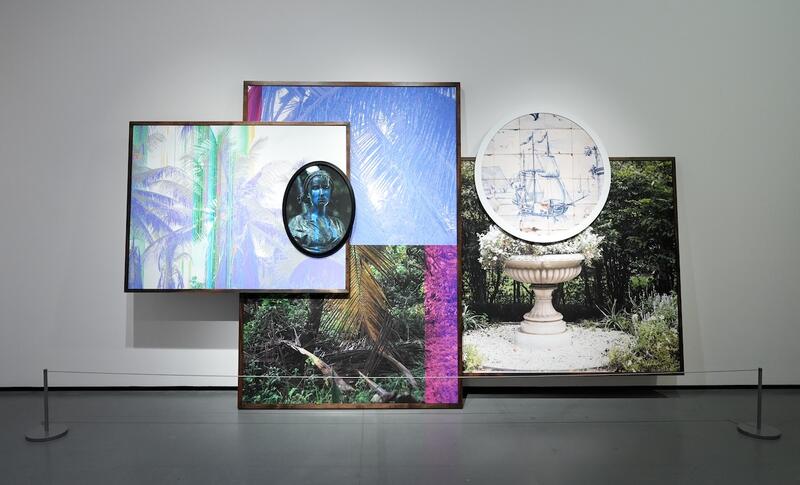
Other artists take a documentary approach. Todd Gray’s Present History (1619) juxtaposes African landscapes with Western gardens and slave ships, creating layered photo-assemblages that explore how the transatlantic slave trade shaped today’s global economy.
-
Sky Hopinka, Mnemonics of Shape and Reason, 2021, HD video, stereo, color, Duration: 4 minutes, 13 seconds. Courtesy Baltimore Museum of Art
Works by Jaune Quick-to-See Smith, Yinka Shonibare, and three video artists—Sky Hopinka, Alberta Whittle, and Wangechi Mutu—further enrich the exhibition. Each investigates our fractured relationship with the environment and the spiritual cost of colonization.
*Cover image: Todd Gray. Present History (1619), 2019. Five archival inkjet prints (pigment-based) in artist's frames, UV laminate. Courtesy Baltimore Museum of Art.
Related Topics
May interest you

PLURAL AMAZONIA: A LIVING CARTOGRAPHY IN THE HEART OF NEW YORK
Americas Society presents Amazonia Açu, an exhibition that explores the cultural, historical, and spiritual diversity of the Pan-Amazon region through contemporary and Indigenous perspectives.

AFRO-CUBAN SPIRITUALITY AT PAMM: DIASPORIC HERITAGE AND CONTEMPORARY VISION
Twin Photography Duo’s First Solo Museum Exhibition Weaves Afro-Cuban Spirituality with Painterly Explorations of their Cultural Heritage.

WIFREDO LAM AT MoMA: BETWEEN DREAM AND DECOLONIZATION
The Museum of Modern Art will host the most extensive retrospective devoted to the artist in the United States, on view at MoMA from November 10, 2025, through March 28, 2026.