LANDSCAPE PARADOXES: TERESITA FERNÁNDEZ IN SEOUL
Liquid Horizon offers a resonant meditation on land and water. Viewers are invited to immerse themselves in layered environments where boundaries between past and present, self and world, and memory and perception dissolve.
Lehmann Maupin Seoul presents Liquid Horizon, an exhibition by New York–based artist Teresita Fernández, on view from August 27 to October 25, 2025. Featuring a glazed ceramic wall installation and luminous sculptural panels that evoke watery realms, the exhibition extends her ongoing interest in subterranean landscapes—soil horizons formed by geological and human-formed layers. Her exploration now moves into the stratified depths of the ocean, revealing layers of shifting density and transparency that expand the visual and conceptual language beyond the terrestrial.
For over three decades, Fernández has examined the complexities and paradoxes within landscape—the visible and hidden, celestial and earthly, fierce and alluring, material and ephemeral, ancient and contemporary. Her material intellect is embedded in sculptural investigations that question how place, land, and landscape are defined. Her work reveals landscapes as embodied sites—at once vast and intimate, private and collective—where poetics and politics intertwine, exposing the layered histories, identities, and cosmologies contained within their strata.
-
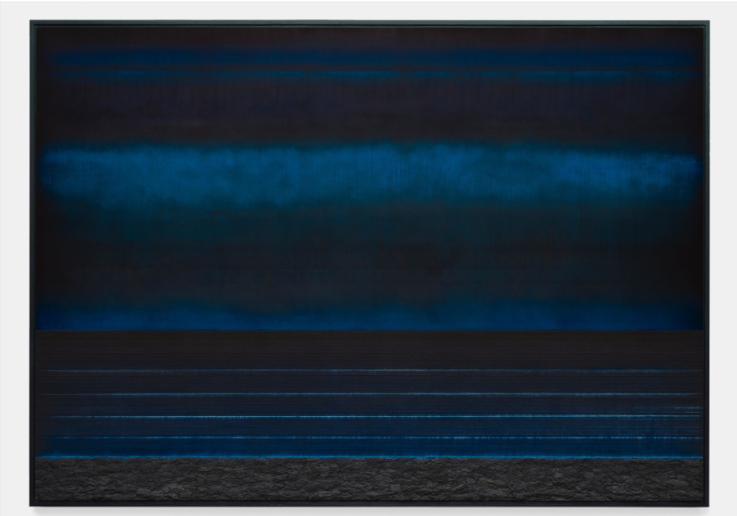
Teresita Fernández. Liquid Horizon 4, 2025 (detail). Solid charcoal, sand, and mixed media on aluminum panel, 60 x 84 x 2 inches. Courtesy Lehmann Maupin
-
Teresita Fernández. Liquid Horizon 4, 2025. Solid charcoal, sand, and mixed media on aluminum panel, 60 x 84 x 2 inches. Courtesy of Lehmann Maupin
Rather than depicting literal geographies, Fernández’s Stacked Landscapes—such as Liquid Horizon 3 (2025)—function as sculptural abstractions and metaphors for perception and the human condition. Fernández is deeply engaged with material resonance and its capacity to evoke emotional and psychological depth. Composed of relief horizontal striations in charcoal, sand, and blue pigments on aluminum, these works suggest geological formations merging with aqueous realms and introspective states.
The merging of land and water in the Stacked Landscapes serves as a critical point of observation, suggesting both origin and passage—a threshold where interior and exterior conditions converge. Rhythmic transitions between light and dark, reflection and absorption, evoke a meditative awareness of history, migration, and otherworldliness.
-
Teresita Fernández. Astral Sea 1, 2024. Glazed ceramic, 72 x 84 x 1.25 inches. Courtesy Lehmann Maupin
In the recent Astral Sea series—also on view in the exhibition—water plays a central role. It absorbs and mirrors, dissolving the boundary between surface and depth, earth and sky, anchoring the viewer in a fluid, shifting field rather than a fixed location. This expanded notion of the horizon recurs throughout the exhibition in varied forms. For Fernández, any single element contains multitudes. Metaphor and memory operate as equal counterparts in her evolving conception of landscape.
The glazed ceramic installation White Phosphorus/Cobalt (2025) echoes the chromatic depth and surface sensitivity of the Stacked Landscapes, while diverging in both structure and scale. Composed of thousands of small ceramic cubes, the work forms a shifting matrix of light and color saturation, moving from pale tones at the center to deeper hues at the edges. This tonal gradient generates a field that simultaneously expands and contracts, suggesting a vortex or astral body. Swirling with blue and white mineral glazes, the title White Phosphorus/Cobalt evokes a range of paradoxical references—from chemical reactions and mining to natural phenomena and the cosmos.
The exhibition also features nine solid graphite relief panels titled Nocturnal (Milk Sky). Rendered in soft blue tones, these works depict the rhythmic rise and fall of the tide.
The exhibition will be on view from August 27 to October 25, 2025, at Lehmann Maupin, 213 Itaewon-ro, Yongsan-gu, Seoul (South Korea).
Related Topics
May interest you

SIGN, STONE, AND TIME: A CONTEMPORARY EXHIBITION IN CANTABRIA
Cave Art Centre of Cantabria 'Alberto I de Monaco' in Puente Viesgo is hosting its first-ever contemporary art exhibition.

BETWEEN EXTINCTION AND LEGACY: ADRIÁN VILLAR ROJAS IN KOREA
For his first solo exhibition in Korea, Adrián Villar Rojas reimagines Art Sonje Center as a sculptural experiment in time and space.