
ALIVE AND PRESENT: INDIGENOUS ART THAT “DOES NOT FOCUS SOLELY ON OBJECTS” AT THE PRE-COLUMBIAN MUSEUM
The Chilean museum unveils a temporary exhibition that foregrounds the living traditions and creative persistence of the Atacameño/Lickanantay, Mapuche, and Rapanui peoples through an extensive process of research and collaboration with Indigenous communities.
The Chilean Museum of Pre-Columbian Art presents Alive and Present. Art of the Atacameño/Lickanantay, Mapuche, and Rapanui Peoples, a new temporary exhibition focused on the tradition and ongoing vitality of Indigenous art in Chile. Supported by Escondida BHP and Chile’s Cultural Donations Law, the exhibition will be on view until the end of June 2026 in the Andes and Furman galleries.
Curated by art historian and researcher Cristian Vargas Paillahueque in collaboration with the Museum’s team, and featuring exhibition design by architect Rodrigo Tisi, the project stems from the Reasoned Catalogue research initiative launched in 2022. This investigation sought to revisit the Museum’s collections through an intercultural and collaborative approach.
-
Moai Tangata y otras piezas rapanui de madera, © Andrés Vargas
In its first phase, the project invited Indigenous elders and artisans from communities in Araucanía, Atacama, and Rapa Nui to engage in dialogue around the objects displayed in the exhibition Chile before Chile. The process resulted in the creation of 220 reasoned entries—one for each researched object—and the publication of three catalogues dedicated to the Rapanui, Mapuche, and Atacameño/Lickanantay collections.
The Reasoned Catalogue research expanded the understanding of these collections by incorporating knowledge held within Indigenous communities themselves. Looking ahead, the Museum plans to extend this work to the Aymara, Quechua, and Diaguita collections.
-
Delegación Atacameña. Nicolas Aguayo
“This exhibition marks a milestone for the Museum because it explores a collaborative way of working with Atacameño/Lickanantay, Mapuche, and Rapanui communities. It does not focus solely on objects, but on the stories, affections, and relationships between them and the people, which remain alive today,” says Cecilia Puga, Director of the Chilean Museum of Pre-Columbian Art.
Curator Cristian Vargas Paillahueque adds that through this process, the pieces “cease to be merely objects of study and become living interlocutors of the peoples who sustain, create, and transform them.”
-
Pieza rapanui, la Barca de Hotu-Matua hecha por Juan Haoa en 1957, colección Museo Chileno de Arte Precolombino (M-106), © Justine Graham.
The exhibition brings together works from the Museum’s own collection as well as loans from institutions such as the National Museum of Natural History, the Valparaíso Museum of Natural History, and the Fonck Museum, in addition to private collections and newly commissioned works by Indigenous artists and artisans. Audiovisual materials and a strong archival component highlight authorship, faces, and the stories behind each piece.
Grounded in the idea that Indigenous creative production is not confined to the past, Alive and Present challenges conventional museum narratives and emphasizes the continuity, vitality, and future projection of Indigenous artistic and cultural traditions in Chile.
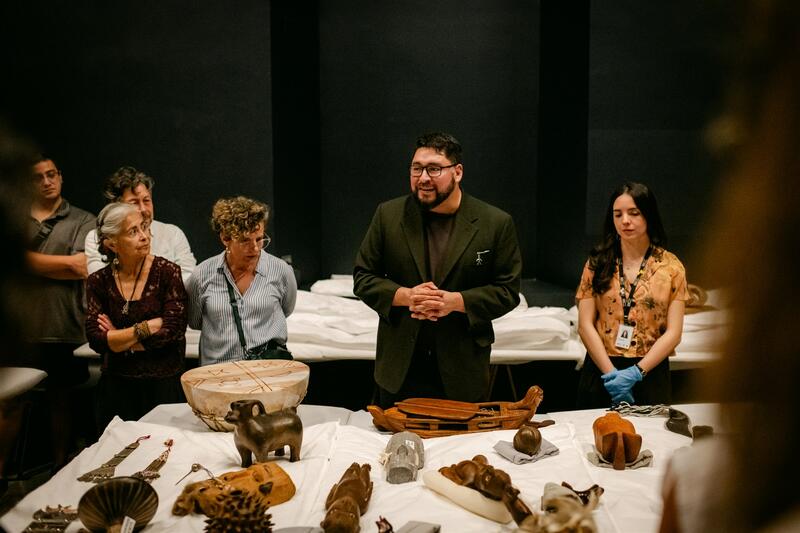
*Cover image: Curator Cristian Vargas Paillahueque presents a preview of the exhibition alongside the museum's collections team. Andrés Vargas.
Related Topics
May interest you
LATIN AMERICAN HISTORIES: MASP PRESENTS ITS 2026 PROGRAM
The museum explores the construction of the region’s identity through a major group exhibition and solo presentations by Jesús Soto, Damián Ortega, Sandra Gamarra, La Chola Poblete, among other artists.
LATIN AMERICAN ARTISTS IN SPAIN: NEW NOTES FROM AN ONGOING RESEARCH
By Mónica Sotos
What are the successive diasporas of Latin American artists to Spain about, from the final years prior to the turn of the twenty-first century to the present? Article 2 of a series of 3.