By
Alisa Minchenko
THE FUTURE OF ART IN TIMES OF WAR - INTERVIEW WITH BJÖRN GELDHOF
November 17, 2026
8 min.
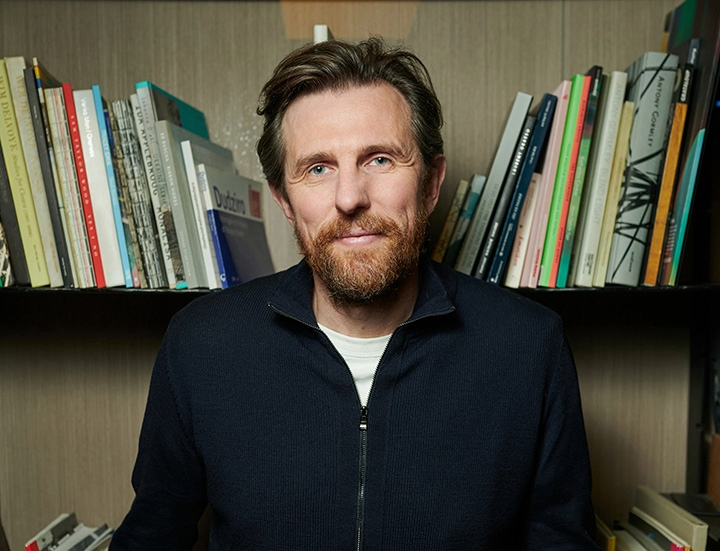
Björn Geldhof, courtesy of PinchukArtCentre
During the ongoing war in Ukraine, where much of the world’s future is being decided, Björn Geldhof, Art Director at PinchukArtCentre and a Jury Member of the international Future Generation Art Prize, offers his perspective on the center's operations and cultural priorities during these decisive turbulent times. This unique context creates challenges for the ArtCentre, but also opportunities to raise important societal topics that simply cannot be ignored. It becomes a space to reflect, heal, and engage. Björn also reflects on the impact of the Future Generation Art Prize for international and Ukrainian artists, which he defines as a process that offers recognition and incredible opportunities to artists under 35 from across the globe.
PinchukArtCentre, located in Kyiv, is one of the most influential art institutions in Ukraine. Currently, due to the Russian aggression, it has to deal with questions of audience safety and handling artworks against war damage. However, Björn explains that as an art institution during war the most challenging question is actually the content.
Björn Geldhof (BG): The real and more sensitive challenge is: How, and what do you discuss? We're an institution that has a critical position within society. Our job is to allow people to think critically, to touch upon subjects that are very often difficult. We do it within a society where more and more pressure mounts on the individual, but also on what can be discussed in public. And I think that's a particular challenge because there are subjects we feel we have to address.
So I really see PinchukArtCentre as a place where you have this kind of oxygen to discuss difficulties, to discuss topics that are otherwise difficult to discuss.
Alisa Minchenko (AM): Can you give an example of such a recent discussion, or maybe the discussion that stuck with you that was quite challenging?
BG: We have many discussions on how to show certain things. Because we have a large audience - to give you an example, our exhibition Joy has about 100,000 visitors, many of whom have gone through war-related trauma.
Enlarge image
-
Piotr Armianovski, Me and Mariupol, 2017. Photo: Sergey Illin
And it is a specific responsibility that you have as an institution to guide these people through an exhibition that might touch on difficult subjects. And how do you do that? How do you address these subjects and make sure that an audience doesn't get re-traumatized, but instead has an ability to perhaps speak about that trauma or engage with it in different ways? For us, these particular challenges also mean that the way we communicate with the audience and ask the audience to communicate with us has to fundamentally change. And regarding that, we have a continuous process of learning, changing, and operating.
AM: I personally recently encountered a similar case of what you are describing. I went to the Kyiv Biennale in Berlin, where I watched an animation by Dana Kavelina showing parallel experiences of a soldier and a cow in industrial farming during the war. And I noticed how certain things were being shown in a careful manner. For instance, there weren't any loud sounds to depict explosions, instead, they were communicated with light. And I think it is such an important thing that you can show traumatic topics, but at the same time remain very sensitive to your audiences.
BG: The same artist, Dana, created for us a work about busification (this is a term used in Ukraine to describe how military recruiters and law enforcement officers forcibly load men of draft age into minibuses to take them to recruitment centers). Which, you know, is an incredibly difficult topic; difficult to discuss. But it was an incredibly debated work. It was also a well-visited work because people felt like this was a place where they could actually engage with the topic without necessarily having a political opinion on it. And I think these are the topics that we, as an institution, really try to address.
AM: What do you think the audiences experience when exploring the space of Pinchuk Art Centre?
BG: Well, that depends on the exhibition. I think what we try to do is make the visits an experience. We try to change the way we operate with audiences so that they can actually step into a conversation with us rather than being just a passive observer. And that is a major part of what we call an experience - because you receive, but you also give. If you now go to the PinchukArtCentre, you will see an exhibition on joy, which I believe is an incredibly important topic to speak of. It's also a topic of resilience and of the everyday we often don't want to talk about.
Enlarge image
-
Ashfika Rahman, Than Para, No Land Without Us, 2025 - ongoing. “Joy”, 2026. PinchukArtCentre. Photo: Ela Bialkowska, OKNO Studio
We have approached the topic from the point of view of soldiers and veterans – asking what joy means to them. And I think that is such an incredible way of empowering joy, because it is deeply philosophical, but also very concrete, very surprising, and sometimes sad. And we've seen that for our audiences, that's been an amazing way to get in touch with joy. Sometimes they come out saying this was not about joy at all, but still being able to consider, rethink, and share their own moments of joy inside of the exhibition.
AM: Very importantly, the Victor Pinchuk Foundation is investing in the future of art and artists in Ukraine. Alongside the PinchukArtCentre, it also organizes the biannual Future Generation Art Prize in contemporary art, where the winner receives 100.000 US dollars for developing their art practice. It targets young artists under 35 years old all over the world working in any medium. Can you explain how the internationality of the prize helps local Ukrainian artists as well?
BG: I think the prize is an incredible accelerator. Ukrainian artists can gain a valuable network for their own development by engaging with our international residents and their art. And the Future Generation Art Prize, from its inception, includes one Ukrainian position always, because the winner of the PinchukArtCentre Prize is automatically selected for the Future Generation Art Prize. And because of this, it creates a kind of springboard for Ukrainian artists because they are shown among their peers globally without any differentiation. The prize is an accelerator for Ukrainian art and the Ukrainian art world.
It also brings in some of the best, most advanced-thinking artists from all over the world physically to Ukraine. And they don't just work, but also engage with the Ukrainian context and the Ukrainian community.”
AM: Would you like to talk about the experiences of those artists in Ukraine, working with Ukrainian institutions and learning about Ukraine?
BG: When artists come to Ukraine, they fall in love with Ukraine. For them, it's always an incredible discovery to see the energy, the people, and to engage with the cultural scene. They almost automatically become ambassadors for the country because of their experiences here. And I think for them it's very enriching to come to a place like Ukraine, to experience its energy, to see the professionalism of our institution. I think it gives them possibilities and inspiration.
We always find that many of the challenges that artists face are also common in Ukraine. So it is very enriching to learn of their own approaches, coming from their particular contexts. You can find connections, which I think is a very, very important part of the Future Generation Art Prize – that it doesn't make it about Ukraine, inside of Ukraine, for Ukraine, but it also brings the world into that conversation.”
AM: What do you think the Future Generation Art Prize provides to the applicants other than the financial head start?
BG: The Future Generation Art Prize is a process. It's not just a prize. Now we have more than 12,000 artists who applied for the new edition. And each of these artists will be seen by seven incredible, competent professionals who will make a shortlist of twenty-one. Now, the one thing I can say, having been part of that process for so long, is that the twenty-one shortlisted artists you see are just the tip of the iceberg. Because many other artists will be picked up by one of these seven curators, as they make a long list of interesting artists to take home. The Future Generation Art Prize is a pool of discovery that allows many more artists to be noticed than what you see in the shortlist. But then ultimately these twenty-one shortlisted artists get such incredible visibility and so much noise around them that they also get picked up internationally, and it accelerates their development.
Our own commitment is to twenty-one shortlisted artists, not only to the winner. And that means that with all these artists, we engage in new production, and often they come back into future programming we have in Ukraine.
AM: How would you define the unique role of the Pinchuk Art Centre and what distinguishes it from the other contemporary art centres and cultural organisations in Ukraine and around the world?
BG: In Ukraine, I think, we are the only institution that has worked systematically for 20 years with local and international artists. That makes us pretty unique. And we work for large audiences, which means that we have a tangible impact on the cultural formation of several generations in Ukraine.
I think what makes us unique in the world is that we are Ukrainian and we work from that very, very unique perspective. Ukraine is ultimately a place where a lot of the future of the world is being decided right now. And we champion Ukrainian artists, allowing the rest of the world to look at Ukraine.
What also makes us unique in the world is being the founders of the Future Generation Art Prize. And that is a unique prize because it is completely democratic, open to anybody who can apply online, wherever they are, whoever they are, whichever medium they work with, as long as they are 35 or younger. And that generates an incredible pool of artists, but also an incredible history that has proven to be a very essential part of the global art community.
The shortlisted artists were announced on the 12th of November. In 2027 PinchukArtCentre will exhibit their works in Kyiv. Following the exhibition the jury will announce the main winner and up to five special prize winners at the Awards Ceremony.
Related Topics
May interest you
Interviews
TOBIAS OSTRANDER: “LATIN AMERICA IS A VERY POTENT SOURCE FOR RETHINKING ART HISTORY”
By
Álvaro De Benito
We speak with Tobias Ostrander, the Estrellita B. Brodsky Adjunct Curator of Latin American Art at Tate Modern, at a moment of growing international recognition for Latin American art, as the institution presents three major exhibitions. The conversation explores the region’s growing visibility, the reassessment of the art-historical canon, and the importance of building a global art history grounded in diverse perspectives and local contexts.

Interviews
AMANDA DE LA GARZA: «MUSEUMS ARE NO LONGER REGARDED AS THE SOLE AUTHORITIES ON TRUTH»
By
Álvaro De Benito
The Mexican cultural practitioner and president of CIMAM discusses the principal challenges facing museums—from diversity and funding to ethics and independence—ahead of the Annual Conference of an organization seeking to broaden the voices participating within it.
Interviews
DUO INTERVIEW WITH FACUNDO BELÉN AND VIRGINIA MARTÍN
By
Violeta Méndez
The founders of the NN gallery talk about their curatorial approach, driven by intuition and the periphery: “When it finally articulates well, it’s not that interesting.”
Interviews
INTERVIEW WITH JOSÉ ROCA: “THE SPECIFICITY OF A MEDIUM GENERATES EXPECTATIONS THAT CAN BE DISRUPTED”
By
Álvaro De Benito
A conversation with the curator of the 37th Ljubljana Biennale of Graphic Arts on navigating biennial management within a turbulent global landscape, detailing his collaborative, site-responsive project exploring expanded printmaking for the 2027 edition.